

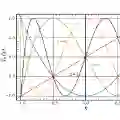
Consider two problems about an unknown probability distribution $p$: 1. How many samples from $p$ are required to test if $p$ is supported on $n$ elements or not? Specifically, given samples from $p$, determine whether it is supported on at most $n$ elements, or it is "$\epsilon$-far" (in total variation distance) from being supported on $n$ elements. 2. Given $m$ samples from $p$, what is the largest lower bound on its support size that we can produce? The best known upper bound for problem (1) uses a general algorithm for learning the histogram of the distribution $p$, which requires $\Theta(\tfrac{n}{\epsilon^2 \log n})$ samples. We show that testing can be done more efficiently than learning the histogram, using only $O(\tfrac{n}{\epsilon \log n} \log(1/\epsilon))$ samples, nearly matching the best known lower bound of $\Omega(\tfrac{n}{\epsilon \log n})$. This algorithm also provides a better solution to problem (2), producing larger lower bounds on support size than what follows from previous work. The proof relies on an analysis of Chebyshev polynomial approximations outside the range where they are designed to be good approximations, and the paper is intended as an accessible self-contained exposition of the Chebyshev polynomial method.
翻译:考虑关于未知概率分布$p$的两个问题:1. 需要从$p$中抽取多少样本才能检验其支撑集是否包含$n$个元素?具体而言,给定来自$p$的样本,需判定该分布是否至多支撑在$n$个元素上,抑或在总变差距离意义下"$\epsilon$-远离"任何支撑集大小为$n$的分布。2. 给定$p$的$m$个样本,我们能够给出的支撑集大小的最大下界是多少?针对问题(1)的最佳已知上界采用学习分布$p$直方图的通用算法,需要$\Theta(\tfrac{n}{\epsilon^2 \log n})$个样本。我们证明测试过程可以比学习直方图更高效,仅需$O(\tfrac{n}{\epsilon \log n} \log(1/\epsilon))$个样本,这近乎匹配了最佳已知下界$\Omega(\tfrac{n}{\epsilon \log n})$。该算法也为问题(2)提供了更优解,相比先前工作能给出更大的支撑集尺寸下界。证明依赖于对切比雪夫多项式在其设计逼近范围之外区域的逼近性分析,本文旨在提供关于切比雪夫多项式方法的可独立阅读的简明阐述。




相关内容


 微信扫码咨询专知VIP会员