

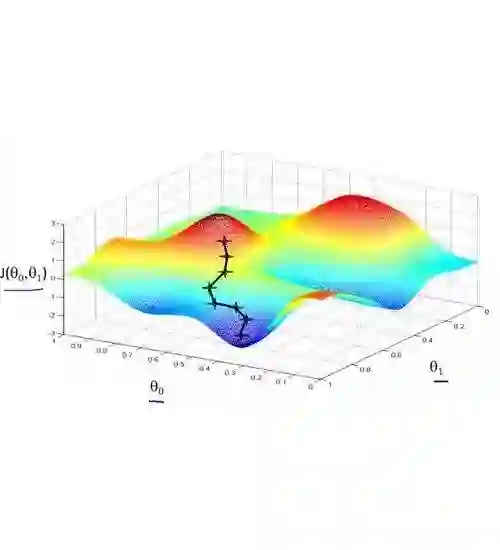
Gradient descent is a fundamental algorithm in both theory and practice for continuous optimization. Identifying its quantum counterpart would be appealing to both theoretical and practical quantum applications. A conventional approach to quantum speedups in optimization relies on the quantum acceleration of intermediate steps of classical algorithms, while keeping the overall algorithmic trajectory and solution quality unchanged. We propose Quantum Hamiltonian Descent (QHD), which is derived from the path integral of dynamical systems referring to the continuous-time limit of classical gradient descent algorithms, as a truly quantum counterpart of classical gradient methods where the contribution from classically-prohibited trajectories can significantly boost QHD's performance for non-convex optimization. Moreover, QHD is described as a Hamiltonian evolution efficiently simulatable on both digital and analog quantum computers. By embedding the dynamics of QHD into the evolution of the so-called Quantum Ising Machine (including D-Wave and others), we empirically observe that the D-Wave-implemented QHD outperforms a selection of state-of-the-art gradient-based classical solvers and the standard quantum adiabatic algorithm, based on the time-to-solution metric, on non-convex constrained quadratic programming instances up to 75 dimensions. Finally, we propose a "three-phase picture" to explain the behavior of QHD, especially its difference from the quantum adiabatic algorithm.
翻译:梯度下降法是连续优化领域理论与实践中的基础算法。寻找其量子对应物无论对量子理论还是实践应用都具有吸引力。传统的量子加速优化方法依赖于对经典算法中间步骤的量子加速,同时保持算法的整体轨迹和求解质量不变。本文提出量子哈密顿下降法(QHD),该算法源于动力系统的路径积分,对应于经典梯度下降算法的连续时间极限,是经典梯度方法的真正量子对应物——其中经典禁阻轨迹的贡献可显著提升QHD在非凸优化中的性能。此外,QHD被描述为一种可在数字和模拟量子计算机上高效模拟的哈密顿演化过程。通过将QHD动力学嵌入到所谓的"量子伊辛机"(包括D-Wave等)的演化中,我们基于时间-求解指标,在高达75维的非凸约束二次规划实例上观察到:D-Wave实现的QHD在性能上优于精选的基于梯度的经典求解器与标准量子绝热算法。最后,我们提出"三阶段图像"来解释QHD的行为特征,特别是其与量子绝热算法的本质差异。




相关内容



 微信扫码咨询专知VIP会员