

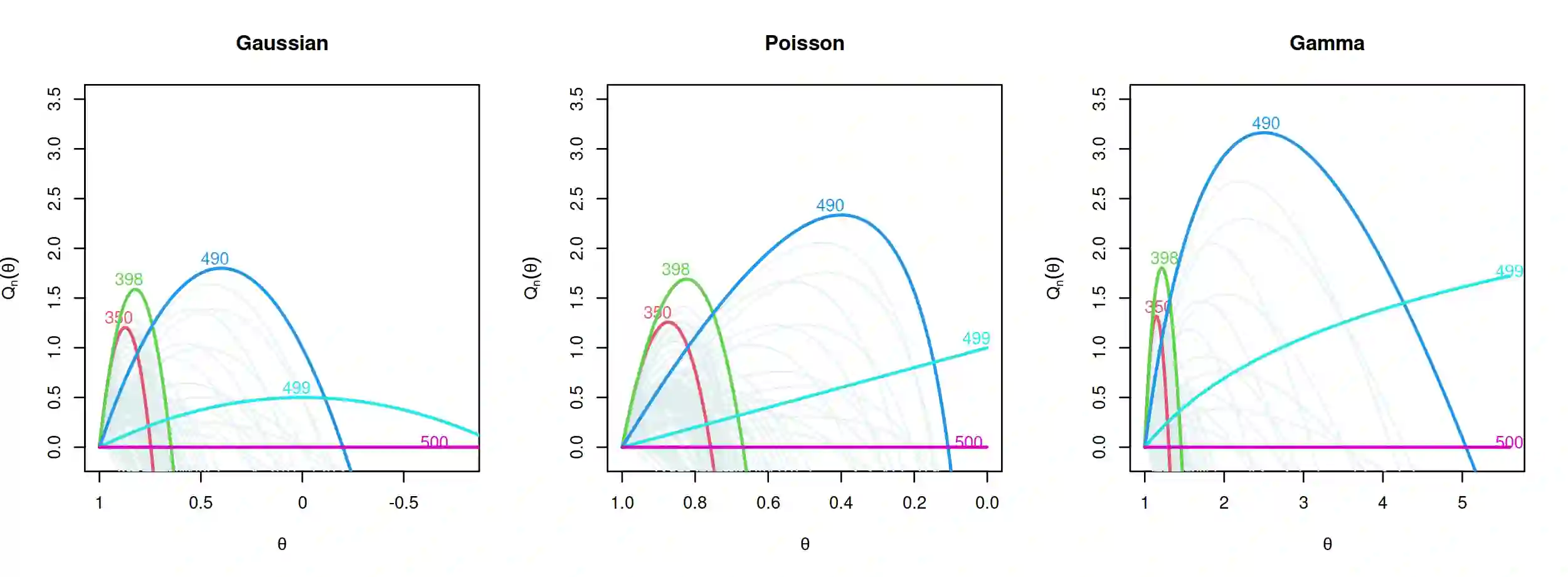
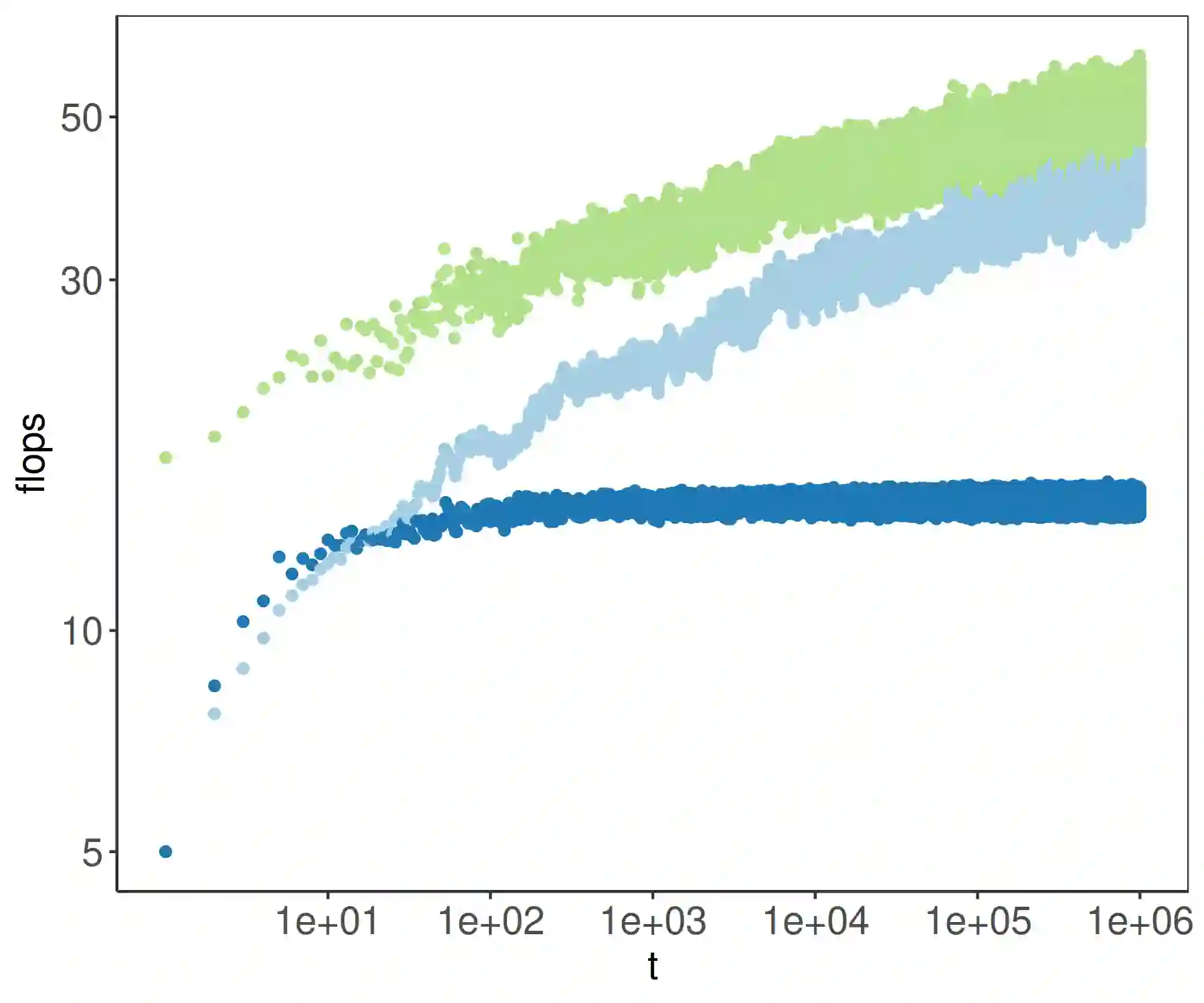
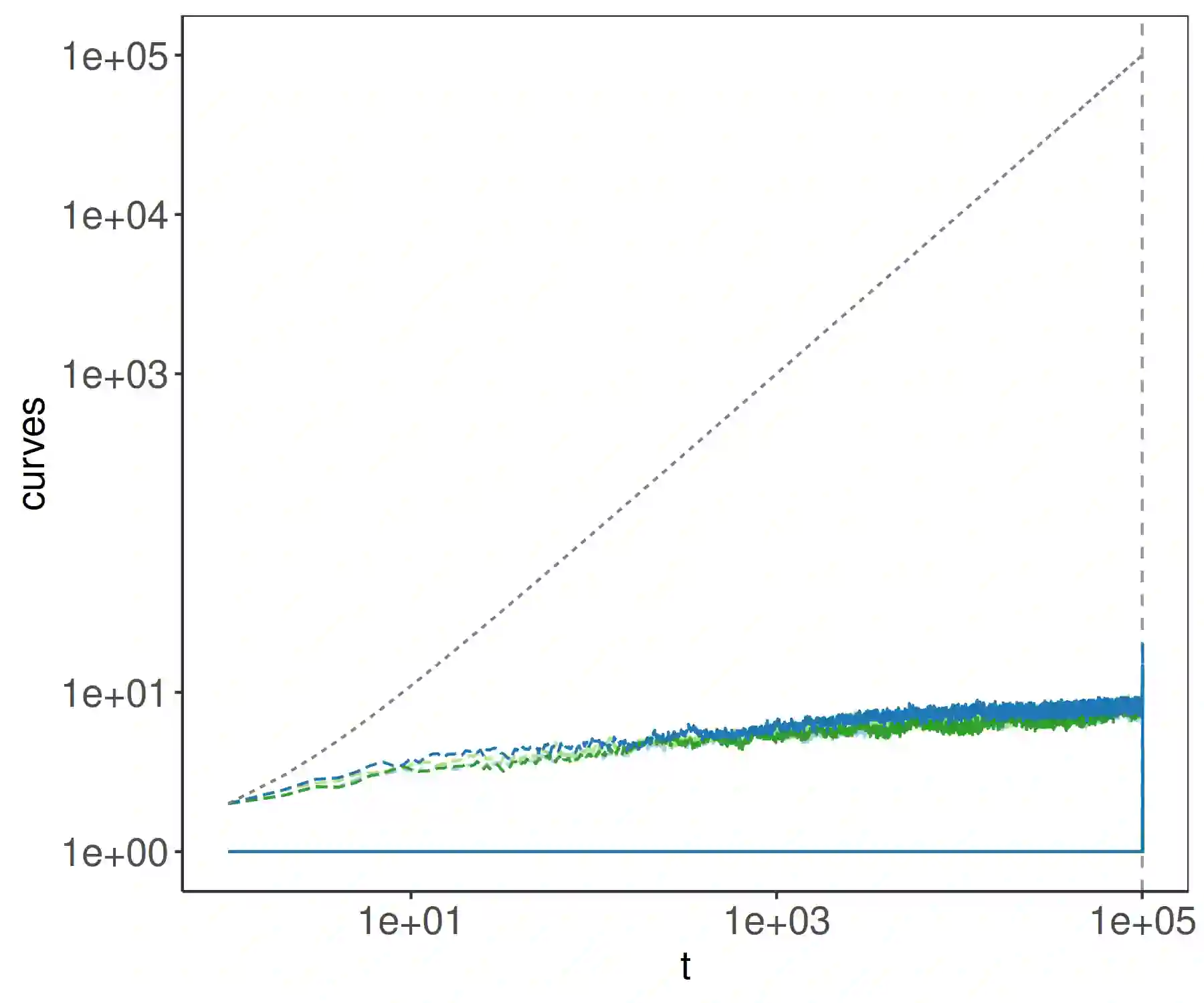
Online changepoint detection algorithms that are based on likelihood-ratio tests have been shown to have excellent statistical properties. However, a simple online implementation is computationally infeasible as, at time $T$, it involves considering $O(T)$ possible locations for the change. Recently, the FOCuS algorithm has been introduced for detecting changes in mean in Gaussian data that decreases the per-iteration cost to $O(\log T)$. This is possible by using pruning ideas, which reduce the set of changepoint locations that need to be considered at time $T$ to approximately $\log T$. We show that if one wishes to perform the likelihood ratio test for a different one-parameter exponential family model, then exactly the same pruning rule can be used, and again one need only consider approximately $\log T$ locations at iteration $T$. Furthermore, we show how we can adaptively perform the maximisation step of the algorithm so that we need only maximise the test statistic over a small subset of these possible locations. Empirical results show that the resulting online algorithm, which can detect changes under a wide range of models, has a constant-per-iteration cost on average.
翻译:基于似然比检验的在线变点检测算法已被证明具有优异的统计性质。然而,简单在线实现在计算上不可行,因为在时刻$T$需考虑$O(T)$个可能的变点位置。近期提出的FOCuS算法可在高斯数据均值变点检测中将每步计算复杂度降至$O(\log T)$。该算法通过剪枝策略实现,可将时刻$T$需考虑的变点位置集缩减至约$\log T$个。研究表明,若需针对单参数指数族模型进行似然比检验,可复用完全相同的剪枝规则,且在第$T$次迭代时仅需考虑约$\log T$个位置。进一步地,我们提出自适应最大化步骤,仅需在极小候选子集上优化检验统计量。实验结果表明,该在线算法可在广泛模型类型下检测变点,且平均每步计算复杂度为常数。




相关内容



 微信扫码咨询专知VIP会员