

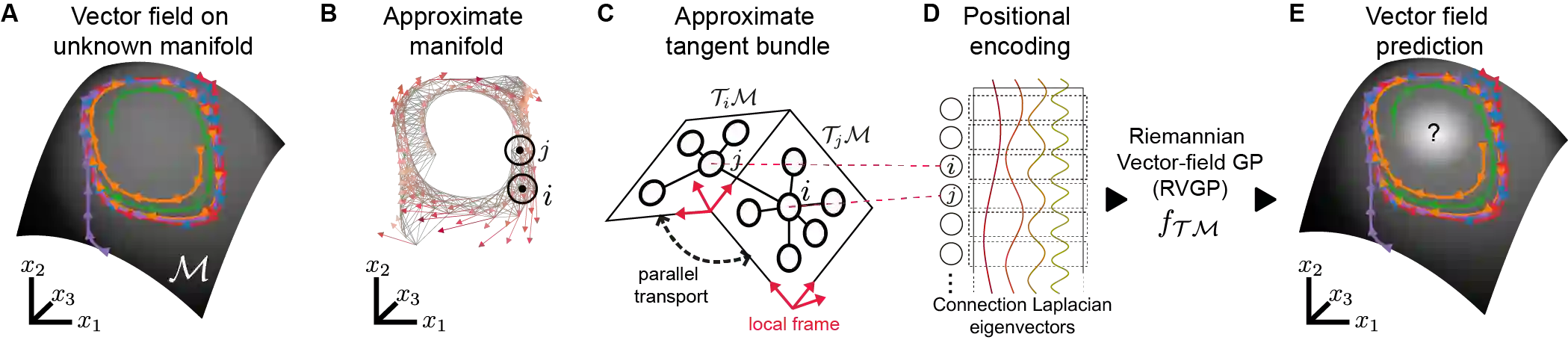
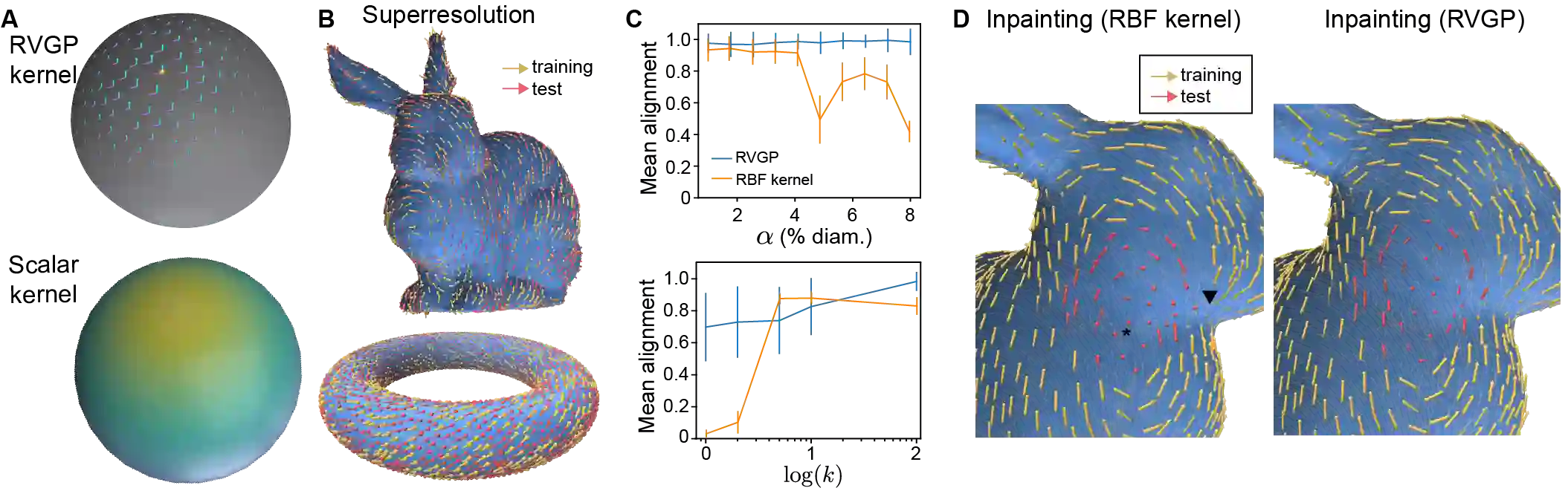
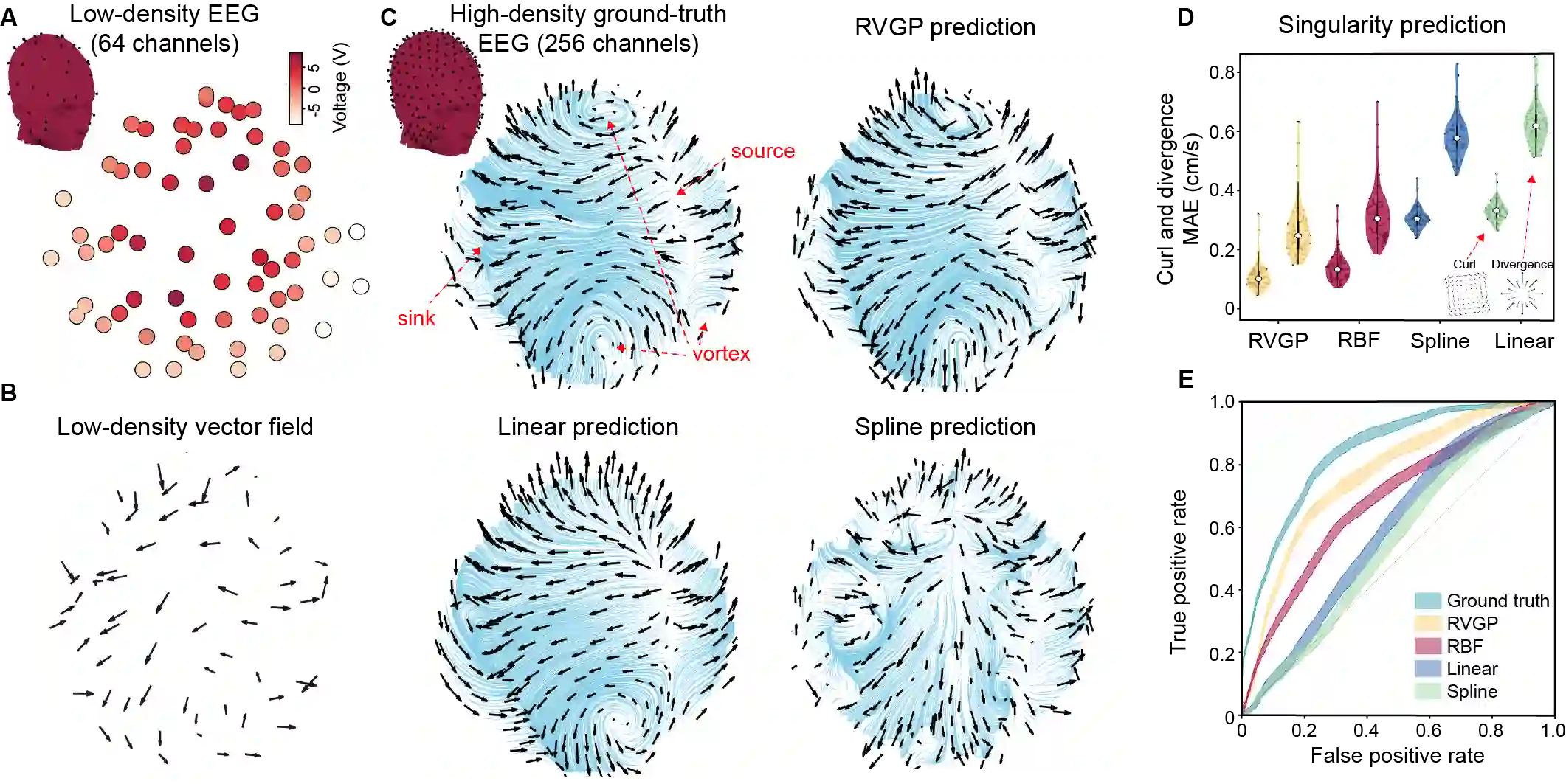
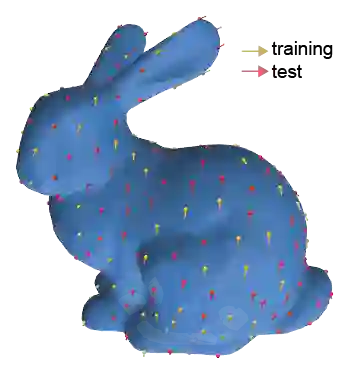
Gaussian processes (GPs) are popular nonparametric statistical models for learning unknown functions and quantifying the spatiotemporal uncertainty in data. Recent works have extended GPs to model scalar and vector quantities distributed over non-Euclidean domains, including smooth manifolds appearing in numerous fields such as computer vision, dynamical systems, and neuroscience. However, these approaches assume that the manifold underlying the data is known, limiting their practical utility. We introduce RVGP, a generalisation of GPs for learning vector signals over latent Riemannian manifolds. Our method uses positional encoding with eigenfunctions of the connection Laplacian, associated with the tangent bundle, readily derived from common graph-based approximation of data. We demonstrate that RVGP possesses global regularity over the manifold, which allows it to super-resolve and inpaint vector fields while preserving singularities. Furthermore, we use RVGP to reconstruct high-density neural dynamics derived from low-density EEG recordings in healthy individuals and Alzheimer's patients. We show that vector field singularities are important disease markers and that their reconstruction leads to a comparable classification accuracy of disease states to high-density recordings. Thus, our method overcomes a significant practical limitation in experimental and clinical applications.
翻译:高斯过程(GPs)是用于学习未知函数并量化数据中时空不确定性的流行非参数统计模型。近期研究将高斯过程扩展到建模分布在非欧几里得域上的标量和向量量,包括出现在计算机视觉、动力系统和神经科学等多个领域的光滑流形。然而,这些方法假设数据背后的流形是已知的,从而限制了其实用性。我们提出RVGP——一种用于在潜在黎曼流形上学习向量信号的高斯过程推广形式。该方法利用连接拉普拉斯算子的特征函数进行位置编码,该算子与切丛相关联,可轻松从基于图的常见数据近似中推导得出。我们证明RVGP在流形上具有全局正则性,使其能够在保持奇异性的同时对向量场进行超分辨率和修复。此外,我们利用RVGP从低密度脑电图记录中重建健康个体及阿尔茨海默病患者的高密度神经动力学。研究表明,向量场奇异性是重要的疾病标志物,对其重建可获得与高密度记录相当的疾病状态分类精度。因此,我们的方法克服了实验和临床应用中的关键实际限制。




相关内容




 微信扫码咨询专知VIP会员