

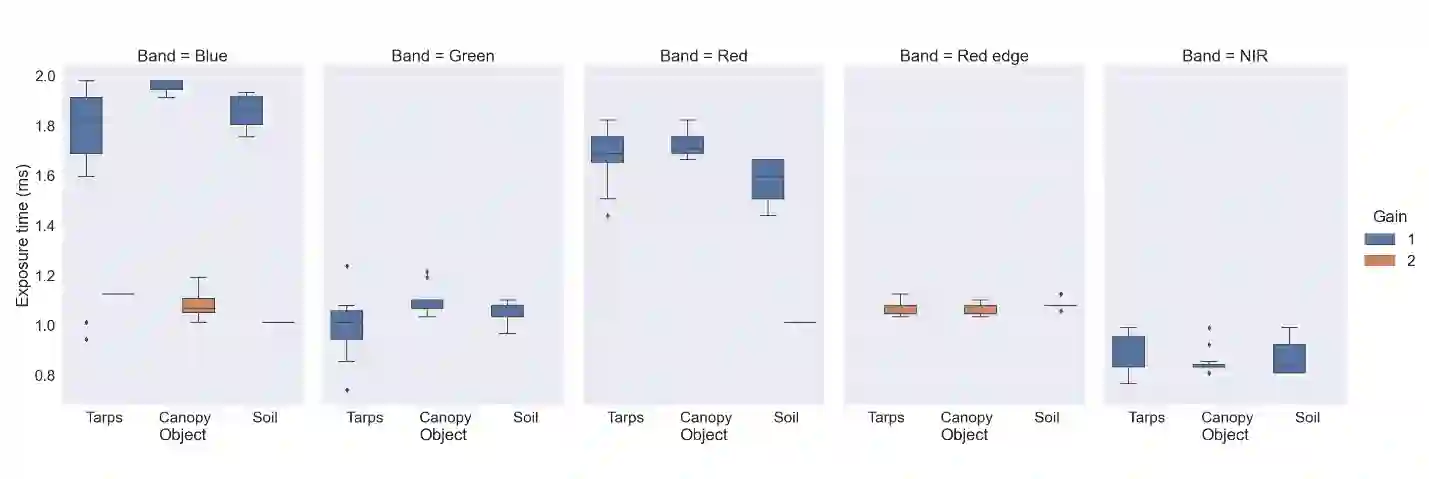
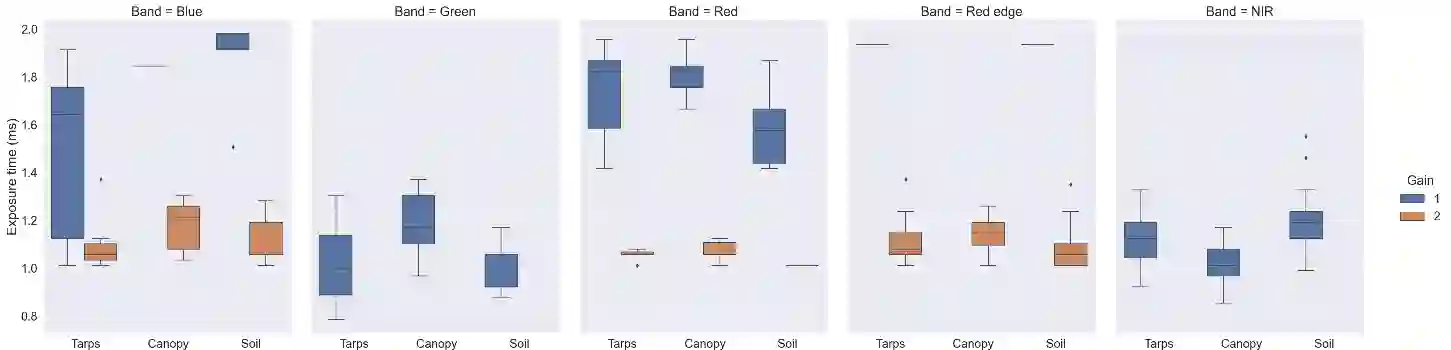
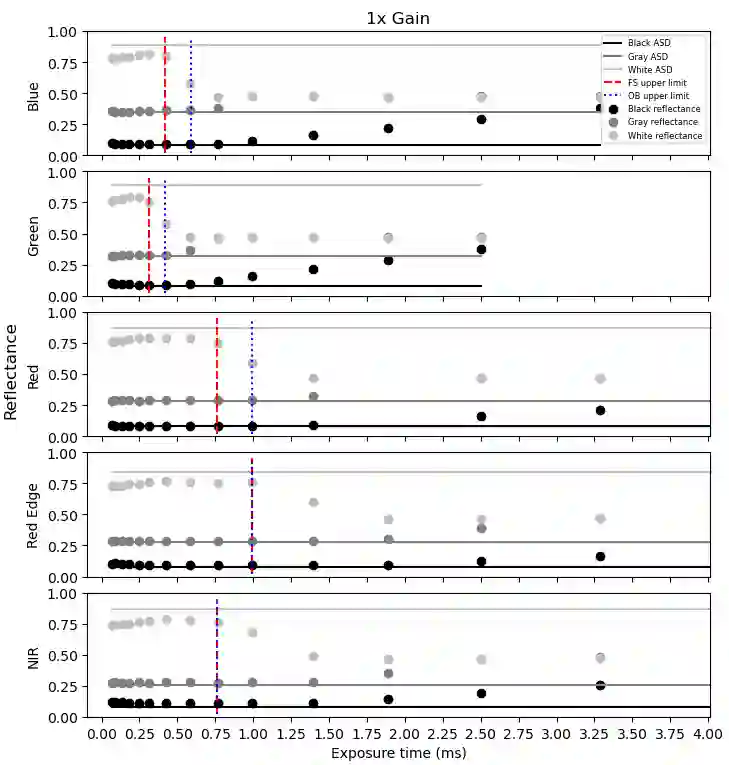
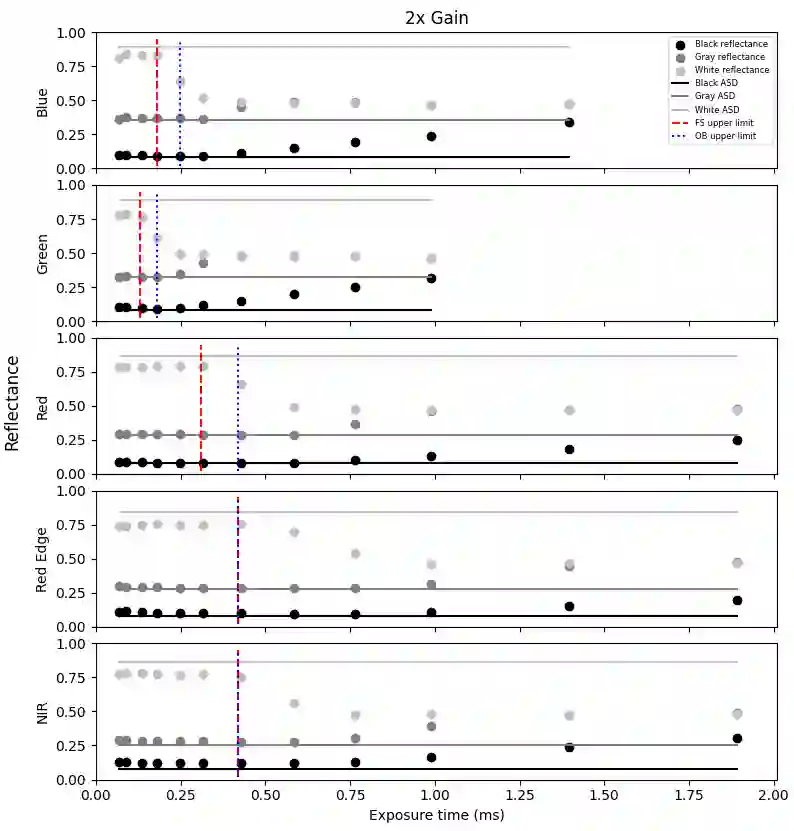
Radiometric accuracy of data is crucial in quantitative precision agriculture, to produce reliable and repeatable data for modeling and decision making. The effect of exposure time and gain settings on the radiometric accuracy of multispectral images was not explored enough. The goal of this study was to determine if having a fixed exposure (FE) time during image acquisition improved radiometric accuracy of images, compared to the default auto-exposure (AE) settings. This involved quantifying the errors from auto-exposure and determining ideal exposure values within which radiometric mean absolute percentage error (MAPE) were minimal (< 5%). The results showed that FE orthomosaic was closer to ground-truth (higher R2 and lower MAPE) than AE orthomosaic. An ideal exposure range was determined for capturing canopy and soil objects, without loss of information from under-exposure or saturation from over-exposure. A simulation of errors from AE showed that MAPE < 5% for the blue, green, red, and NIR bands and < 7% for the red edge band for exposure settings within the determined ideal ranges and increased exponentially beyond the ideal exposure upper limit. Further, prediction of total plant nitrogen uptake (g/plant) using vegetation indices (VIs) from two different growing seasons were closer to the ground truth (mostly, R2 > 0.40, and MAPE = 12 to 14%, p < 0.05) when FE was used, compared to the prediction from AE images (mostly, R2 < 0.13, MAPE = 15 to 18%, p >= 0.05).
翻译:数据辐射精度对于定量化精准农业至关重要,是生成可靠且可重复性数据以供建模与决策的基础。曝光时间与增益设置对多光谱图像辐射精度的影响尚未得到充分探究。本研究旨在确定相较于默认自动曝光(AE)设置,在图像采集过程中采用固定曝光(FE)时间能否提升图像的辐射精度。研究内容包括量化自动曝光引入的误差,并确定辐射平均绝对百分比误差(MAPE)最小(<5%)的理想曝光值范围。结果表明,FE正射影像的辐射精度更接近地面真值(R²更高,MAPE更低)。研究确定了采集冠层与土壤目标的最佳曝光范围,在该范围内既能避免欠曝导致的信息丢失,也能防止过曝造成的饱和失真。通过模拟AE误差发现:在确定的最佳曝光范围内,蓝、绿、红及近红外波段的MAPE低于5%,红边波段的MAPE低于7%;而超出最佳曝光上限后,MAPE呈指数级增长。进一步分析表明,相较于AE图像(R²多低于0.13,MAPE范围为15%-18%,p≥0.05),采用FE图像基于不同生长季的植被指数(VIs)预测植株总氮吸收量(克/株)时,结果更接近地面真值(R²多高于0.40,MAPE范围为12%-14%,p<0.05)。




相关内容




 微信扫码咨询专知VIP会员