

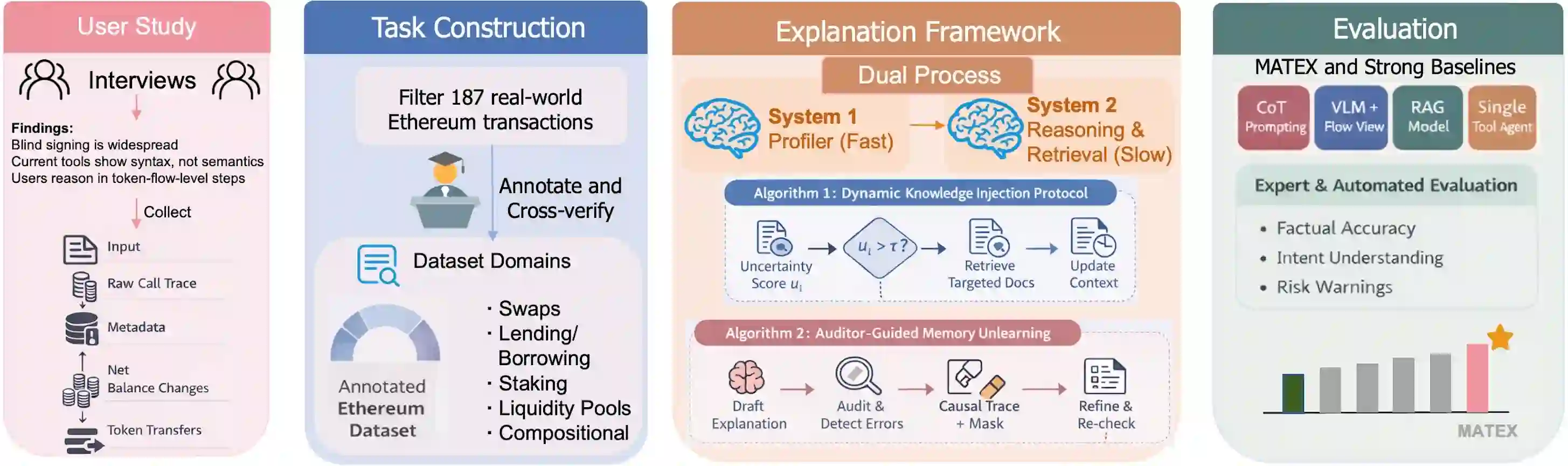
Understanding the economic intent of Ethereum transactions is critical for user safety, yet current tools expose only raw on-chain data or surface-level intent, leading to widespread "blind signing" (approving transactions without understanding them). Through interviews with 16 Web3 users, we find that effective explanations should be structured, risk-aware, and grounded at the token-flow level. Motivated by these findings, we formulate TxSum, a new user-centered NLP task for Ethereum transaction understanding, and construct a dataset of 187 complex Ethereum transactions annotated with transaction-level summaries and token flow-level semantic labels. We further introduce MATEX, a grounded multi-agent framework for high-stakes transaction explanation. It selectively retrieves external knowledge under uncertainty and audits explanations against raw traces to improve token-flow-level factual consistency. MATEX achieves the strongest overall explanation quality, especially on micro-level factuality and intent quality. It improves user comprehension on complex transactions from 52.9% to 76.5% over the strongest baseline and raises malicious-transaction rejection from 36.0% to 88.0%, while maintaining a low false-rejection rate on benign transactions.
翻译:理解以太坊交易的经济意图对用户安全至关重要,然而现有工具仅能提供原始链上数据或表层意图信息,导致普遍的"盲签"现象(在不理解交易内容的情况下予以批准)。通过对16名Web3用户的访谈,我们发现有效的解释应当具备结构化、风险感知能力,并锚定于代币流动层面。基于这些发现,我们提出了TxSum——一个面向以太坊交易理解的用户中心化新型NLP任务,并构建了包含187笔复杂以太坊交易的数据集,其中标注了交易级摘要与代币流动级语义标签。我们进一步提出MATEX,一个基于多智能体的锚定式高风险交易解释框架。该框架能在不确定性条件下选择性检索外部知识,并通过原始交易轨迹审计解释内容,从而提升代币流动层面的事实一致性。MATEX实现了最优的整体解释质量,尤其在微观层面事实准确性与意图质量方面表现突出。相较于最强基线模型,该框架将用户对复杂交易的理解率从52.9%提升至76.5%,并将恶意交易拒绝率从36.0%提高至88.0%,同时在良性交易上保持较低的错误拒绝率。







相关内容

 微信扫码咨询专知VIP会员