

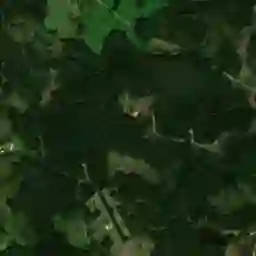
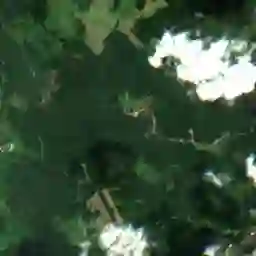
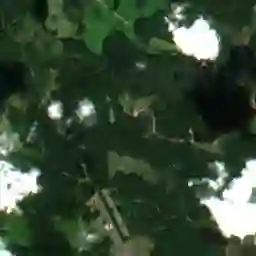
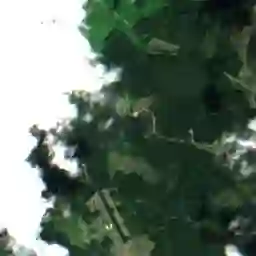
Satellite imagery analysis plays a pivotal role in remote sensing; however, information loss due to cloud cover significantly impedes its application. Although existing deep cloud removal models have achieved notable outcomes, they scarcely consider contextual information. This study introduces a high-performance cloud removal architecture, termed Progressive Multi-scale Attention Autoencoder (PMAA), which concurrently harnesses global and local information to construct robust contextual dependencies using a novel Multi-scale Attention Module (MAM) and a novel Local Interaction Module (LIM). PMAA establishes long-range dependencies of multi-scale features using MAM and modulates the reconstruction of fine-grained details utilizing LIM, enabling simultaneous representation of fine- and coarse-grained features at the same level. With the help of diverse and multi-scale features, PMAA consistently outperforms the previous state-of-the-art model CTGAN on two benchmark datasets. Moreover, PMAA boasts considerable efficiency advantages, with only 0.5% and 14.6% of the parameters and computational complexity of CTGAN, respectively. These comprehensive results underscore PMAA's potential as a lightweight cloud removal network suitable for deployment on edge devices to accomplish large-scale cloud removal tasks. Our source code and pre-trained models are available at https://github.com/XavierJiezou/PMAA.
翻译:卫星影像分析在遥感领域发挥着关键作用,然而云层覆盖导致的信息丢失严重阻碍了其应用。尽管现有的深度云去除模型已取得显著成果,但它们很少考虑上下文信息。本研究提出了一种高性能云去除架构,称为渐进式多尺度注意力自编码器(PMAA),该模型同时利用全局和局部信息,通过新型多尺度注意力模块(MAM)和局部交互模块(LIM)构建鲁棒的上下文依赖关系。PMAA利用MAM建立多尺度特征的长程依赖关系,并利用LIM调节细粒度细节的重建,从而在同一层级上同时表示细粒度和粗粒度特征。借助多样化的多尺度特征,PMAA在两个基准数据集上始终优于先前最先进的模型CTGAN。此外,PMAA具有显著的效率优势,其参数和计算复杂度仅为CTGAN的0.5%和14.6%。这些综合结果突显了PMAA作为一种轻量级云去除网络的潜力,适用于部署在边缘设备上以完成大规模云去除任务。我们的源代码和预训练模型可在https://github.com/XavierJiezou/PMAA获取。





相关内容





 微信扫码咨询专知VIP会员