

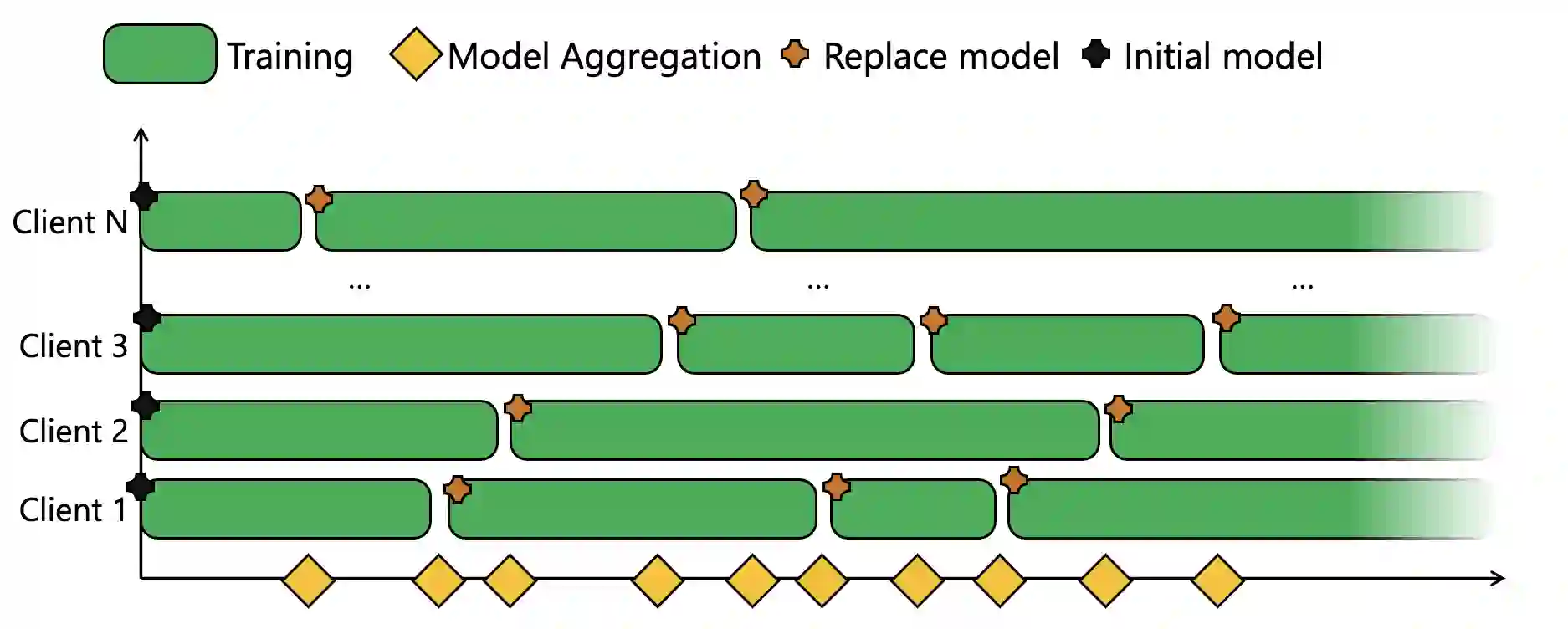
Federated learning (FL) systems face performance challenges in dealing with heterogeneous devices and non-identically distributed data across clients. We propose a dynamic global model aggregation method within Asynchronous Federated Learning (AFL) deployments to address these issues. Our aggregation method scores and adjusts the weighting of client model updates based on their upload frequency to accommodate differences in device capabilities. Additionally, we also immediately provide an updated global model to clients after they upload their local models to reduce idle time and improve training efficiency. We evaluate our approach within an AFL deployment consisting of 10 simulated clients with heterogeneous compute constraints and non-IID data. The simulation results, using the FashionMNIST dataset, demonstrate over 10% and 19% improvement in global model accuracy compared to state-of-the-art methods PAPAYA and FedAsync, respectively. Our dynamic aggregation method allows reliable global model training despite limiting client resources and statistical data heterogeneity. This improves robustness and scalability for real-world FL deployments.
翻译:联邦学习(FL)系统在处理异构设备和客户端间非独立同分布数据时面临性能挑战。我们提出一种在异步联邦学习(AFL)部署中使用的动态全局模型聚合方法来解决这些问题。我们的聚合方法根据客户端模型更新的上传频率进行评分并调整其权重,以适应设备能力的差异。此外,我们还在客户端上传本地模型后立即提供更新的全局模型,以减少空闲时间并提高训练效率。我们在一个包含10个具有异构计算约束和非独立同分布数据的模拟客户端的AFL部署中评估了该方法。使用FashionMNIST数据集的仿真结果表明,与最先进的方法PAPAYA和FedAsync相比,全局模型准确率分别提高了超过10%和19%。我们的动态聚合方法能够在客户端资源受限和数据统计异质性的情况下实现可靠的全局模型训练,从而增强了实际FL部署的鲁棒性和可扩展性。








相关内容





 微信扫码咨询专知VIP会员