

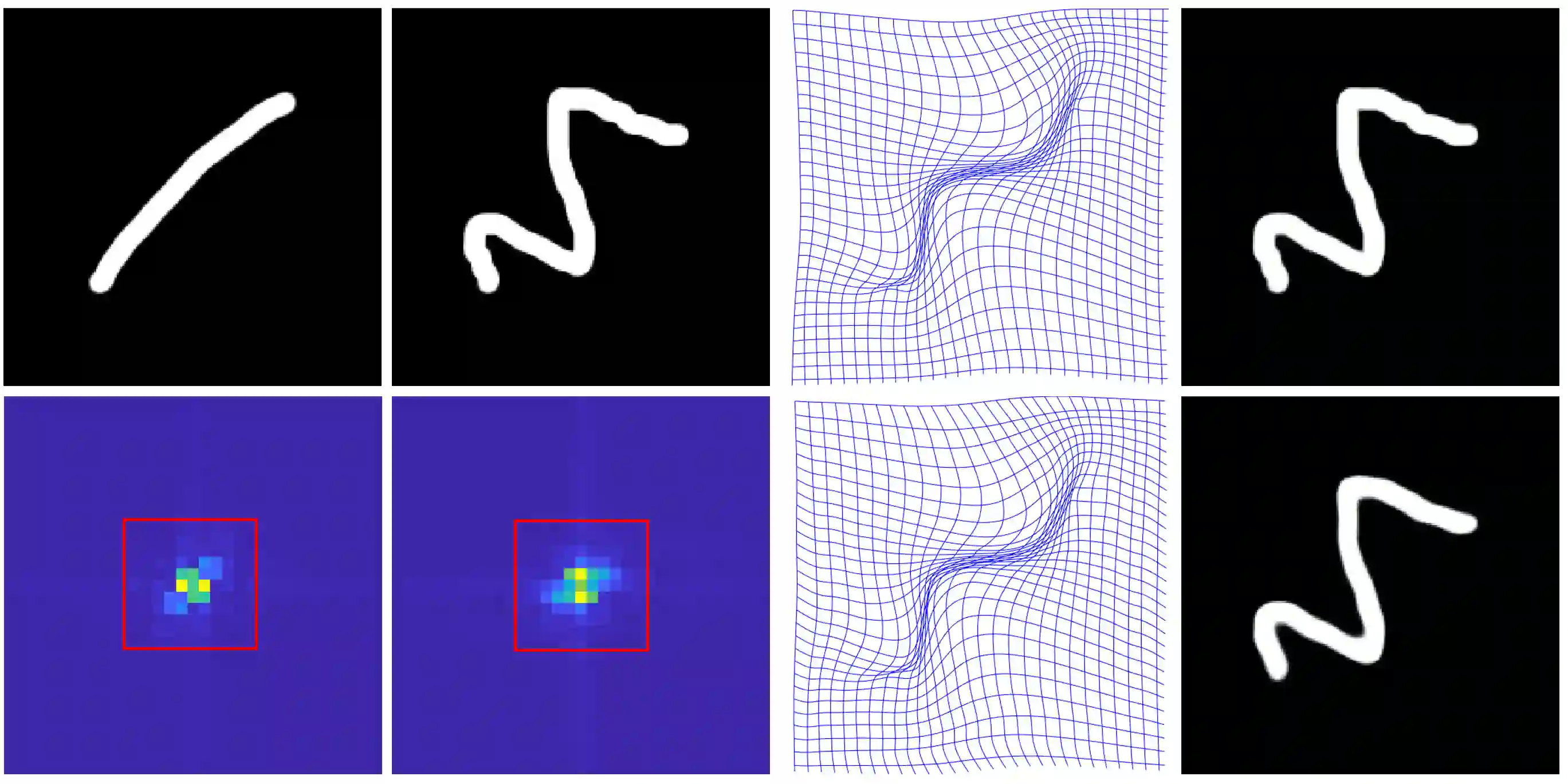
Unsupervised image registration commonly adopts U-Net style networks to predict dense displacement fields in the full-resolution spatial domain. For high-resolution volumetric image data, this process is however resource-intensive and time-consuming. To tackle this problem, we propose the Fourier-Net, replacing the expansive path in a U-Net style network with a parameter-free model-driven decoder. Specifically, instead of our Fourier-Net learning to output a full-resolution displacement field in the spatial domain, we learn its low-dimensional representation in a band-limited Fourier domain. This representation is then decoded by our devised model-driven decoder (consisting of a zero padding layer and an inverse discrete Fourier transform layer) to the dense, full-resolution displacement field in the spatial domain. These changes allow our unsupervised Fourier-Net to contain fewer parameters and computational operations, resulting in faster inference speeds. Fourier-Net is then evaluated on two public 3D brain datasets against various state-of-the-art approaches. For example, when compared to a recent transformer-based method, named TransMorph, our Fourier-Net, which only uses 2.2\% of its parameters and 6.66\% of the multiply-add operations, achieves a 0.5\% higher Dice score and an 11.48 times faster inference speed. Code is available at \url{https://github.com/xi-jia/Fourier-Net}.
翻译:无监督图像配准通常采用U-Net风格网络在满分辨率空间域中预测密集位移场。然而,对于高分辨率体积图像数据而言,此过程计算资源消耗大且耗时严重。为解决该问题,我们提出傅立叶网络(Fourier-Net),用无参数模型驱动解码器替代U-Net风格网络中的扩展路径。具体而言,我们的Fourier-Net并非学习在空间域输出满分辨率位移场,而是在带限傅立叶域中学习其低维表示。随后,该表示由我们设计的模型驱动解码器(包含零填充层和逆离散傅立叶变换层)解码为空间域中密集的满分辨率位移场。这些改进使得无监督Fourier-Net包含更少的参数和计算操作,从而获得更快的推理速度。我们在两个公开3D脑部数据集上对比多种先进方法评估了Fourier-Net。例如,与近期基于Transformer的方法TransMorph相比,仅使用其2.2%参数和6.66%乘法累加运算量的Fourier-Net,Dice得分提高了0.5%,推理速度提升了11.48倍。代码已开源在\url{https://github.com/xi-jia/Fourier-Net}。





相关内容



 微信扫码咨询专知VIP会员