

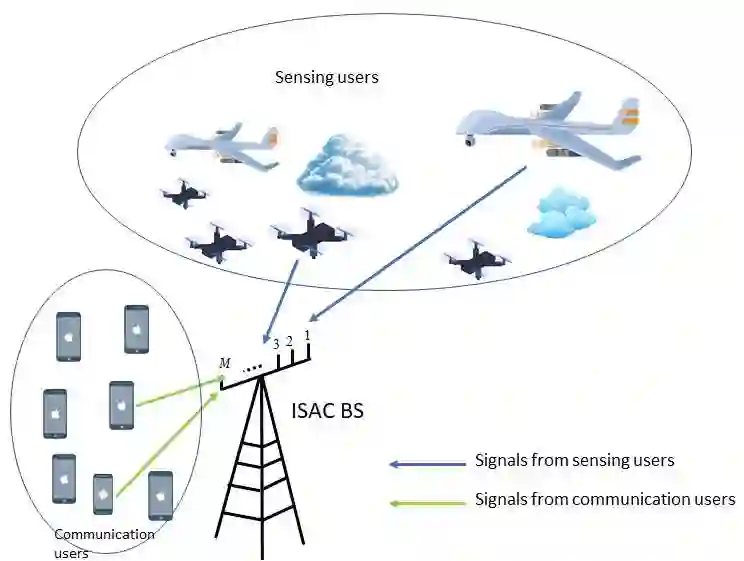
This work considers the problem of integrated sensing and communication (ISAC) with a massive number of unsourced and uncoordinated users. In the proposed model, known as the unsourced ISAC system (UNISAC), all active communication and sensing users share a short frame to transmit their signals, without requiring scheduling with the base station (BS). Hence, the signal received from each user is affected by significant interference from numerous interfering users, making it challenging to extract the transmitted signals. UNISAC aims to decode the transmitted message sequences from communication users while simultaneously detect active sensing users, regardless of the identity of the decoded and detected users. In this paper, we derive an achievable performance limit for UNISAC and demonstrate its superiority over conventional approaches such as ALOHA, time-division multiple access, treating interference as noise, and multiple signal classification. Through numerical simulations, we validate the UNISAC's effectiveness in detecting and decoding a large number of users.
翻译:本文考虑在大量无源且无需协调的用户场景下的集成感知与通信(ISAC)问题。在所提出的模型——即无源ISAC系统(UNISAC)中,所有活跃的通信与感知用户共享一个短帧传输信号,无需与基站(BS)进行调度。因此,从每个用户接收到的信号会受到大量干扰用户的显著干扰,使得提取传输信号变得极具挑战。UNISAC旨在同时实现从通信用户解码传输的消息序列,并检测活跃的感知用户,而无需关注被解码和检测用户的具体身份。本文推导了UNISAC的可达性能极限,并证明了其相较于传统方法(如ALOHA、时分多址、将干扰视为噪声以及多重信号分类)的优越性。通过数值仿真,我们验证了UNISAC在检测和解码大量用户方面的有效性。




相关内容




 微信扫码咨询专知VIP会员