

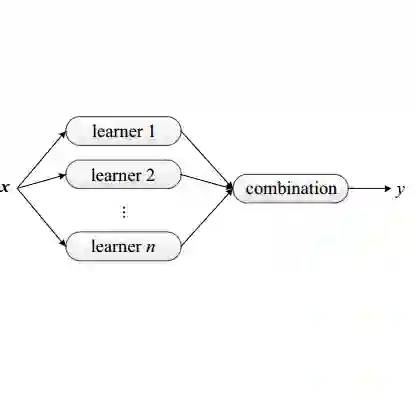
Transfer learning has been widely adopted for few-shot classification. Recent studies reveal that obtaining good generalization representation of images on novel classes is the key to improving the few-shot classification accuracy. To address this need, we prove theoretically that leveraging ensemble learning on the base classes can correspondingly reduce the true error in the novel classes. Following this principle, a novel method named Ensemble Learning with Multi-Order Statistics (ELMOS) is proposed in this paper. In this method, after the backbone network, we use multiple branches to create the individual learners in the ensemble learning, with the goal to reduce the storage cost. We then introduce different order statistics pooling in each branch to increase the diversity of the individual learners. The learners are optimized with supervised losses during the pre-training phase. After pre-training, features from different branches are concatenated for classifier evaluation. Extensive experiments demonstrate that each branch can complement the others and our method can produce a state-of-the-art performance on multiple few-shot classification benchmark datasets.
翻译:迁移学习已被广泛用于小样本分类任务。近期研究表明,在新类别上获取良好的图像泛化表征是提升小样本分类精度的关键。针对这一需求,我们从理论上证明在基类上利用集成学习能够相应降低新类别上的真实误差。遵循该原理,本文提出一种名为"基于多阶统计量的集成学习"(ELMOS)的新方法。该方法在主干网络之后使用多个分支创建集成学习中的个体学习器,以降低存储成本。随后,我们在每个分支中引入不同阶次的统计量池化以增加个体学习器的多样性。在预训练阶段,这些学习器通过监督损失进行优化。预训练完成后,将不同分支提取的特征进行拼接用于分类器评估。大量实验表明,各分支能够相互补充,本方法在多个小样本分类基准数据集上均取得了最优性能。




相关内容


 微信扫码咨询专知VIP会员