

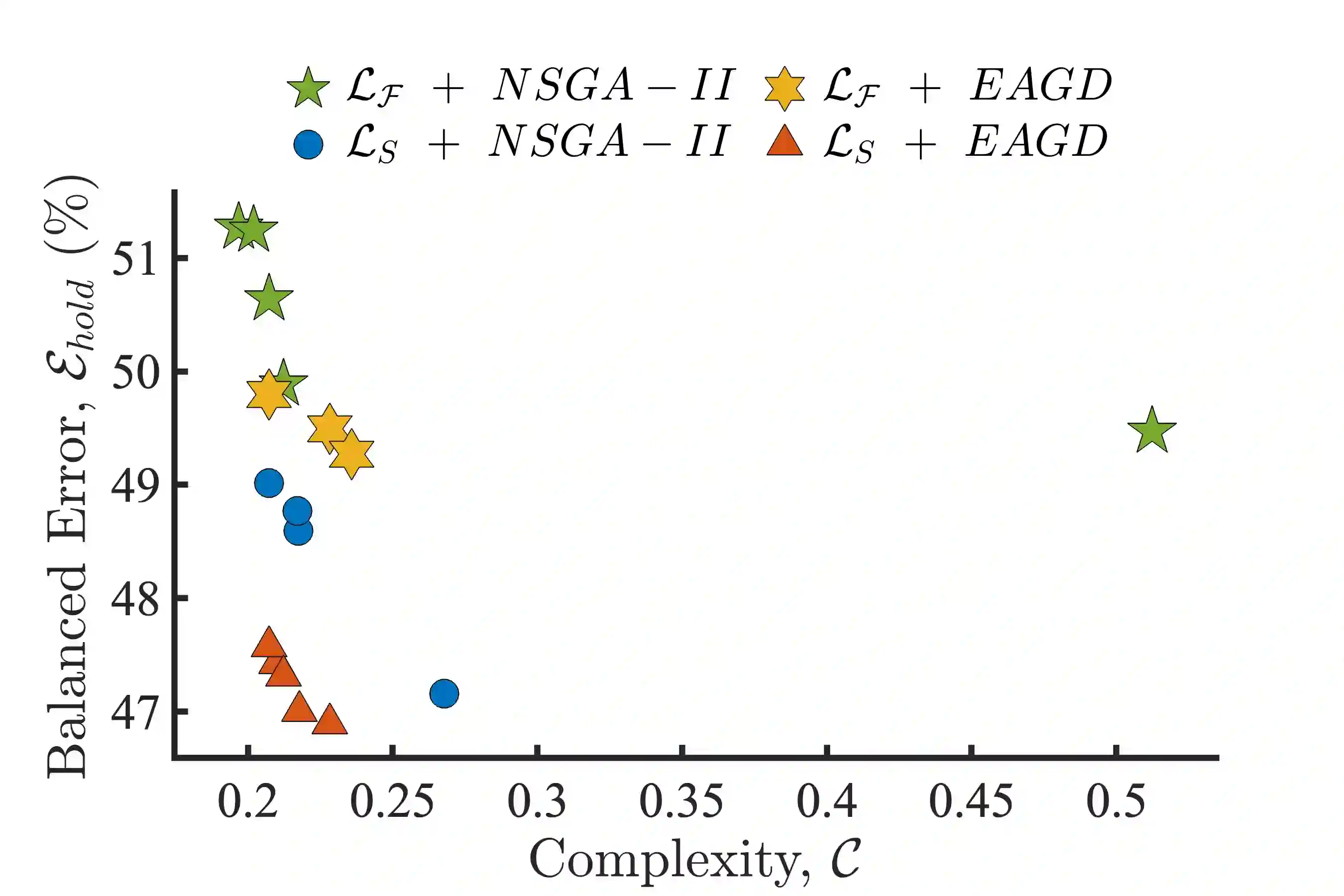
This note focuses on the optimization of neural architectures for stock index movement forecasting following a major market disruption or crisis. Given that such crises may introduce a shift in market dynamics, this study aims to investigate whether the training data from market dynamics prior to the crisis are compatible with the data during the crisis period. To this end, two distinct learning environments are designed to evaluate and reconcile the effects of possibly different market dynamics. These environments differ principally based on the role assigned to the pre-crisis data. In both environments, a set of non-dominated architectures are identified to satisfy the multi-criteria co-evolution problem, which simultaneously addresses the selection issues related to features and hidden layer topology. To test the hypothesis of pre-crisis data incompatibility, the day-ahead movement prediction of the NASDAQ index is considered during two recent and major market disruptions; the 2008 financial crisis and the COVID-19 pandemic. The results of a detailed comparative evaluation convincingly support the incompatibility hypothesis and highlight the need to select re-training windows carefully.
翻译:本文聚焦于重大市场动荡或危机后股票指数走势预测中神经架构的优化问题。鉴于此类危机可能引发市场动态转变,本研究旨在探究危机前市场动态训练数据与危机期间数据是否兼容。为此,我们设计了两种差异化学习环境来评估并调和潜在的不同市场动态效应,其核心区别在于对危机前数据的处理方式。两种环境中均通过识别一组非支配架构来满足多准则协同进化问题,该问题同时解决了特征选择与隐层拓扑结构的选择难题。为验证危机前数据不兼容假说,我们选取了两次近期重大市场动荡(2008年金融危机与COVID-19疫情)期间的纳斯达克指数次日走势预测进行实证分析。详细比较评估结果有力地支持了数据不兼容假说,并凸显了审慎选择重训练时间窗口的必要性。





相关内容



 微信扫码咨询专知VIP会员