

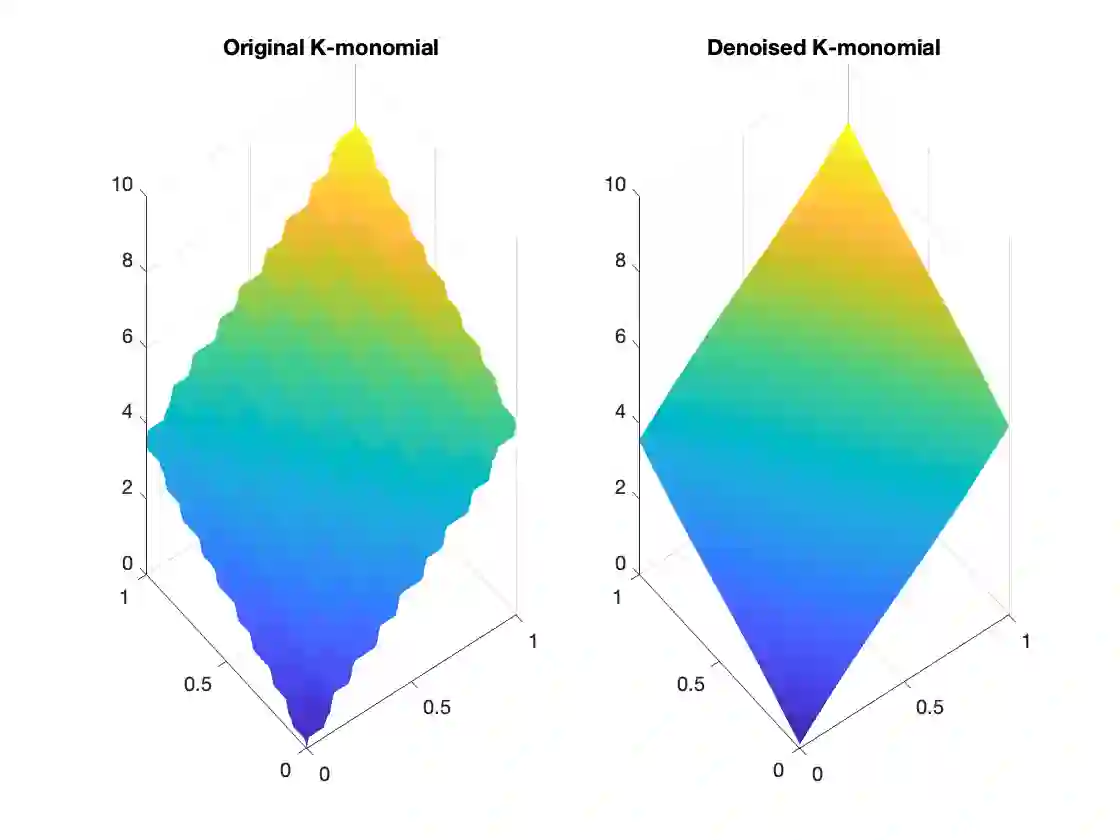
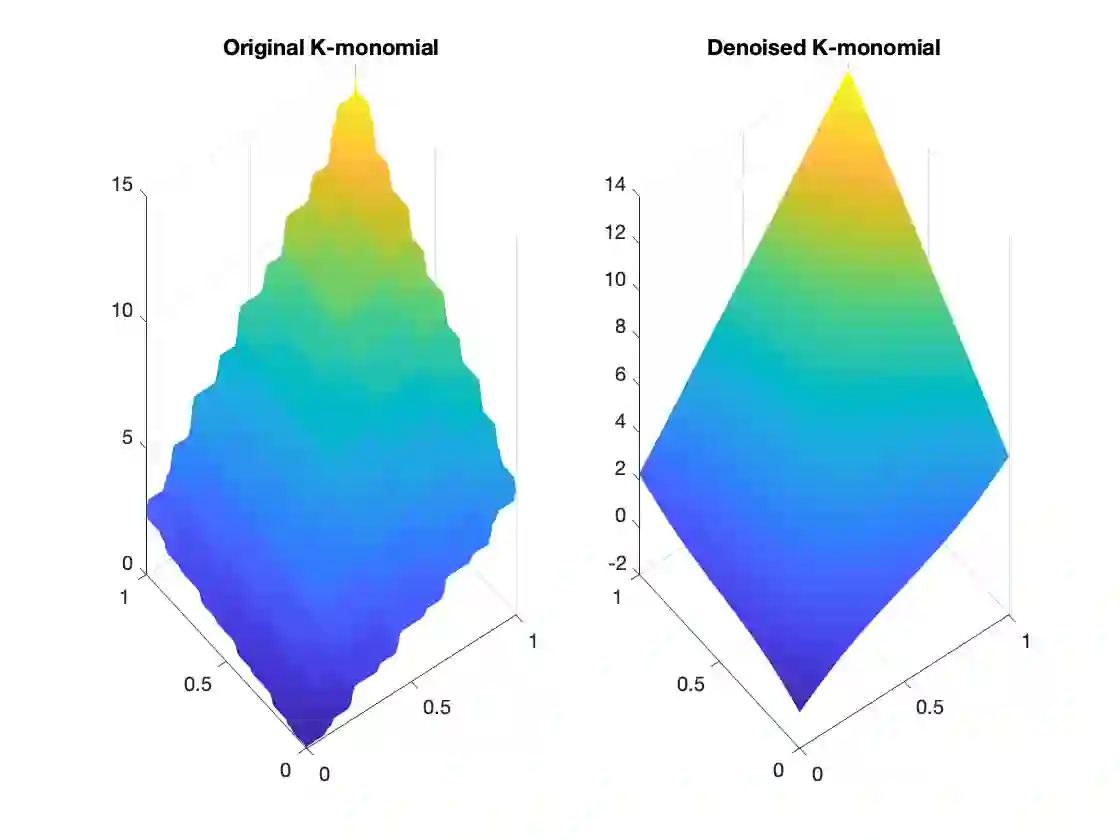
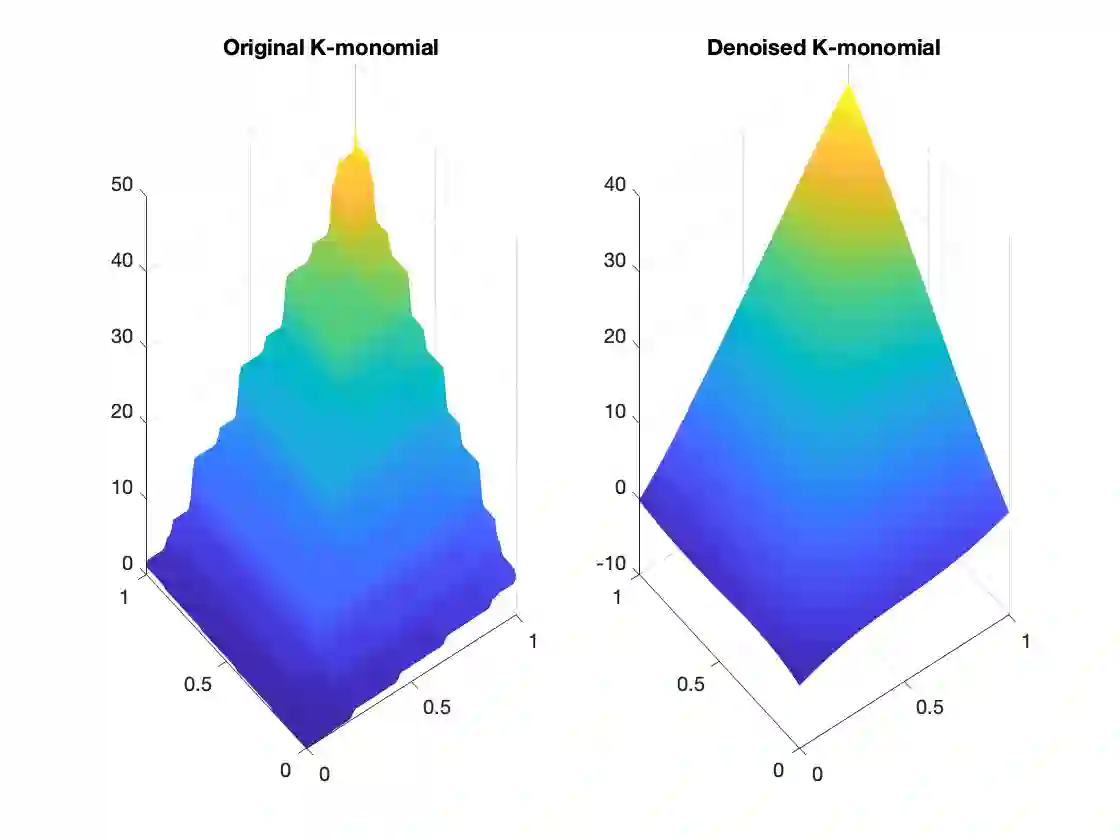
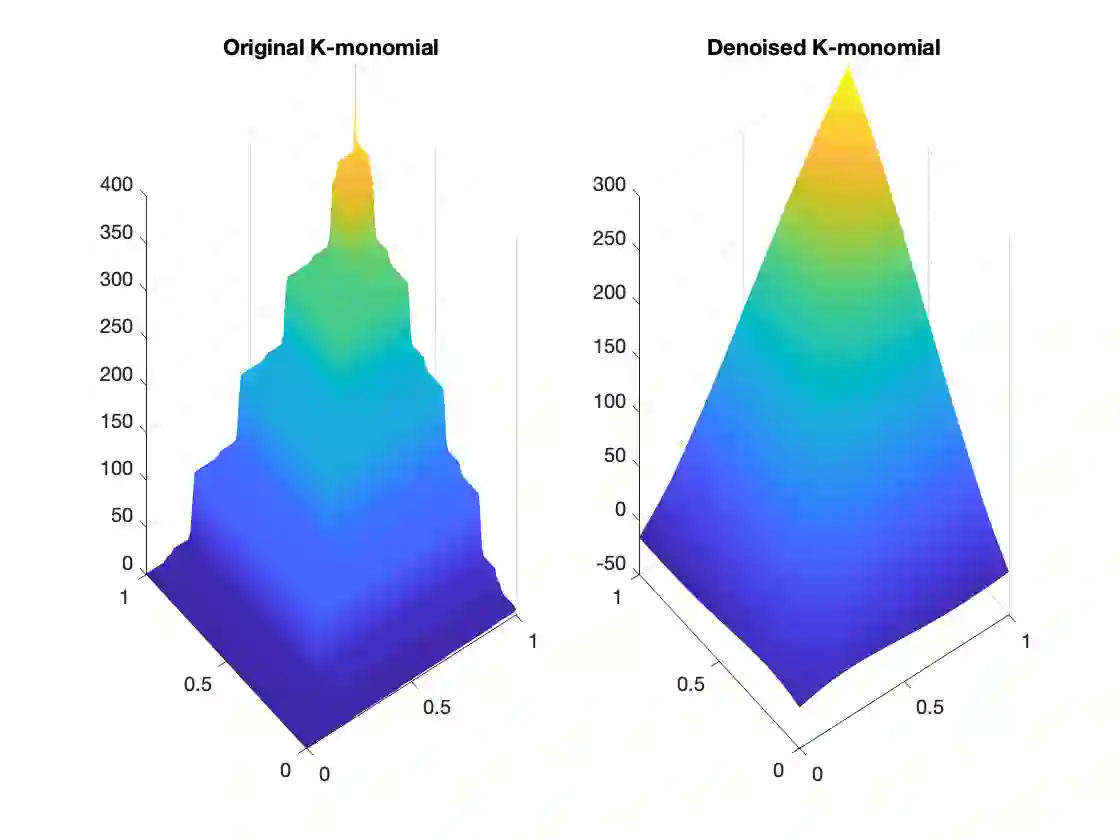
We propose a new approach for approximating functions in $C([0,1]^d)$ via Kolmogorov superposition theorem (KST) based on the linear spline approximation of the K-outer function in Kolmogorov superposition representation. We improve the results in \cite{LaiShenKST21} by showing that the optimal approximation rate based on our proposed approach is $\mathcal{O}(\frac{1}{n^2})$, with $n$ being the number of knots over $[0,1]$, and the approximation constant increases linearly in $d$. We show that there is a dense subclass in $C([0,1]^d)$ whose approximation can achieve such optimal rate, and the number of parameters needed in such approximation is at most $\mathcal{O}(nd)$. Moreover, for $d\geq 4$, we apply the tensor product spline denoising technique to smooth the KB-splines and get the corresponding LKB-splines. We use those LKB-splines as the basis to approximate functions for the cases when $d=4$ and $d=6$, which extends the results in \cite{LaiShenKST21} for $d=2$ and $d=3$. Based on the idea of pivotal data locations introduced in \cite{LaiShenKST21}, we validate via numerical experiments that fewer than $\mathcal{O}(nd)$ function values are enough to achieve the approximation rates such as $\mathcal{O}(\frac{1}{n})$ or $\mathcal{O}(\frac{1}{n^2})$ based on the smoothness of the K-outer function. Finally, we demonstrate that our approach can be applied to numerically solving partial differential equation such as the Poisson equation with accurate approximation results.
翻译:我们提出了一种基于Kolmogorov叠加定理(KST)的函数逼近新方法,该方法利用Kolmogorov叠加表示中K-外部函数的线性样条逼近。通过证明基于所提方法的优化逼近率为 $\mathcal{O}(\frac{1}{n^2})$(其中 $n$ 为区间 $[0,1]$ 上的节点数),且逼近常数随维度 $d$ 线性增长,我们改进了文献 \cite{LaiShenKST21} 中的结果。我们证明存在 $C([0,1]^d)$ 的一个稠密子类,其函数逼近可达到该最优速率,且所需参数个数不超过 $\mathcal{O}(nd)$。此外,对于 $d\geq 4$ 的情形,我们采用张量积样条去噪技术对KB样条进行平滑处理,得到相应的LKB样条。我们将这些LKB样条作为基函数逼近 $d=4$ 和 $d=6$ 情形下的函数,从而将文献 \cite{LaiShenKST21} 中针对 $d=2$ 和 $d=3$ 的结果扩展到更高维度。基于文献 \cite{LaiShenKST21} 提出的枢轴数据位置思想,我们通过数值实验验证:根据K-外部函数的平滑性,仅需少于 $\mathcal{O}(nd)$ 个函数值即可实现 $\mathcal{O}(\frac{1}{n})$ 或 $\mathcal{O}(\frac{1}{n^2})$ 的逼近速率。最后,我们展示了该方法可应用于数值求解偏微分方程(如泊松方程),并取得精确的逼近结果。




相关内容



 微信扫码咨询专知VIP会员