

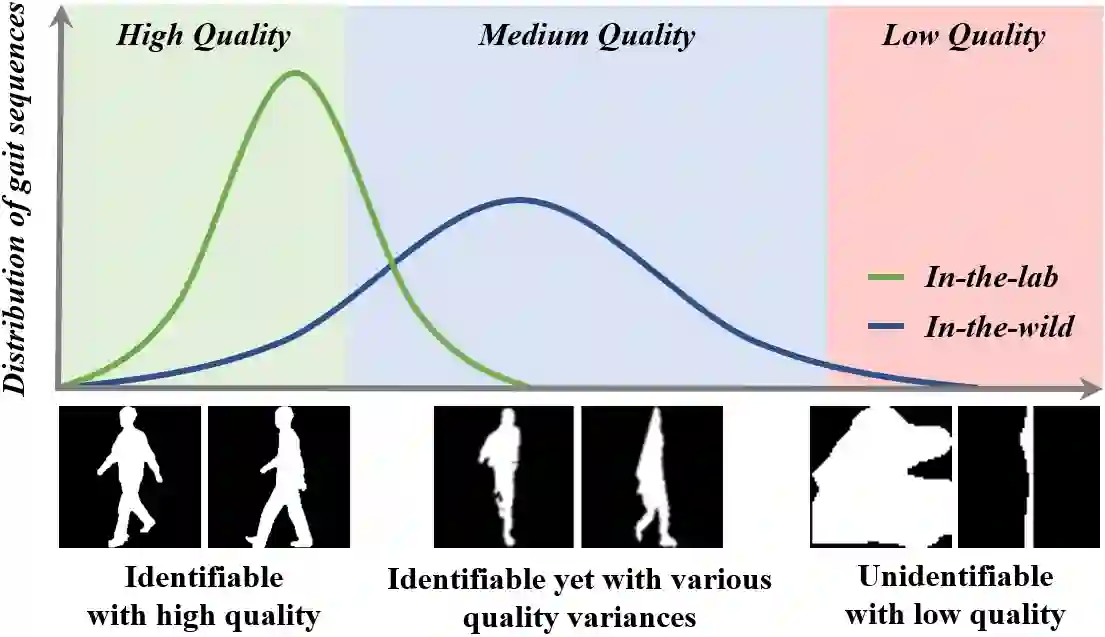
Gait recognition is a promising biometric method that aims to identify pedestrians from their unique walking patterns. Silhouette modality, renowned for its easy acquisition, simple structure, sparse representation, and convenient modeling, has been widely employed in controlled in-the-lab research. However, as gait recognition rapidly advances from in-the-lab to in-the-wild scenarios, various conditions raise significant challenges for silhouette modality, including 1) unidentifiable low-quality silhouettes (abnormal segmentation, severe occlusion, or even non-human shape), and 2) identifiable but challenging silhouettes (background noise, non-standard posture, slight occlusion). To address these challenges, we revisit gait recognition pipeline and approach gait recognition from a quality perspective, namely QAGait. Specifically, we propose a series of cost-effective quality assessment strategies, including Maxmial Connect Area and Template Match to eliminate background noises and unidentifiable silhouettes, Alignment strategy to handle non-standard postures. We also propose two quality-aware loss functions to integrate silhouette quality into optimization within the embedding space. Extensive experiments demonstrate our QAGait can guarantee both gait reliability and performance enhancement. Furthermore, our quality assessment strategies can seamlessly integrate with existing gait datasets, showcasing our superiority. Code is available at https://github.com/wzb-bupt/QAGait.
翻译:步态识别是一种前景广阔的生物特征识别方法,旨在通过个体独特的行走模式进行身份识别。轮廓模态因其易于获取、结构简单、表示稀疏且建模方便等优势,已在受控实验室研究中得到广泛应用。然而,随着步态识别从实验室场景快速拓展至野外真实场景,多种条件给轮廓模态带来了显著挑战,包括:1) 无法识别的低质量轮廓(异常分割、严重遮挡甚至非人体形状),以及2) 可识别但具有挑战性的轮廓(背景噪声、非标准姿态、轻微遮挡)。为解决这些问题,我们重新审视了步态识别流程,并从质量维度出发提出了QAGait方法。具体而言,我们设计了一系列经济高效的质量评估策略,包括用于消除背景噪声和不可识别轮廓的最大连通区域法及模板匹配法,以及用于处理非标准姿态的对齐策略。同时,我们提出了两种质量感知损失函数,将轮廓质量融入嵌入空间中的优化过程。大量实验表明,QAGait既能保证步态可靠性,又能提升识别性能。此外,我们的质量评估策略可无缝集成至现有步态数据集,彰显了方法的优越性。代码已开源至https://github.com/wzb-bupt/QAGait。








相关内容





 微信扫码咨询专知VIP会员