

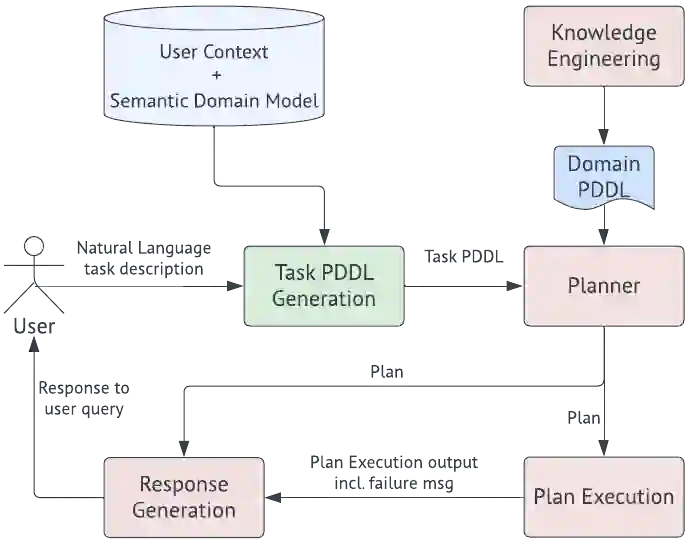
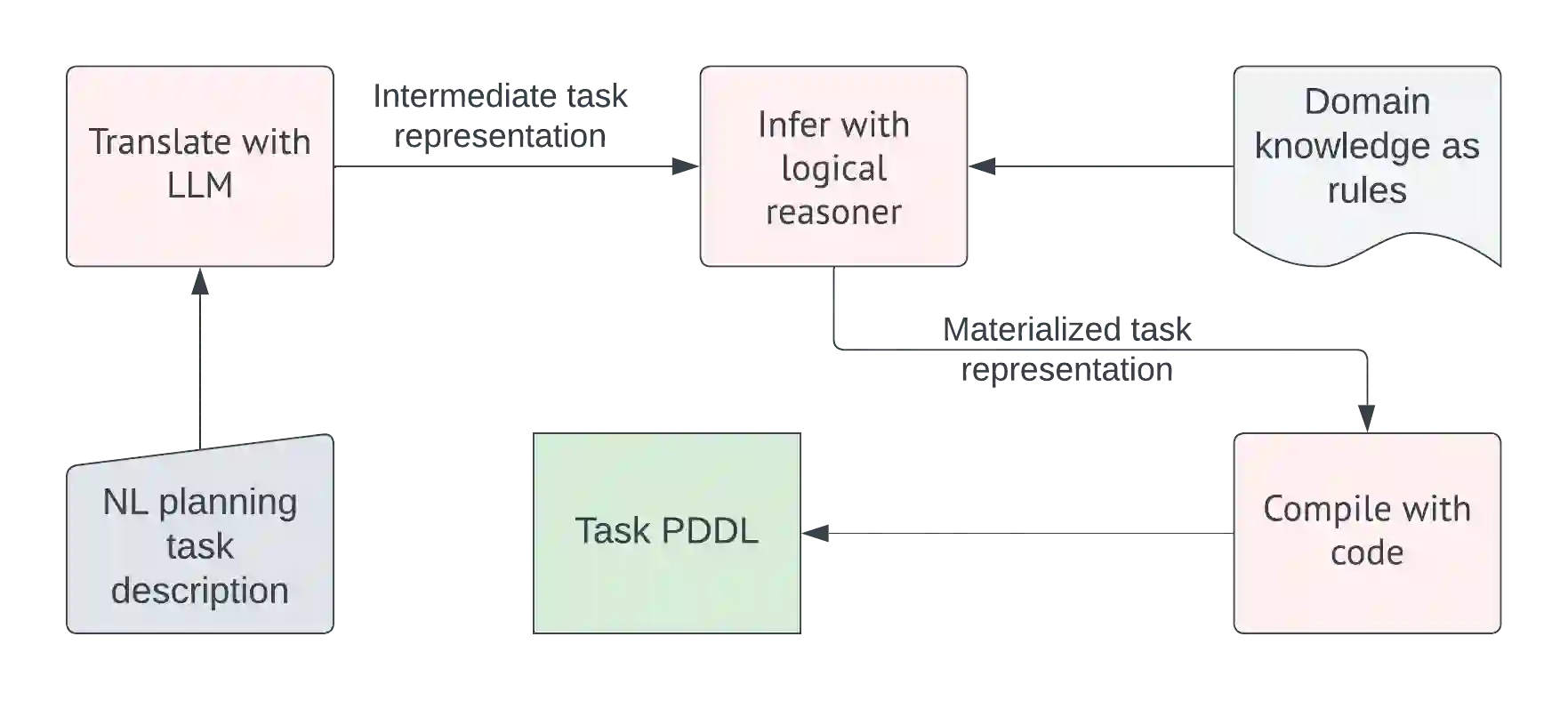
We study the problem of generating plans for given natural language planning task requests. On one hand, LLMs excel at natural language processing but do not perform well on planning. On the other hand, classical planning tools excel at planning tasks but require input in a structured language such as the Planning Domain Definition Language (PDDL). We leverage the strengths of both the techniques by using an LLM for generating the PDDL representation (task PDDL) of planning task requests followed by using a classical planner for computing a plan. Unlike previous approaches that use LLMs for generating task PDDLs directly, our approach comprises of (a) translate: using an LLM only for generating a logically interpretable intermediate representation of natural language task descriptions, (b) infer: deriving additional logically dependent information from the intermediate representation using a logic reasoner (currently, Answer Set Programming solver), and (c) compile: generating the target task PDDL from the base and inferred information. We observe that using an LLM to only output the intermediate representation significantly reduces LLM errors. Consequently, TIC approach achieves, for at least one LLM, high accuracy on task PDDL generation for all seven domains of our evaluation dataset.
翻译:我们研究针对给定自然语言规划任务请求生成规划的问题。一方面,大语言模型擅长自然语言处理,但在规划任务上表现不佳;另一方面,经典规划工具擅长处理规划任务,但需要以结构化语言(如规划领域定义语言PDDL)作为输入。我们通过利用大语言模型生成规划任务请求的PDDL表示(任务PDDL),再使用经典规划器计算规划,从而结合两种技术的优势。与以往直接利用大语言模型生成任务PDDL的方法不同,我们的方法包含:(a)翻译:仅使用大语言模型生成自然语言任务描述的逻辑可解释中间表示;(b)推理:利用逻辑推理器(当前为回答集编程求解器)从中间表示推导额外的逻辑依赖信息;(c)编译:基于基础信息和推理信息生成目标任务PDDL。我们观察到,仅利用大语言模型输出中间表示可显著减少其错误。因此,TIC方法在评估数据集的全部七个领域中,至少针对一种大语言模型实现了任务PDDL生成的高精度。




相关内容




 微信扫码咨询专知VIP会员