

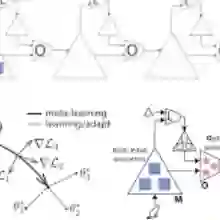
In the early observation period of a time series, there might be only a few historic observations available to learn a model. However, in cases where an existing prior set of datasets is available, Meta learning methods can be applicable. In this paper, we devise a Meta learning method that exploits samples from additional datasets and learns to augment time series through adversarial learning as an auxiliary task for the target dataset. Our model (FEML), is equipped with a shared Convolutional backbone that learns features for varying length inputs from different datasets and has dataset specific heads to forecast for different output lengths. We show that FEML can meta learn across datasets and by additionally learning on adversarial generated samples as auxiliary samples for the target dataset, it can improve the forecasting performance compared to single task learning, and various solutions adapted from Joint learning, Multi-task learning and classic forecasting baselines.
翻译:在时间序列的早期观测阶段,可能仅有少量历史观测数据可用于学习模型。然而,当存在已有的先验数据集集合时,元学习方法便可适用。本文设计了一种元学习方法,该方法利用额外数据集中的样本,并通过对抗学习作为目标数据集的辅助任务来学习增强时间序列。本文模型(FEML)配备共享卷积主干网络,可学习来自不同数据集的变长输入特征,并设有特定于数据集的预测头以输出不同长度的预测结果。实验表明,FEML能够跨数据集进行元学习,并通过在目标数据集上额外学习对抗生成的样本作为辅助样本,相较于单任务学习以及从联合学习、多任务学习和经典预测基线中适配的多种解决方案,可提升预测性能。




相关内容




 微信扫码咨询专知VIP会员