

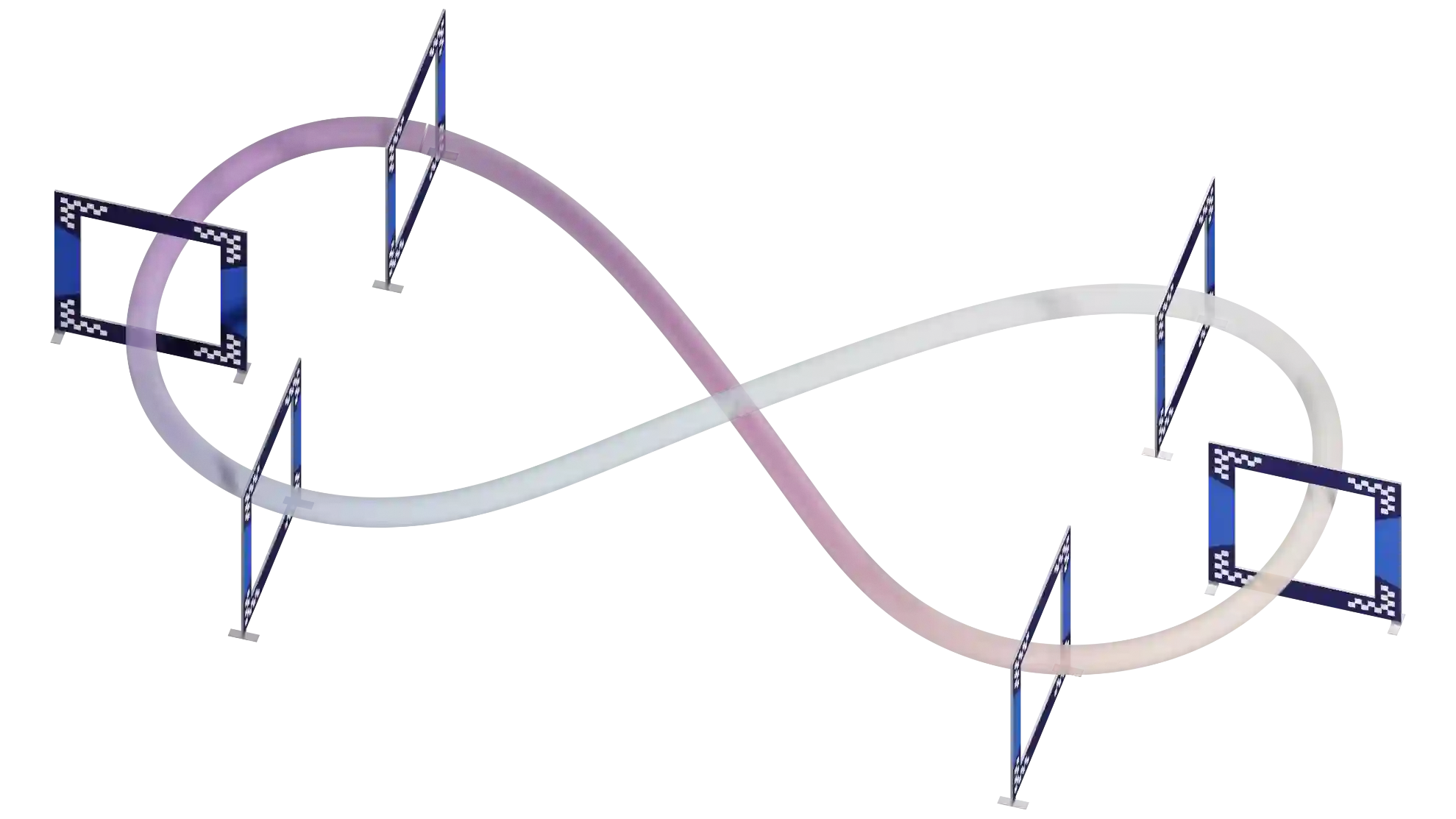
Scene transfer for vision-based mobile robotics applications is a highly relevant and challenging problem. The utility of a robot greatly depends on its ability to perform a task in the real world, outside of a well-controlled lab environment. Existing scene transfer end-to-end policy learning approaches often suffer from poor sample efficiency or limited generalization capabilities, making them unsuitable for mobile robotics applications. This work proposes an adaptive multi-pair contrastive learning strategy for visual representation learning that enables zero-shot scene transfer and real-world deployment. Control policies relying on the embedding are able to operate in unseen environments without the need for finetuning in the deployment environment. We demonstrate the performance of our approach on the task of agile, vision-based quadrotor flight. Extensive simulation and real-world experiments demonstrate that our approach successfully generalizes beyond the training domain and outperforms all baselines.
翻译:针对基于视觉的移动机器人应用而言,场景迁移是一个高度相关且极具挑战性的问题。机器人的实用性很大程度上取决于其在受控实验室环境之外的真实世界中执行任务的能力。现有的场景迁移端到端策略学习方法往往存在样本效率低或泛化能力有限的问题,这使得它们不适用于移动机器人应用。本文提出一种自适应多对对比学习策略用于视觉表征学习,可实现零样本场景迁移与真实世界部署。基于该嵌入表示的策略控制模型能够在未见环境中运行,而无需在部署环境中进行微调。我们通过敏捷的视觉四旋翼飞行任务验证了该方法性能。大量仿真与真实世界实验表明,我们的方法成功实现了训练域之外的泛化,并优于所有基线方法。





相关内容



 微信扫码咨询专知VIP会员