

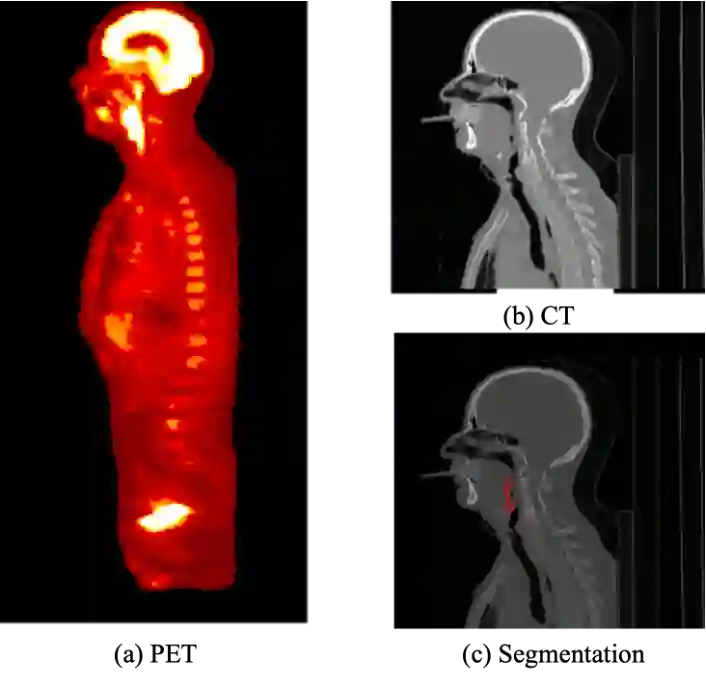
The 5-year survival rate of Head and Neck Cancer (HNC) has not improved over the past decade and one common cause of treatment failure is recurrence. In this paper, we built Cox proportional hazard (CoxPH) models that predict the recurrence free survival (RFS) of oropharyngeal HNC patients. Our models utilise both clinical information and multimodal radiomics features extracted from tumour regions in Computed Tomography (CT) and Positron Emission Tomography (PET). Furthermore, we were one of the first studies to explore the impact of segmentation accuracy on the predictive power of the extracted radiomics features, through under- and over-segmentation study. Our models were trained using the HEad and neCK TumOR (HECKTOR) challenge data, and the best performing model achieved a concordance index (C-index) of 0.74 for the model utilising clinical information and multimodal CT and PET radiomics features, which compares favourably with the model that only used clinical information (C-index of 0.67). Our under- and over-segmentation study confirms that segmentation accuracy affects radiomics extraction, however, it affects PET and CT differently.
翻译:过去十年间,头颈癌(HNC)的五年生存率未见改善,治疗失败的常见原因之一是复发。本文构建了预测口咽部头颈癌患者无复发生存期(RFS)的Cox比例风险(CoxPH)模型。我们的模型同时利用临床信息以及从计算机断层扫描(CT)和正电子发射断层扫描(PET)肿瘤区域中提取的多模态影像组学特征。此外,作为最早探索分割精度对提取影像组学特征预测能力影响的研究之一,我们通过欠分割和过分割研究进行了分析。模型基于头颈部肿瘤(HECKTOR)挑战赛数据进行训练,其中结合临床信息与CT/PET多模态影像组学特征的最佳模型的一致性指数(C-index)达到0.74,显著优于仅使用临床信息的模型(C-index为0.67)。我们的欠分割和过分割研究证实,分割精度会影响影像组学特征提取,但其对PET和CT的影响存在差异。





相关内容




 微信扫码咨询专知VIP会员