

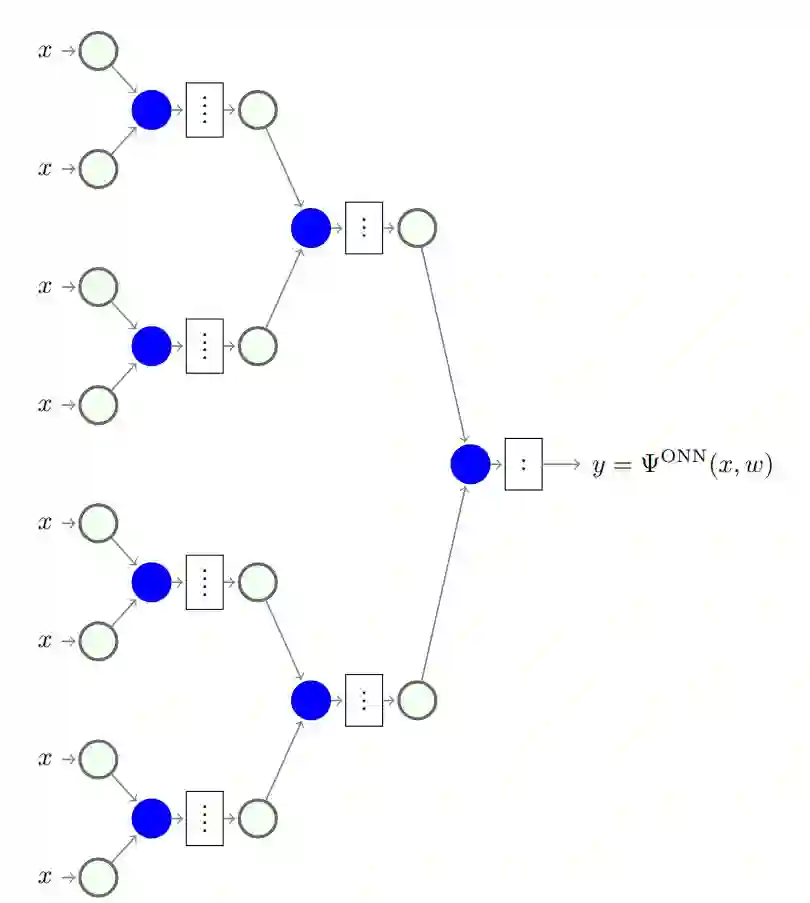
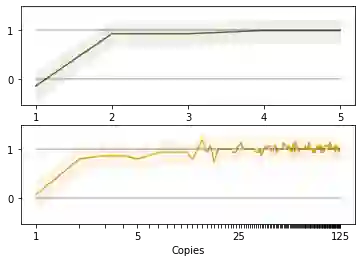
All analog signal processing is fundamentally subject to noise, and this is also the case in modern implementations of Optical Neural Networks (ONNs). Therefore, to mitigate noise in ONNs, we propose two designs that are constructed from a given, possibly trained, Neural Network (NN) that one wishes to implement. Both designs have the capability that the resulting ONNs gives outputs close to the desired NN. To establish the latter, we analyze the designs mathematically. Specifically, we investigate a probabilistic framework for the first design that establishes that the design is correct, i.e., for any feed-forward NN with Lipschitz continuous activation functions, an ONN can be constructed that produces output arbitrarily close to the original. ONNs constructed with the first design thus also inherit the universal approximation property of NNs. For the second design, we restrict the analysis to NNs with linear activation functions and characterize the ONNs' output distribution using exact formulas. Finally, we report on numerical experiments with LeNet ONNs that give insight into the number of components required in these designs for certain accuracy gains. We specifically study the effect of noise as a function of the depth of an ONN. The results indicate that in practice, adding just a few components in the manner of the first or the second design can already be expected to increase the accuracy of ONNs considerably.
翻译:所有模拟信号处理本质上都受噪声影响,现代光学神经网络(ONNs)的实现也不例外。因此,为减轻ONNs中的噪声,我们基于某个已给定(可能已训练)的待实现神经网络(NN)提出了两种设计方案。这两种方案均能使最终得到的ONN输出与期望的NN高度接近。为验证这一特性,我们从数学角度分析了这些设计。具体而言,针对第一种设计,我们建立了一个概率框架来证明其正确性:对于任意具有Lipschitz连续激活函数的前馈NN,均可构造出输出任意接近原始NN的ONN。由此构建的ONN也继承了NN的通用逼近性质。对于第二种设计,我们将分析限定在采用线性激活函数的NN,并通过精确公式刻画了ONN的输出分布。最后,我们报告了基于LeNet ONN的数值实验,揭示了为达到特定精度增益所需组件数量的规律,并重点研究了噪声作为ONN深度函数的效应。结果表明,在实践中,仅需按第一种或第二种设计添加少量组件,即可显著提升ONN的精度。







相关内容





 微信扫码咨询专知VIP会员