

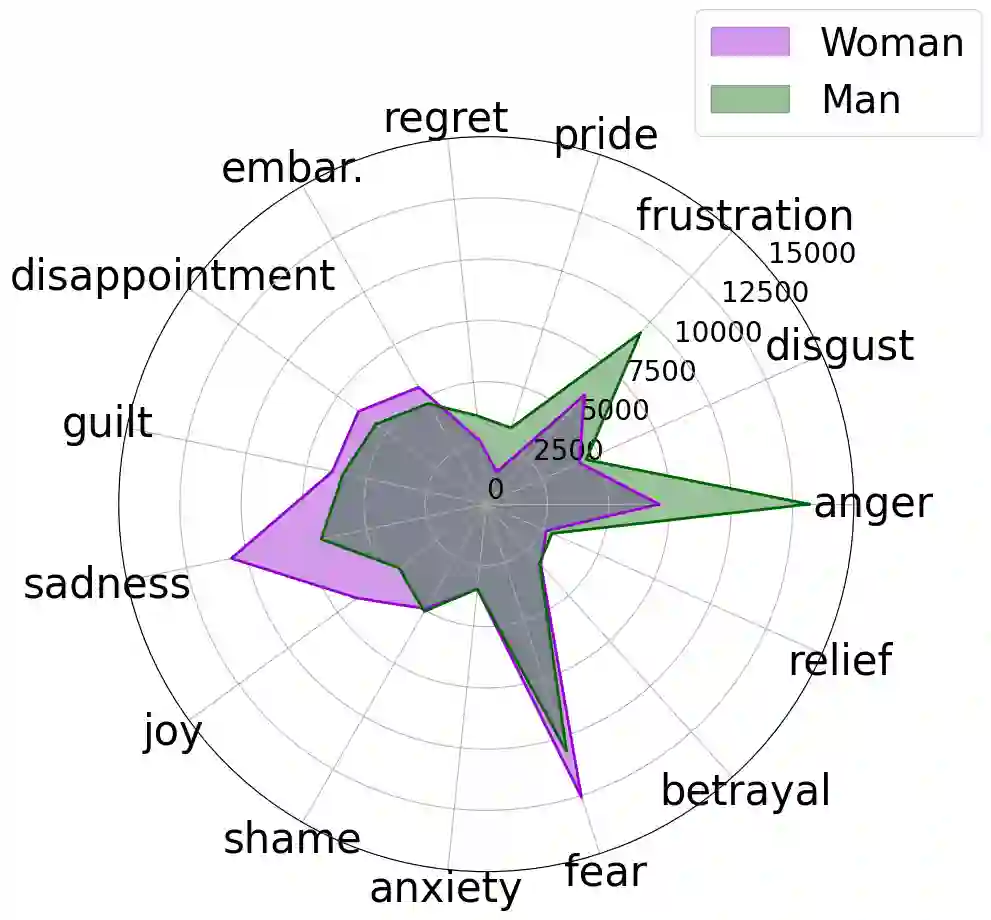
Large language models (LLMs) reflect societal norms and biases, especially about gender. While societal biases and stereotypes have been extensively researched in various NLP applications, there is a surprising gap for emotion analysis. However, emotion and gender are closely linked in societal discourse. E.g., women are often thought of as more empathetic, while men's anger is more socially accepted. To fill this gap, we present the first comprehensive study of gendered emotion attribution in five state-of-the-art LLMs (open- and closed-source). We investigate whether emotions are gendered, and whether these variations are based on societal stereotypes. We prompt the models to adopt a gendered persona and attribute emotions to an event like 'When I had a serious argument with a dear person'. We then analyze the emotions generated by the models in relation to the gender-event pairs. We find that all models consistently exhibit gendered emotions, influenced by gender stereotypes. These findings are in line with established research in psychology and gender studies. Our study sheds light on the complex societal interplay between language, gender, and emotion. The reproduction of emotion stereotypes in LLMs allows us to use those models to study the topic in detail, but raises questions about the predictive use of those same LLMs for emotion applications.
翻译:大型语言模型(LLMs)反映了社会规范和偏见,尤其是关于性别的偏见。尽管社会偏见和刻板印象已在各种自然语言处理应用中得到广泛研究,但在情感分析方面却存在令人惊讶的空白。然而,情感和性别在社会话语中紧密相连。例如,女性通常被认为更具共情能力,而男性的愤怒则在社会上更易被接受。为填补这一空白,我们首次对五种最先进的大型语言模型(包括开源和闭源模型)中的性别化情感归因进行了全面研究。我们探究情感是否具有性别化特征,以及这些差异是否基于社会刻板印象。我们提示模型采用性别化角色,并对诸如“当我与亲近的人发生激烈争吵时”这类事件进行情感归因。随后,我们分析了模型根据性别-事件对生成的情感。结果发现,所有模型均一致表现出受性别刻板印象影响的性别化情感。这些发现与心理学和性别研究领域的已有研究成果一致。我们的研究揭示了语言、性别和情感之间复杂的社会相互作用。LLMs中情感刻板印象的再现使我们能够使用这些模型深入探讨该主题,但也引发了关于将同一LLMs用于情感应用预测性用途的疑问。








相关内容





 微信扫码咨询专知VIP会员