

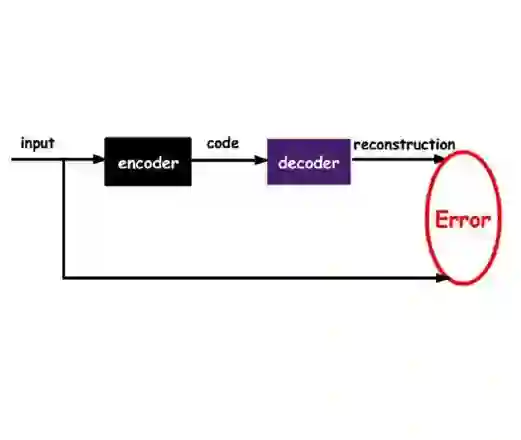
Autoencoders, which consist of an encoder and a decoder, are widely used in machine learning for dimension reduction of high-dimensional data. The encoder embeds the input data manifold into a lower-dimensional latent space, while the decoder represents the inverse map, providing a parametrization of the data manifold by the manifold in latent space. A good regularity and structure of the embedded manifold may substantially simplify further data processing tasks such as cluster analysis or data interpolation. We propose and analyze a novel regularization for learning the encoder component of an autoencoder: a loss functional that prefers isometric, extrinsically flat embeddings and allows to train the encoder on its own. To perform the training it is assumed that for pairs of nearby points on the input manifold their local Riemannian distance and their local Riemannian average can be evaluated. The loss functional is computed via Monte Carlo integration with different sampling strategies for pairs of points on the input manifold. Our main theorem identifies a geometric loss functional of the embedding map as the $\Gamma$-limit of the sampling-dependent loss functionals. Numerical tests, using image data that encodes different explicitly given data manifolds, show that smooth manifold embeddings into latent space are obtained. Due to the promotion of extrinsic flatness, these embeddings are regular enough such that interpolation between not too distant points on the manifold is well approximated by linear interpolation in latent space as one possible postprocessing.
翻译:自编码器由编码器和解码器组成,广泛用于机器学习中高维数据的降维。编码器将输入数据流形嵌入到低维隐空间,而解码器表示逆映射,通过隐空间中的流形提供数据流形的参数化。嵌入流形的良好正则性和结构可能大幅简化后续数据处理任务(如聚类分析或数据插值)。我们提出并分析了一种用于学习自编码器编码器组件的新型正则化方法:一种偏好等距、外在平坦嵌入的损失泛函,使得编码器能够独立训练。为执行训练,假设输入流形上近邻点对的局部黎曼距离和局部黎曼平均值可被评估。该损失泛函通过蒙特卡洛积分计算,对输入流形上的点对采用不同采样策略。我们的主要定理将嵌入映射的几何损失泛函识别为采样依赖损失泛函的Γ-极限。数值测试使用编码不同显式给定数据流形的图像数据,表明可获得平滑的隐空间流形嵌入。由于促进了外在平坦性,这些嵌入具有足够正则性,使得流形上距离不太远的点之间的插值可通过隐空间中的线性插值(作为一种后处理)得到良好近似。




相关内容



 微信扫码咨询专知VIP会员