

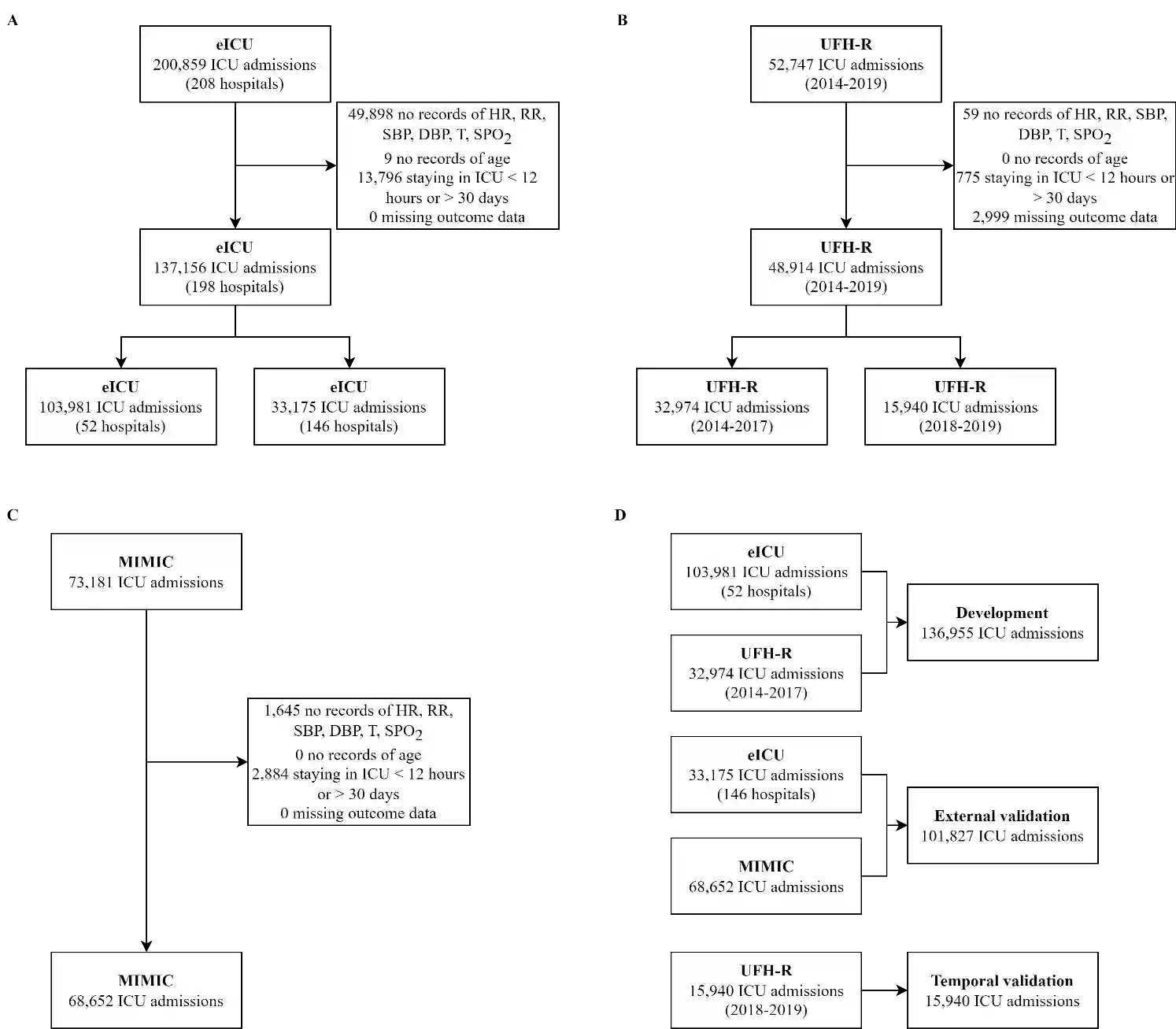
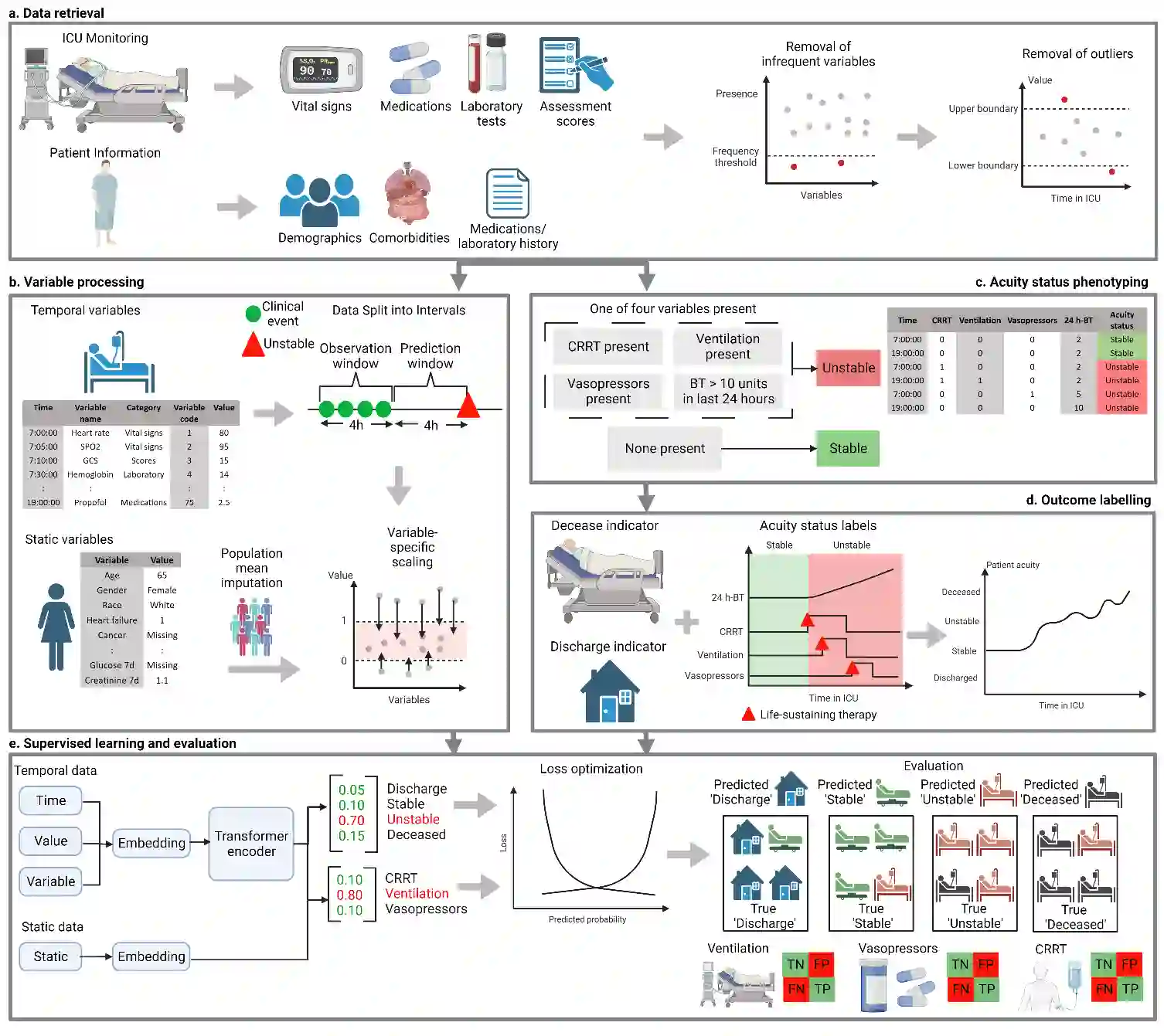
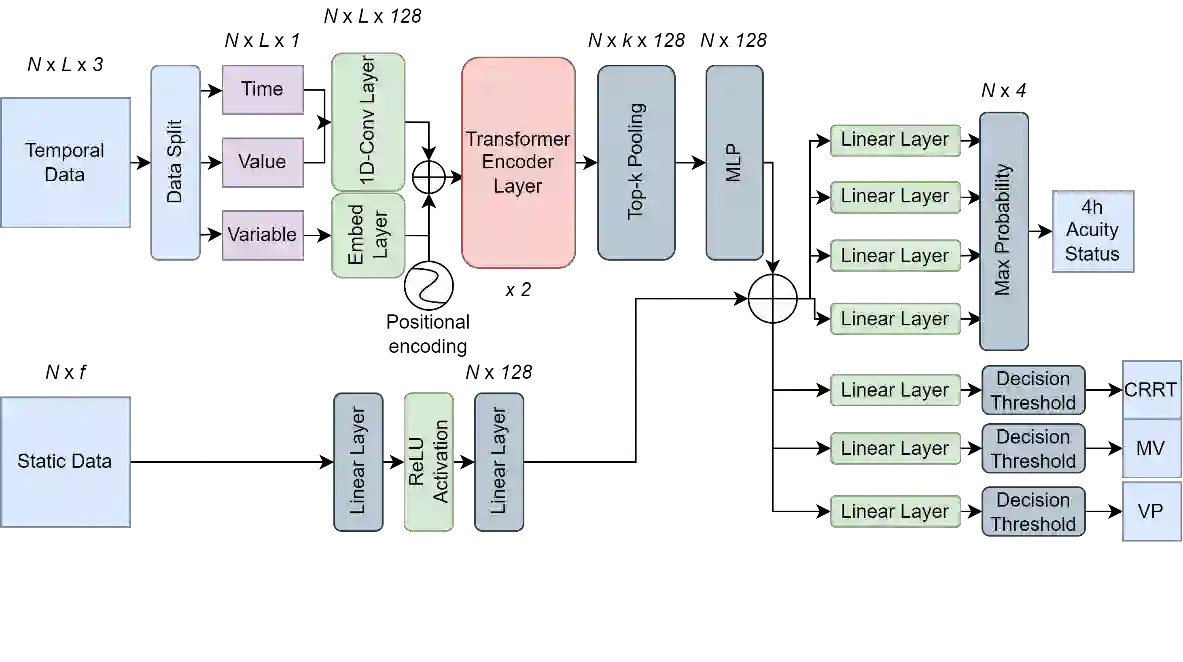
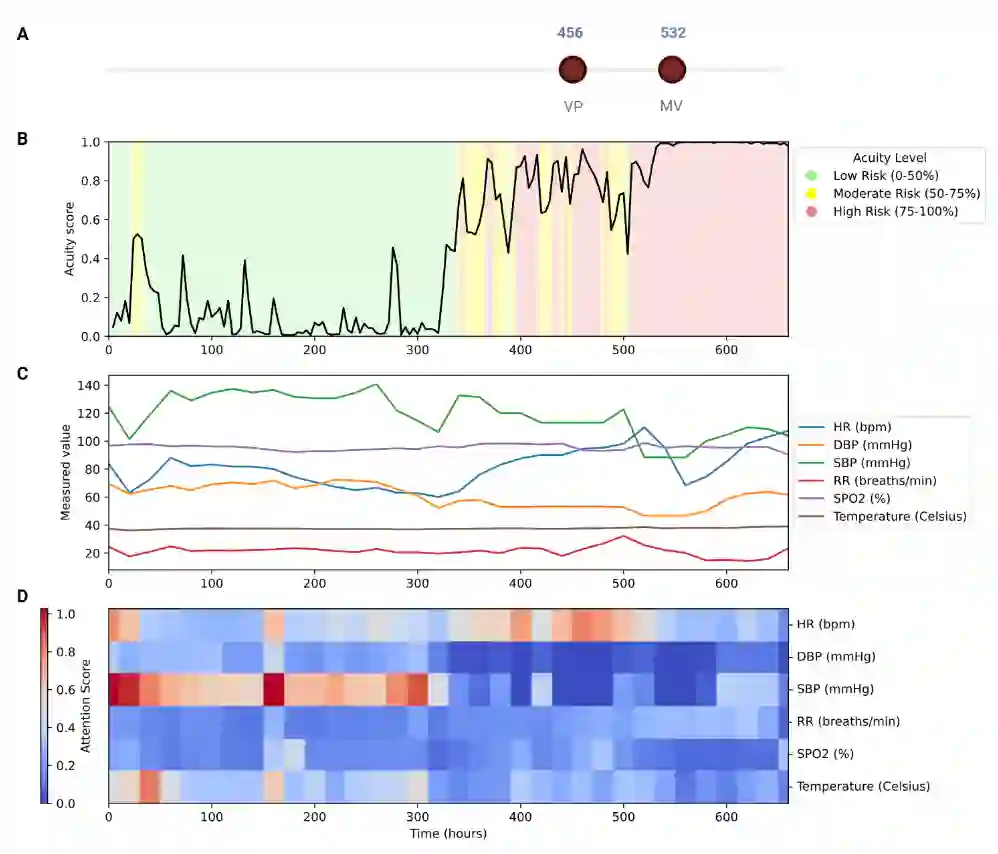
The acuity state of patients in the intensive care unit (ICU) can quickly change from stable to unstable, sometimes leading to life-threatening conditions. Early detection of deteriorating conditions can result in providing more timely interventions and improved survival rates. Current approaches rely on manual daily assessments. Some data-driven approaches have been developed, that use mortality as a proxy of acuity in the ICU. However, these methods do not integrate acuity states to determine the stability of a patient or the need for life-sustaining therapies. In this study, we propose APRICOT (Acuity Prediction in Intensive Care Unit), a Transformer-based neural network to predict acuity state in real-time in ICU patients. We develop and extensively validate externally, temporally, and prospectively the APRICOT model on three large datasets: University of Florida Health (UFH), eICU Collaborative Research Database (eICU), and Medical Information Mart for Intensive Care (MIMIC)-IV. The performance of APRICOT shows comparable results to state-of-the-art mortality prediction models (external AUROC 0.93-0.93, temporal AUROC 0.96-0.98, and prospective AUROC 0.98) as well as acuity prediction models (external AUROC 0.80-0.81, temporal AUROC 0.77-0.78, and prospective AUROC 0.87). Furthermore, APRICOT can make predictions for the need for life-sustaining therapies, showing comparable results to state-of-the-art ventilation prediction models (external AUROC 0.80-0.81, temporal AUROC 0.87-0.88, and prospective AUROC 0.85), and vasopressor prediction models (external AUROC 0.82-0.83, temporal AUROC 0.73-0.75, prospective AUROC 0.87). This tool allows for real-time acuity monitoring of a patient and can provide helpful information to clinicians to make timely interventions. Furthermore, the model can suggest life-sustaining therapies that the patient might need in the next hours in the ICU.
翻译:重症监护室(ICU)患者的病情严重状态可能迅速从稳定转为不稳定,甚至导致危及生命的情况。早期识别病情恶化趋势有助于及时干预并提高生存率。当前方法依赖于人工每日评估,部分数据驱动方法虽已开发,但仅将死亡率作为ICU病情严重程度的替代指标。然而,这些方法未能整合病情严重状态以判断患者稳定性或对生命支持疗法的需求。本研究提出APRICOT(重症监护室病情严重程度预测),一种基于Transformer的神经网络模型,用于实时预测ICU患者的病情严重状态。我们在三大数据集(佛罗里达大学健康中心UFH、eICU协作研究数据库eICU及重症监护医学信息集市MIMIC-IV)上对APRICOT模型进行了外部验证、时间验证及前瞻性验证。APRICOT在死亡率预测(外部AUROC 0.93-0.93,时间AUROC 0.96-0.98,前瞻性AUROC 0.98)和病情严重程度预测(外部AUROC 0.80-0.81,时间AUROC 0.77-0.78,前瞻性AUROC 0.87)方面均达到与现有最优模型相当的性能。此外,APRICOT可预测生命支持疗法的需求:在机械通气预测(外部AUROC 0.80-0.81,时间AUROC 0.87-0.88,前瞻性AUROC 0.85)和血管升压药预测(外部AUROC 0.82-0.83,时间AUROC 0.73-0.75,前瞻性AUROC 0.87)方面同样表现优异。该工具可实现患者病情严重程度的实时监测,为临床医生提供及时干预的决策支持,并可建议患者未来数小时内可能需要的生命支持疗法。




相关内容




 微信扫码咨询专知VIP会员