

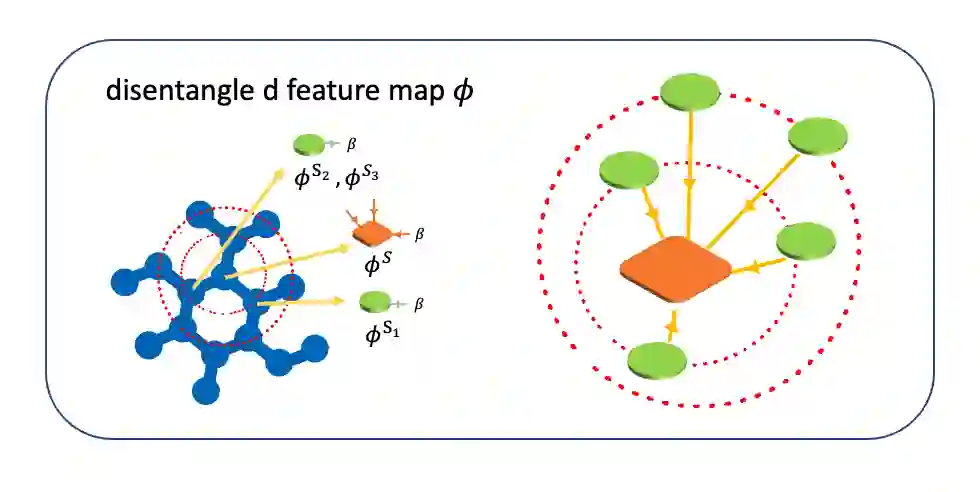
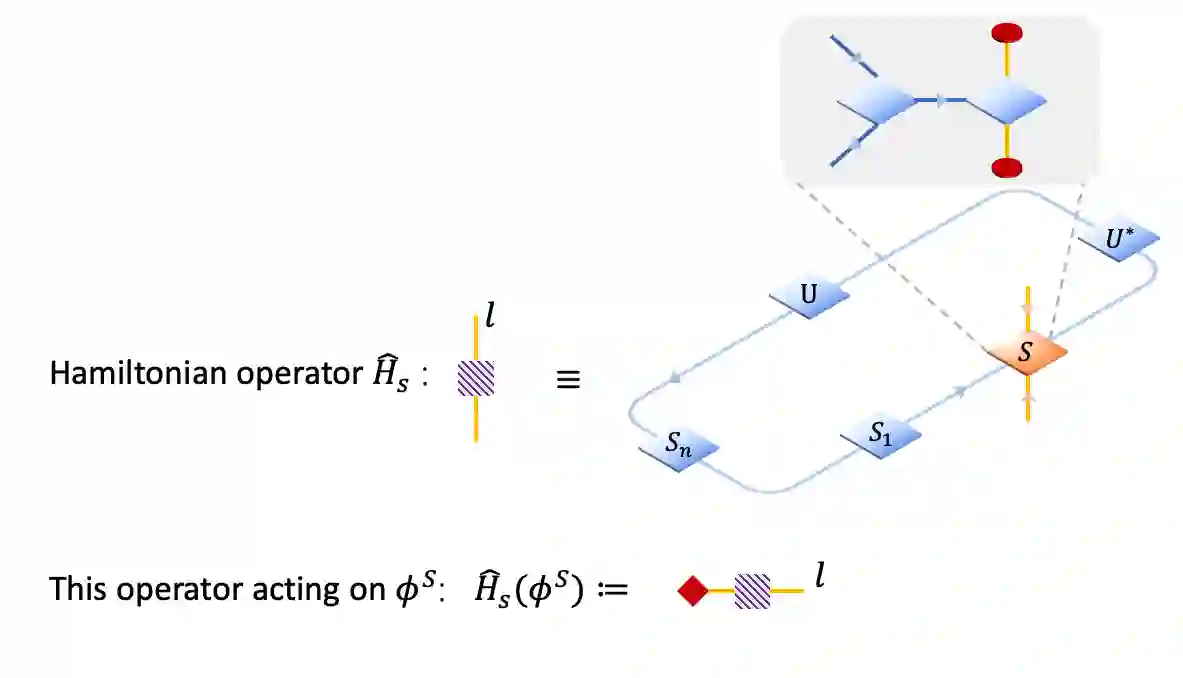
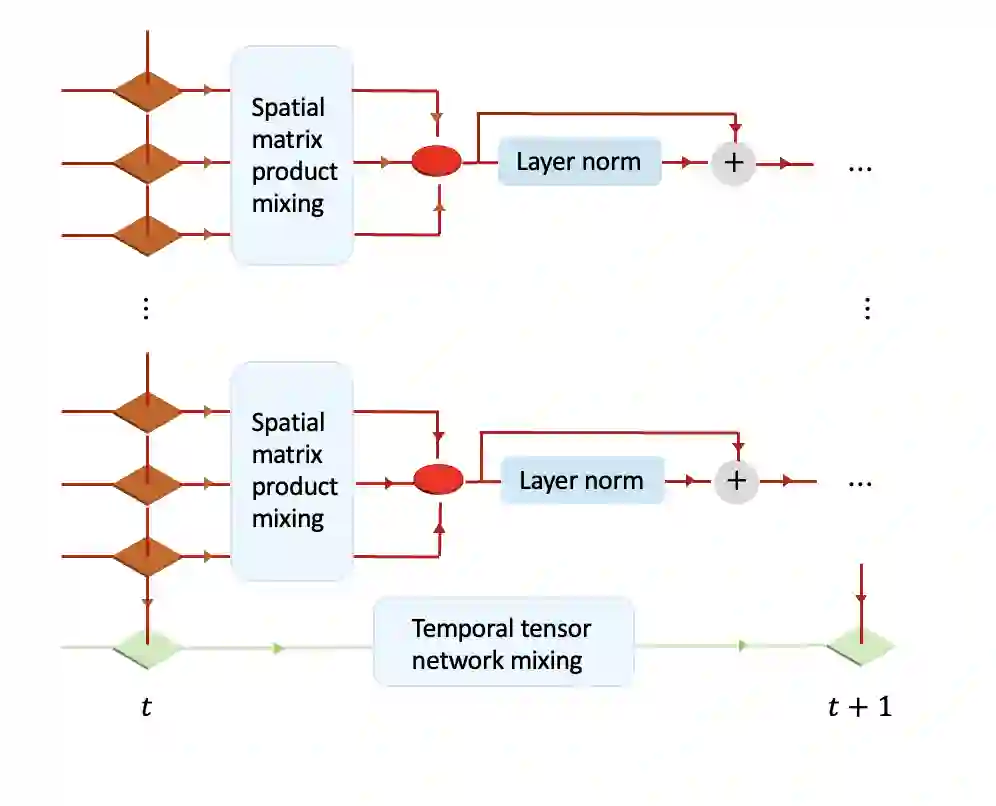
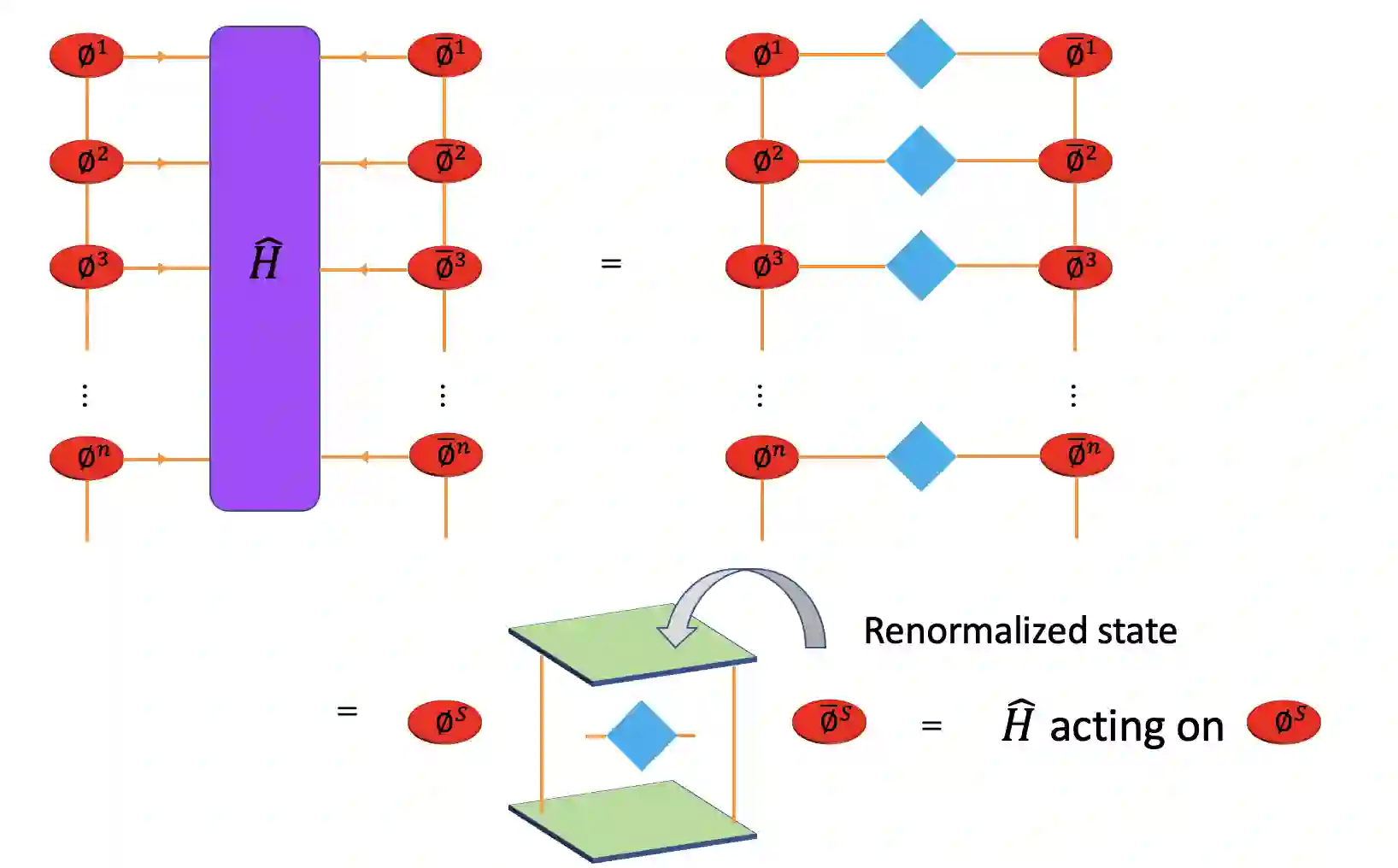
By conceiving physical systems as 3D many-body point clouds, geometric graph neural networks (GNNs), such as SE(3)/E(3) equivalent GNNs, have showcased promising performance. In particular, their effective message-passing mechanics make them adept at modeling molecules and crystalline materials. However, current geometric GNNs only offer a mean-field approximation of the many-body system, encapsulated within two-body message passing, thus falling short in capturing intricate relationships within these geometric graphs. To address this limitation, tensor networks, widely employed by computational physics to handle manybody systems using high-order tensors, have been introduced. Nevertheless, integrating these tensorized networks into the message-passing framework of GNNs faces scalability and symmetry conservation (e.g., permutation and rotation) challenges. In response, we introduce an innovative equivariant Matrix Product State (MPS)-based message-passing strategy, through achieving an efficient implementation of the tensor contraction operation. Our method effectively models complex many-body relationships, suppressing mean-field approximations, and captures symmetries within geometric graphs. Importantly, it seamlessly replaces the standard message-passing and layer-aggregation modules intrinsic to geometric GNNs. We empirically validate the superior accuracy of our approach on benchmark tasks, including predicting classical Newton systems and quantum tensor Hamiltonian matrices. To our knowledge, our approach represents the inaugural utilization of parameterized geometric tensor networks.
翻译:通过将物理系统视为三维多体点云,几何图神经网络(GNNs),如SE(3)/E(3)等变GNNs,已展现出优异的性能。特别是其有效的消息传递机制使其擅长对分子和晶体材料进行建模。然而,当前的几何GNNs仅提供多体系统的平均场近似,且局限于两体消息传递,因而难以捕捉这些几何图中复杂的内在关系。为克服这一局限,计算物理学中广泛采用张量网络来处理基于高阶张量的多体系统。然而,将这些张量化网络集成到GNN的消息传递框架中,面临可扩展性和对称性守恒(例如排列和旋转)的挑战。为此,我们提出了一种创新的基于等变矩阵乘积态(MPS)的消息传递策略,通过高效实现张量收缩操作,有效建模复杂多体关系,抑制平均场近似,并捕捉几何图中的对称性。重要的是,该策略可无缝替代几何GNN固有的标准消息传递和层级聚合模块。我们在基准任务上通过实验验证了该方法在预测经典牛顿系统和量子张量哈密顿矩阵等方面的卓越准确性。据我们所知,该方法首次实现了参数化几何张量网络的应用。




相关内容




 微信扫码咨询专知VIP会员