

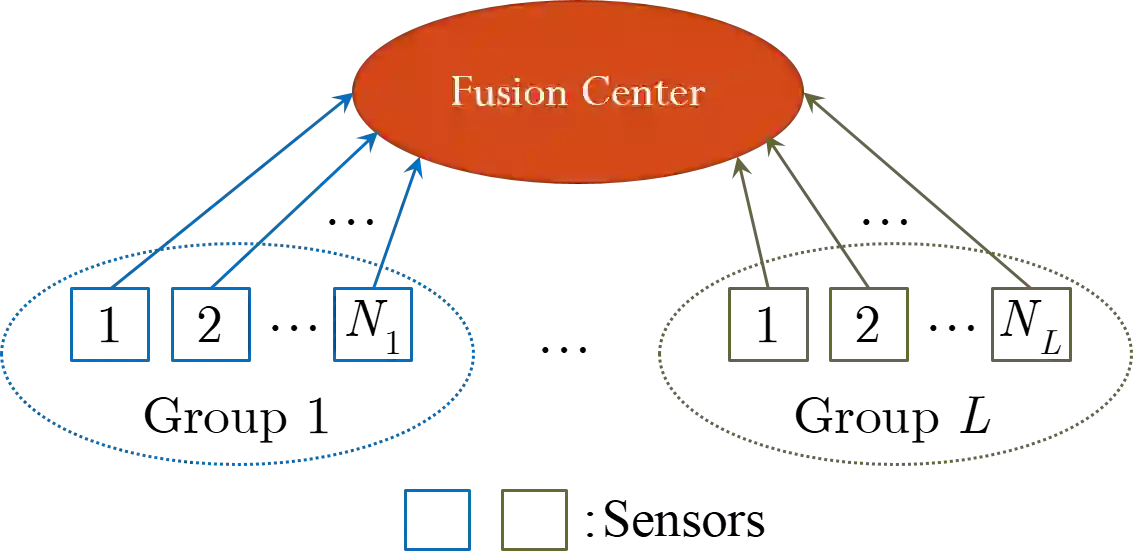
The heterogeneous distributed quickest change detection (HetDQCD) problem with 1-bit feedback is studied, in which a fusion center monitors an abrupt change through a bunch of heterogeneous sensors via anonymous 1-bit feedbacks. Two fusion rules, one-shot and voting rules, are considered. We analyze the performance in terms of the worst-case expected detection delay and the average run length to false alarm for the two fusion rules. Our analysis unveils the mixed impact of involving more sensors into the decision and enables us to find near optimal choices of parameters in the two schemes. Notably, it is shown that, in contrast to the homogeneous setting, the first alarm rule may no longer lead to the best performance among one-shot schemes. The non-anonymous setting is then investigated where a novel weighted voting rule is proposed that assigns different weights to votes from different types of sensors. Simulation results show that the proposed scheme is able to outperform all the above schemes and the mixture CUSUM scheme for the anonymous HetDQCD, hinting at the price of anonymity.
翻译:研究了具有1比特反馈的异构分布式快速变化检测问题,其中融合中心通过匿名1比特反馈监测来自一组异构传感器的突变。本文考虑了一次性投票和多数投票两种融合规则。我们分析了两种规则在最坏情况下的期望检测延迟和虚警平均运行长度方面的性能。分析揭示了增加传感器数量对决策的混合影响,并使我们能够找到两种方案中参数接近最优的选择。值得注意的是,与同构设置相比,在一一次性方案中,首次报警规则可能不再产生最佳性能。随后研究了非匿名设置,提出了一种新颖的加权投票规则,该规则为来自不同类型传感器的投票分配不同权重。仿真结果表明,所提出的方案能够优于所有上述方案以及用于匿名HetDQCD的混合CUSUM方案,暗示了匿名的代价。




相关内容




 微信扫码咨询专知VIP会员