

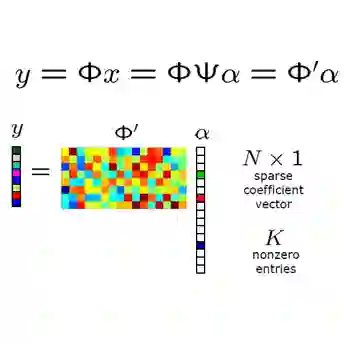
Noiseless compressive sensing is a protocol that enables undersampling and later recovery of a signal without loss of information. This compression is possible because the signal is usually sufficiently sparse in a given basis. Currently, the algorithm offering the best tradeoff between compression rate, robustness, and speed for compressive sensing is the LASSO (l1-norm bias) algorithm. However, many studies have pointed out the possibility that the implementation of lp-norms biases, with p smaller than one, could give better performance while sacrificing convexity. In this work, we focus specifically on the extreme case of the l0-based reconstruction, a task that is complicated by the discontinuity of the loss. In the first part of the paper, we describe via statistical physics methods, and in particular the replica method, how the solutions to this optimization problem are arranged in a clustered structure. We observe two distinct regimes: one at low compression rate where the signal can be recovered exactly, and one at high compression rate where the signal cannot be recovered accurately. In the second part, we present two message-passing algorithms based on our first results for the l0-norm optimization problem. The proposed algorithms are able to recover the signal at compression rates higher than the ones achieved by LASSO while being computationally efficient.
翻译:无噪声压缩感知是一种能够在欠采样条件下无损恢复信号的协议。这种压缩之所以可行,是因为信号在特定基上通常具有充分的稀疏性。目前,在压缩感知中实现压缩率、鲁棒性和速度最佳权衡的算法是LASSO(l1范数偏差)算法。然而,大量研究表明,采用p值小于1的lp范数偏差,虽以牺牲凸性为代价,但可能获得更优性能。本文聚焦于l0范数重建这一极端情况,其任务因损失函数的不连续性而变得复杂。在第一部分,我们通过统计物理方法(特别是副本方法)揭示了该优化问题解呈现聚类结构的特点。我们观察到两种截然不同的状态:在低压缩率下信号可精确恢复,而在高压缩率下信号无法准确恢复。在第二部分,基于前述l0范数优化问题的研究结果,我们提出了两种消息传递算法。所提出的算法能在保持计算高效性的同时,在高于LASSO的压缩率下实现信号恢复。




相关内容


 微信扫码咨询专知VIP会员