

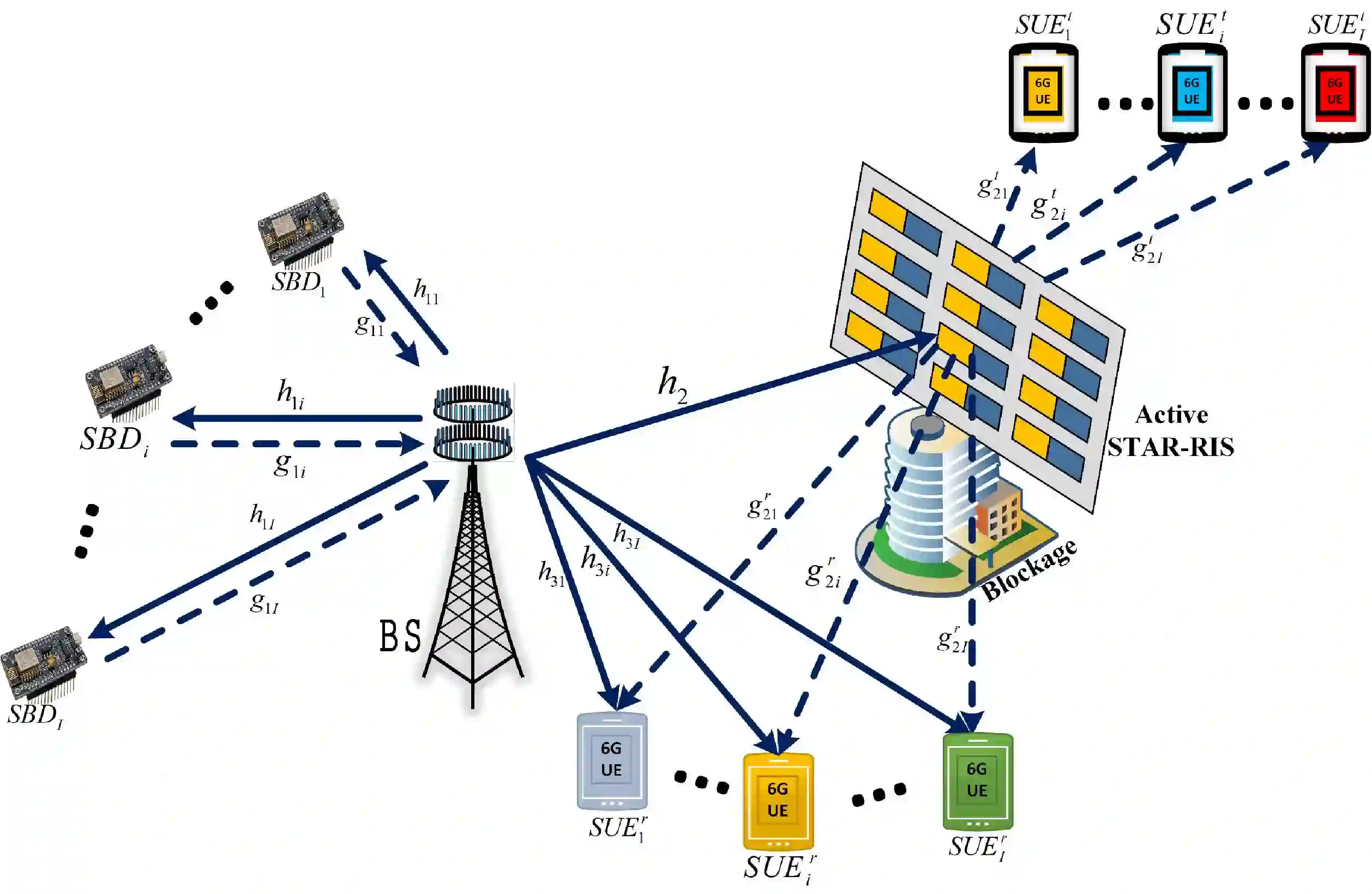
In this paper, we employ active simultaneously transmitting and reflecting reconfigurable intelligent surface (ASRIS) to aid in establishing and enhancing communication within a commensal symbiotic radio (CSR) network. Unlike traditional RIS, ASRIS not only ensures coverage in an omni directional manner but also amplifies received signals, consequently elevating overall network performance. in the first phase, base station (BS) with active massive MIMO antennas, send ambient signal to SBDs. In the first phase, the BS transmits ambient signals to the symbiotic backscatter devices (SBDs), and after harvesting the energy and modulating their information onto the signal carrier, the SBDs send Backscatter signals back to the BS. In this scheme, we employ the Backscatter Relay system to facilitate the transmission of information from the SBDs to the symbiotic User Equipments (SUEs) with the assistance of the BS. In the second phase, the BS transmits information signals to the SUEs after eliminating interference using the Successive Interference Cancellation (SIC) method. ASRIS is employed to establish communication among SUEs lacking a line of sight (LoS) and to amplify power signals for SUEs with a LoS connection to the BS. It is worth noting that we use NOMA for multiple access in all network. The main goal of this paper is to maximize the sum throughput between all users. To achieve this, we formulate an optimization problem with variables including active beamforming coefficients at the BS and ASRIS, as well as the phase adjustments of ASRIS and scheduling parameters between the first and second phases. To model this optimization problem, we employ three deep reinforcement learning (DRL) methods, namely PPO, TD3, and A3C. Finally, the mentioned methods are simulated and compared with each other.
翻译:本文采用主动同时发射与反射可重构智能表面(ASRIS)来辅助建立并增强共生无线电(CSR)网络中的通信。与传统RIS不同,ASRIS不仅能实现全向覆盖,还能放大接收信号,从而提升整体网络性能。在第一阶段,配备主动大规模MIMO天线的基站(BS)向共生后向散射设备(SBD)发送环境信号。SBD在能量收集后,将其信息调制到信号载波上,并向后向散射信号回传至基站。在该方案中,我们采用后向散射中继系统,在基站辅助下实现从SBD到共生用户设备(SUE)的信息传输。在第二阶段,基站采用连续干扰消除(SIC)方法消除干扰后向SUE发送信息信号。ASRIS用于建立缺乏视距链路(LoS)的SUE之间的通信,并为具有BS视距连接的SUE放大功率信号。值得注意的是,整个网络采用NOMA实现多址接入。本文主要目标是最大化所有用户之间的总和吞吐量。为此,我们构建了一个优化问题,其变量包括基站和ASRIS处的主动波束成形系数、ASRIS的相位调整以及第一阶段与第二阶段之间的调度参数。针对该优化问题,我们采用了三种深度强化学习(DRL)方法进行建模:PPO、TD3和A3C。最后,对所提方法进行了仿真并相互比较。




相关内容




 微信扫码咨询专知VIP会员