

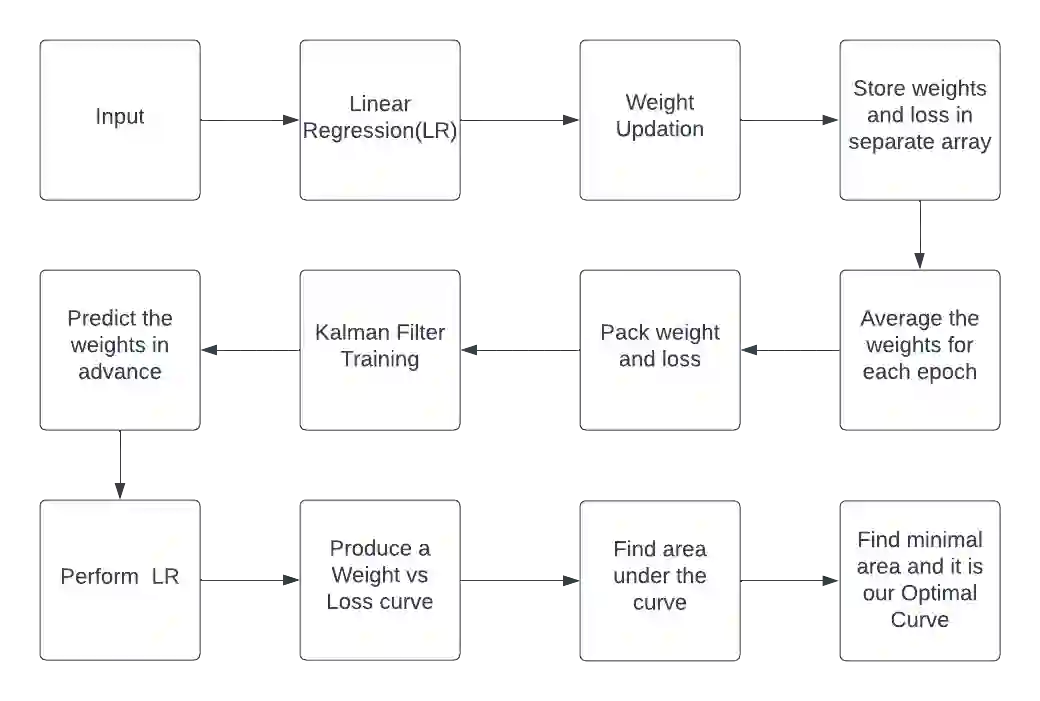
This research enhances linear regression models by integrating a Kalman filter and analysing curve areas to minimize loss. The goal is to develop an optimal linear regression equation using stochastic gradient descent (SGD) for weight updating. Our approach involves a stepwise process, starting with user-defined parameters. The linear regression model is trained using SGD, tracking weights and loss separately and zipping them finally. A Kalman filter is then trained based on weight and loss arrays to predict the next consolidated weights. Predictions result from multiplying input averages with weights, evaluated for loss to form a weight-versus-loss curve. The curve's equation is derived using the two-point formula, and area under the curve is calculated via integration. The linear regression equation with minimum area becomes the optimal curve for prediction. Benefits include avoiding constant weight updates via gradient descent and working with partial datasets, unlike methods needing the entire set. However, computational complexity should be considered. The Kalman filter's accuracy might diminish beyond a certain prediction range.
翻译:本研究通过集成卡尔曼滤波并分析曲线面积以最小化损失,从而增强线性回归模型。其目标是利用随机梯度下降(SGD)更新权重,推导出最优线性回归方程。该方法采用逐步流程,从用户定义参数开始。线性回归模型通过SGD进行训练,分别追踪权重与损失,最终将其压缩整合。随后基于权重与损失数组训练卡尔曼滤波,以预测下一组综合权重。预测结果通过输入平均值与权重的乘积获得,并依据损失进行评估,从而构建权重-损失曲线。利用两点公式推导曲线方程,并通过积分计算曲线下面积。具有最小面积的线性回归方程即为最优预测曲线。本方法的优势在于避免通过梯度下降持续更新权重,且仅需部分数据集即可运行,不同于需使用完整数据集的方法。然而,需考虑计算复杂度。此外,卡尔曼滤波在超出特定预测范围后其准确性可能下降。




相关内容




 微信扫码咨询专知VIP会员