

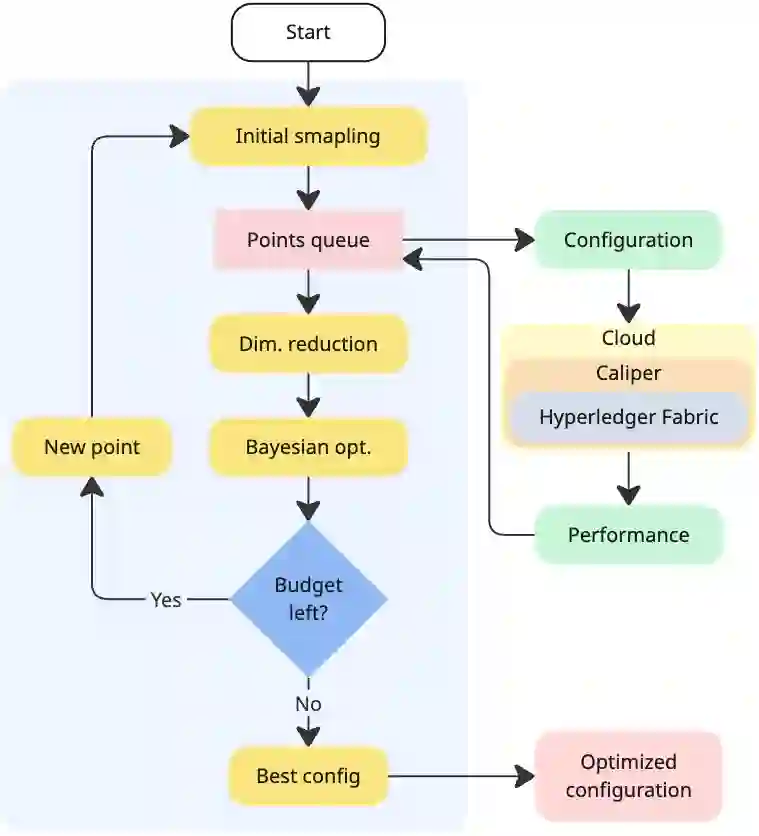
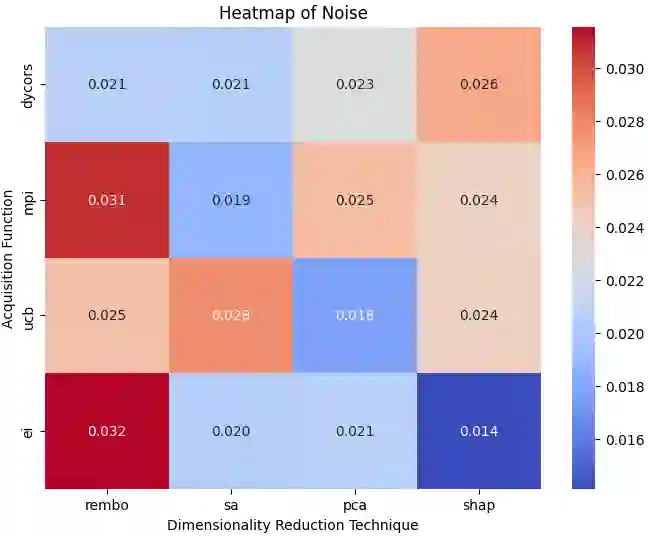
Hyperledger Fabric performance depends on many interacting configuration parameters, making manual tuning difficult. We study automated throughput tuning by treating benchmarking as a noisy black-box optimization problem and applying Bayesian optimization (BO) with dimensionality reduction (DR). We implement an end-to-end Caliper-in-the-loop pipeline that deploys candidate configurations, benchmarks them, and updates the optimizer from observed throughput. The search space, derived from Fabric configuration files, has 317 dimensions. In a cloud testbed, we evaluate 16 BO+DR variants and a random-search baseline. The best method, DYCORS-PCA, achieves a 12% TPS improvement relative to the first evaluated configuration, while MPI-REMBO achieves 9%. These results suggest that BO with DR is a practical approach for high-dimensional Hyperledger Fabric tuning, while also highlighting the role of measurement noise in interpreting gains.
翻译:Hyperledger Fabric的性能受众多交互配置参数影响,导致手动调优困难。本研究将基准测试视为带噪声的黑盒优化问题,并应用结合降维技术的贝叶斯优化,探索自动化吞吐量调优方法。我们构建了端到端的环测校准内循环管线,该管线可部署候选配置、进行基准测试,并根据观测到的吞吐量更新优化器。从Fabric配置文件推导出的搜索空间具有317个维度。在云测试平台上,我们评估了16种贝叶斯优化与降维变体及随机搜索基线。最优方法DYCORS-PCA相比初始评估配置实现12%的每秒事务数提升,而MPI-REMBO实现9%的提升。这些结果表明,结合降维的贝叶斯优化是高维Hyperledger Fabric调优的实用方法,同时揭示了测量噪声在性能增益解读中的关键作用。





相关内容


 微信扫码咨询专知VIP会员