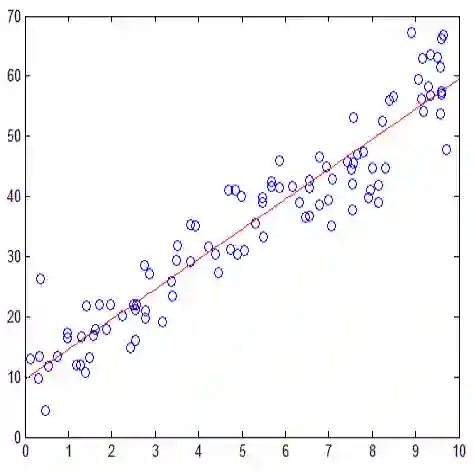
This book is meant to provide an introduction to linear models and the theories behind them. Our goal is to give a rigorous introduction to the readers with prior exposure to ordinary least squares. In machine learning, the output is usually a nonlinear function of the input. Deep learning even aims to find a nonlinear dependence with many layers, which require a large amount of computation. However, most of these algorithms build upon simple linear models. We then describe linear models from different perspectives and find the properties and theories behind the models. The linear model is the main technique in regression problems, and the primary tool for it is the least squares approximation, which minimizes a sum of squared errors. This is a natural choice when we're interested in finding the regression function which minimizes the corresponding expected squared error. This book is primarily a summary of purpose, significance of important theories behind linear models, e.g., distribution theory and the minimum variance estimator. We first describe ordinary least squares from three different points of view, upon which we disturb the model with random noise and Gaussian noise. Through Gaussian noise, the model gives rise to the likelihood so that we introduce a maximum likelihood estimator. It also develops some distribution theories via this Gaussian disturbance. The distribution theory of least squares will help us answer various questions and introduce related applications. We then prove least squares is the best unbiased linear model in the sense of mean squared error, and most importantly, it actually approaches the theoretical limit. We end up with linear models with the Bayesian approach and beyond.


翻译:本书旨在介绍线性模型及其背后的理论。我们的目标是为已接触过普通最小二乘法的读者提供严格的入门指导。在机器学习中,输出通常是输入的非线性函数。深度学习甚至试图通过多层结构发现非线性依赖关系,这需要大量计算。然而,这些算法大多建立在简单线性模型之上。因此,我们从不同角度描述线性模型,探究其背后的性质与理论。线性模型是回归问题中的主要技术,其核心工具是最小二乘逼近,即最小化误差平方和。当我们希望找到使相应期望平方误差最小的回归函数时,这是一个自然的选择。本书主要总结了线性模型背后重要理论的目的和意义,例如分布理论和最小方差估计量。我们首先从三个不同视角描述普通最小二乘法,并在此基础上用随机噪声和高斯噪声扰动模型。通过高斯噪声,模型引出了似然函数,从而引入最大似然估计量。同时,高斯扰动还发展了部分分布理论。最小二乘法的分布理论有助于回答各种问题并引入相关应用。接着,我们证明在均方误差意义上,最小二乘法是最优无偏线性模型,且最重要的是它实际上逼近了理论极限。最后,我们以贝叶斯方法及其他扩展内容结束对线性模型的讨论。


0
下载
关闭预览

相关内容

对于给定d个属性描述的示例x=(x1,x2,......,xd),通过属性的线性组合来进行预测。一般的写法如下: f(x)=w'x+b,因此,线性模型具有很好的解释性(understandability,comprehensibility),参数w代表每个属性在回归过程中的重要程度。
【ACL2020】多模态信息抽取,365页ppt
专知会员服务
151+阅读 · 2020年7月6日
FlowQA: Grasping Flow in History for Conversational Machine Comprehension
专知会员服务
34+阅读 · 2019年10月18日
Keras François Chollet 《Deep Learning with Python 》, 386页pdf
专知会员服务
164+阅读 · 2019年10月12日
开源书:PyTorch深度学习起步
专知会员服务
51+阅读 · 2019年10月11日
强化学习最新教程,17页pdf
专知会员服务
182+阅读 · 2019年10月11日
【SIGGRAPH2019】TensorFlow 2.0深度学习计算机图形学应用
专知会员服务
41+阅读 · 2019年10月9日
学习自然语言处理路线图
专知会员服务
140+阅读 · 2019年9月24日
强化学习的Unsupervised Meta-Learning
CreateAMind
18+阅读 · 2019年1月7日
Unsupervised Learning via Meta-Learning
CreateAMind
44+阅读 · 2019年1月3日
meta learning 17年:MAML SNAIL
CreateAMind
11+阅读 · 2019年1月2日
A Technical Overview of AI & ML in 2018 & Trends for 2019
待字闺中
18+阅读 · 2018年12月24日
disentangled-representation-papers
CreateAMind
26+阅读 · 2018年9月12日
STRCF for Visual Object Tracking
统计学习与视觉计算组
15+阅读 · 2018年5月29日
Focal Loss for Dense Object Detection
统计学习与视觉计算组
12+阅读 · 2018年3月15日
IJCAI | Cascade Dynamics Modeling with Attention-based RNN
KingsGarden
13+阅读 · 2017年7月16日
From Softmax to Sparsemax-ICML16(1)
KingsGarden
74+阅读 · 2016年11月26日
国家自然科学基金
2+阅读 · 2015年12月31日
国家自然科学基金
0+阅读 · 2015年12月31日
国家自然科学基金
0+阅读 · 2015年12月31日
国家自然科学基金
1+阅读 · 2015年12月31日
国家自然科学基金
0+阅读 · 2015年12月31日
国家自然科学基金
2+阅读 · 2015年12月31日
国家自然科学基金
0+阅读 · 2014年12月31日
国家自然科学基金
0+阅读 · 2014年12月31日
国家自然科学基金
1+阅读 · 2014年12月31日
国家自然科学基金
0+阅读 · 2014年12月31日
Arxiv
0+阅读 · 2024年3月15日
Arxiv
0+阅读 · 2024年3月14日
Arxiv
0+阅读 · 2024年3月14日
VIP会员
最新内容
ECCV 2026 | MIMFlow:MIM与归一化流统一图像生成
专知会员服务
1+阅读 · 今天11:43
网状网络及其在军事领域的运用
专知会员服务
4+阅读 · 今天6:18
无美国参与的欧洲战争方式(万字长文)
专知会员服务
5+阅读 · 今天5:54
《国防领域敏感性分析白皮书》
专知会员服务
6+阅读 · 今天3:42
综述 | 从问答到任务完成:Agent系统与Harness设计
Agentic RL:框架、实践与长程智能体训练
专知会员服务
6+阅读 · 6月24日
重新思考无人机时代的生存能力
专知会员服务
9+阅读 · 6月24日
装甲突击旅:现代战争思考、战斗与组织
专知会员服务
7+阅读 · 6月24日
在人工智能加速决策环境中拓展OODA循环
专知会员服务
9+阅读 · 6月24日
相关VIP内容
【ACL2020】多模态信息抽取,365页ppt
专知会员服务
151+阅读 · 2020年7月6日
FlowQA: Grasping Flow in History for Conversational Machine Comprehension
专知会员服务
34+阅读 · 2019年10月18日
Keras François Chollet 《Deep Learning with Python 》, 386页pdf
专知会员服务
164+阅读 · 2019年10月12日
开源书:PyTorch深度学习起步
专知会员服务
51+阅读 · 2019年10月11日
强化学习最新教程,17页pdf
专知会员服务
182+阅读 · 2019年10月11日
【SIGGRAPH2019】TensorFlow 2.0深度学习计算机图形学应用
专知会员服务
41+阅读 · 2019年10月9日
学习自然语言处理路线图
专知会员服务
140+阅读 · 2019年9月24日
相关资讯
强化学习的Unsupervised Meta-Learning
CreateAMind
18+阅读 · 2019年1月7日
Unsupervised Learning via Meta-Learning
CreateAMind
44+阅读 · 2019年1月3日
meta learning 17年:MAML SNAIL
CreateAMind
11+阅读 · 2019年1月2日
A Technical Overview of AI & ML in 2018 & Trends for 2019
待字闺中
18+阅读 · 2018年12月24日
disentangled-representation-papers
CreateAMind
26+阅读 · 2018年9月12日
STRCF for Visual Object Tracking
统计学习与视觉计算组
15+阅读 · 2018年5月29日
Focal Loss for Dense Object Detection
统计学习与视觉计算组
12+阅读 · 2018年3月15日
IJCAI | Cascade Dynamics Modeling with Attention-based RNN
KingsGarden
13+阅读 · 2017年7月16日
From Softmax to Sparsemax-ICML16(1)
KingsGarden
74+阅读 · 2016年11月26日
相关基金
国家自然科学基金
2+阅读 · 2015年12月31日
国家自然科学基金
0+阅读 · 2015年12月31日
国家自然科学基金
0+阅读 · 2015年12月31日
国家自然科学基金
1+阅读 · 2015年12月31日
国家自然科学基金
0+阅读 · 2015年12月31日
国家自然科学基金
2+阅读 · 2015年12月31日
国家自然科学基金
0+阅读 · 2014年12月31日
国家自然科学基金
0+阅读 · 2014年12月31日
国家自然科学基金
1+阅读 · 2014年12月31日
国家自然科学基金
0+阅读 · 2014年12月31日
Top
微信扫码咨询专知VIP会员