

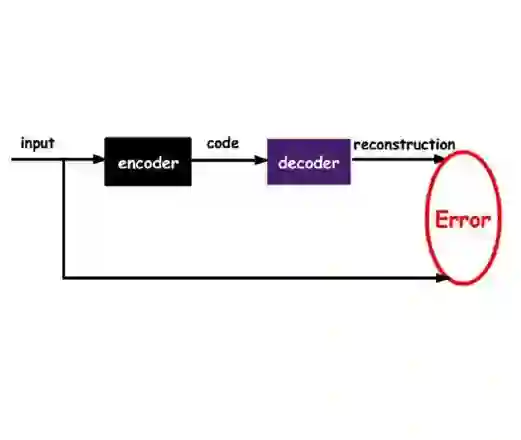
Deep Learning is having a remarkable impact on the design of Reduced Order Models (ROMs) for Partial Differential Equations (PDEs), where it is exploited as a powerful tool for tackling complex problems for which classical methods might fail. In this respect, deep autoencoders play a fundamental role, as they provide an extremely flexible tool for reducing the dimensionality of a given problem by leveraging on the nonlinear capabilities of neural networks. Indeed, starting from this paradigm, several successful approaches have already been developed, which are here referred to as Deep Learning-based ROMs (DL-ROMs). Nevertheless, when it comes to stochastic problems parameterized by random fields, the current understanding of DL-ROMs is mostly based on empirical evidence: in fact, their theoretical analysis is currently limited to the case of PDEs depending on a finite number of (deterministic) parameters. The purpose of this work is to extend the existing literature by providing some theoretical insights about the use of DL-ROMs in the presence of stochasticity generated by random fields. In particular, we derive explicit error bounds that can guide domain practitioners when choosing the latent dimension of deep autoencoders. We evaluate the practical usefulness of our theory by means of numerical experiments, showing how our analysis can significantly impact the performance of DL-ROMs.
翻译:深度学习正在对偏微分方程降阶模型的设计产生显著影响,其作为强大工具被用于处理经典方法可能失效的复杂问题。在此背景下,深度自编码器扮演着关键角色——通过利用神经网络的非线性能力,为降低问题维度提供了极为灵活的工具。事实上,基于这一范式已发展出多种成功方法,本文统称为基于深度学习的降阶模型。然而,对于由随机场参数化的随机问题,目前对DL-ROM的理解主要基于经验证据:其理论分析目前仅限于依赖于有限数量确定性参数的偏微分方程。本文旨在通过提供关于随机场生成随机性背景下使用DL-ROM的理论洞见,来拓展现有文献。具体而言,我们推导了显式误差界,可指导领域从业者选择深度自编码器的潜在维数。通过数值实验评估了理论的实际有效性,展示了我们的分析如何显著影响DL-ROM的性能。




相关内容



 微信扫码咨询专知VIP会员