

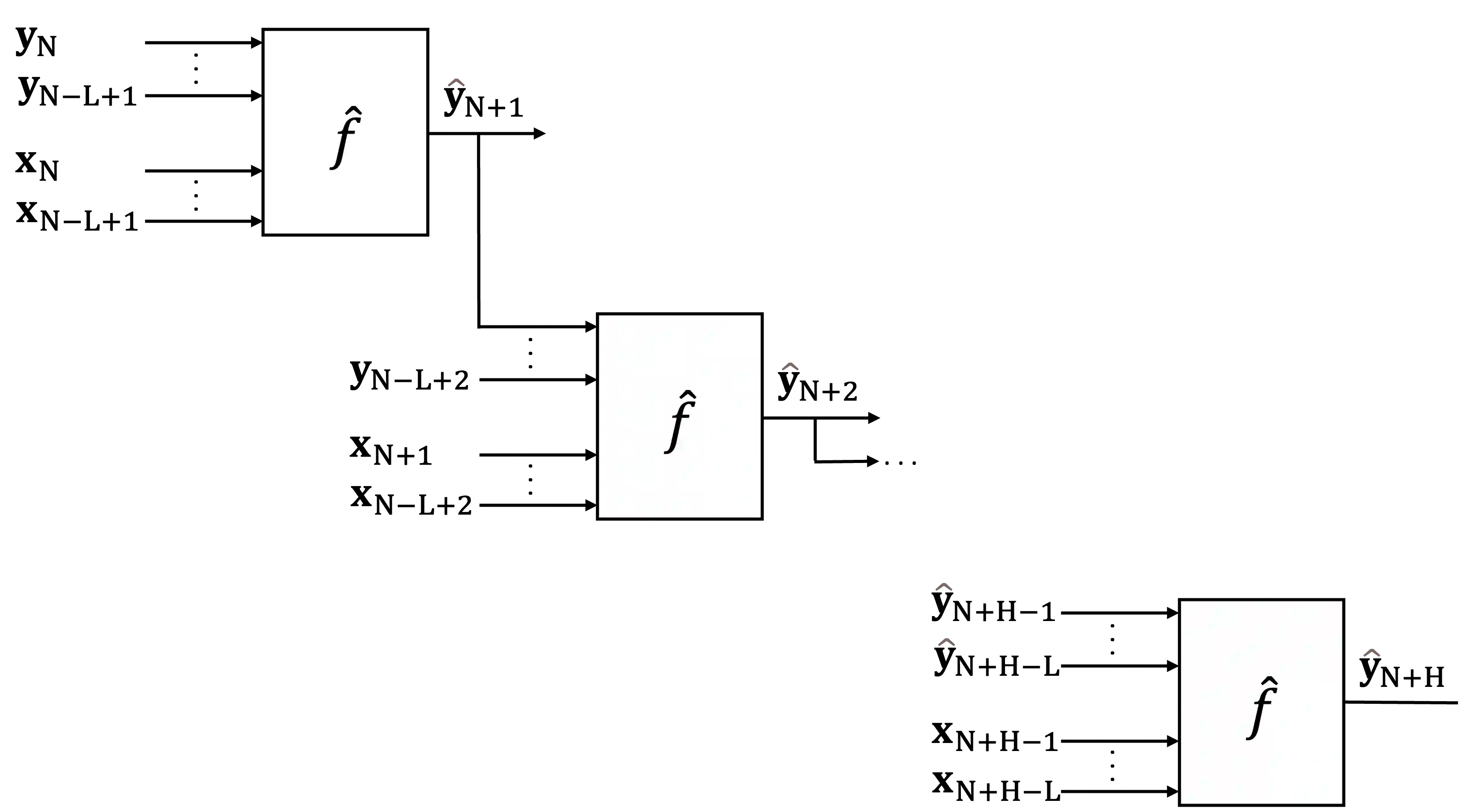
This paper develops an approach for multi-step forecasting of dynamical systems by integrating probabilistic input forecasting with physics-informed output prediction. Accurate multi-step forecasting of time series systems is important for the automatic control and optimization of physical processes, enabling more precise decision-making. While mechanistic-based and data-driven machine learning (ML) approaches have been employed for time series forecasting, they face significant limitations. Incomplete knowledge of process mathematical models limits mechanistic-based direct employment, while purely data-driven ML models struggle with dynamic environments, leading to poor generalization. To address these limitations, this paper proposes a dual-level strategy for physics-informed forecasting of dynamical systems. On the first level, input variables are forecast using a hybrid method that integrates a long short-term memory (LSTM) network into probabilistic state transition models (STMs). On the second level, these stochastically predicted inputs are sequentially fed into a physics-informed neural network (PINN) to generate multi-step output predictions. The experimental results of the paper demonstrate that the hybrid input forecasting models achieve a higher log-likelihood and lower mean squared errors (MSE) compared to conventional STMs. Furthermore, the PINNs driven by the input forecasting models outperform their purely data-driven counterparts in terms of MSE and log-likelihood, exhibiting stronger generalization and forecasting performance across multiple test cases.
翻译:本文提出了一种通过整合概率输入预测与物理信息输出预测的动态系统多步预测方法。时间序列系统的精确多步预测对于物理过程的自动控制与优化至关重要,能够实现更精准的决策。虽然基于机理建模和数据驱动的机器学习方法已被应用于时间序列预测,但它们存在显著局限性:过程数学模型的认知不完整限制了机理模型的直接应用,而纯数据驱动的机器学习模型难以适应动态环境,导致泛化能力不足。为解决这些问题,本文提出了一种面向动态系统的物理信息预测双层级策略。在第一层级,采用将长短期记忆网络整合到概率状态转移模型的混合方法对输入变量进行预测。在第二层级,这些随机预测的输入被顺序馈入物理信息神经网络以生成多步输出预测。实验结果表明:与传统状态转移模型相比,混合输入预测模型实现了更高的对数似然和更低的均方误差;此外,由输入预测模型驱动的物理信息神经网络在均方误差和对数似然指标上均优于纯数据驱动模型,在多个测试案例中展现出更强的泛化能力和预测性能。




相关内容



 微信扫码咨询专知VIP会员