

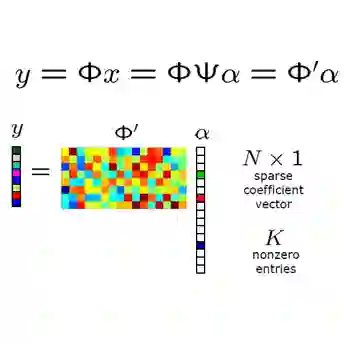
Hyperspectral Imaging (HSI) is used in a wide range of applications such as remote sensing, yet the transmission of the HS images by communication data links becomes challenging due to the large number of spectral bands that the HS images contain together with the limited data bandwidth available in real applications. Compressive Sensing reduces the images by randomly subsampling the spectral bands of each spatial pixel and then it performs the image reconstruction of all the bands using recovery algorithms which impose sparsity in a certain transform domain. Since the image pixels are not strictly sparse, this work studies a data sparsification pre-processing stage prior to compression to ensure the sparsity of the pixels. The sparsified images are compressed $2.5\times$ and then recovered using the Generalized Orthogonal Matching Pursuit algorithm (gOMP) characterized by high accuracy, low computational requirements and fast convergence. The experiments are performed in five conventional hyperspectral images where the effect of different sparsification levels in the quality of the uncompressed as well as the recovered images is studied. It is concluded that the gOMP algorithm reconstructs the hyperspectral images with higher accuracy as well as faster convergence when the pixels are highly sparsified and hence at the expense of reducing the quality of the recovered images with respect to the original images.
翻译:高光谱成像(HSI)广泛应用于遥感等领域,然而高光谱图像包含大量光谱波段,加之实际应用中有限的数据带宽,使得通过通信数据链路传输高光谱图像面临挑战。压缩感知通过对每个空间像素的光谱波段进行随机子采样来压缩图像,随后利用在特定变换域中施加稀疏性的恢复算法对所有波段进行图像重建。由于图像像素并非严格稀疏,本文研究了压缩前的一种数据稀疏化预处理阶段,以确保像素的稀疏性。稀疏化后的图像被压缩2.5倍,随后采用广义正交匹配追踪算法(gOMP)进行恢复,该算法具有高精度、低计算需求和快速收敛的特点。实验在五组常规高光谱图像上进行,研究了不同稀疏化程度对未压缩图像及恢复图像质量的影响。结果表明,当像素被高度稀疏化时,gOMP算法能以更高精度和更快收敛速度重建高光谱图像,但代价是恢复图像相对于原始图像的质量有所降低。




相关内容



 微信扫码咨询专知VIP会员