

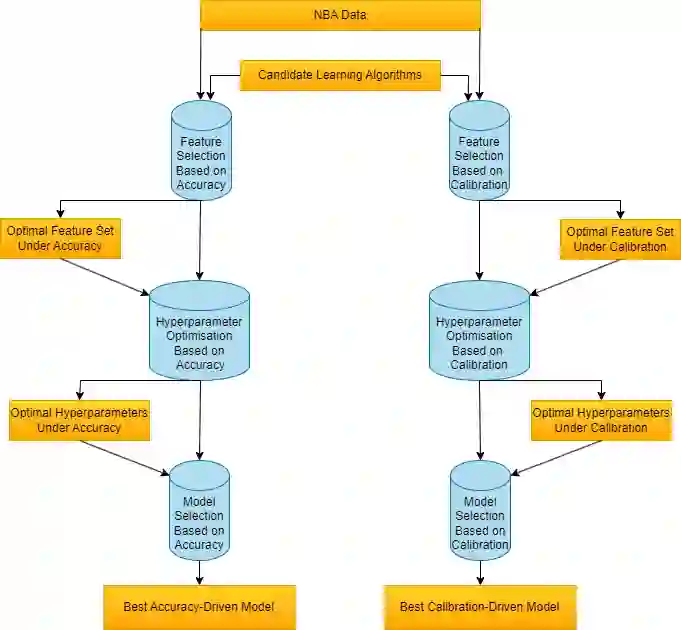
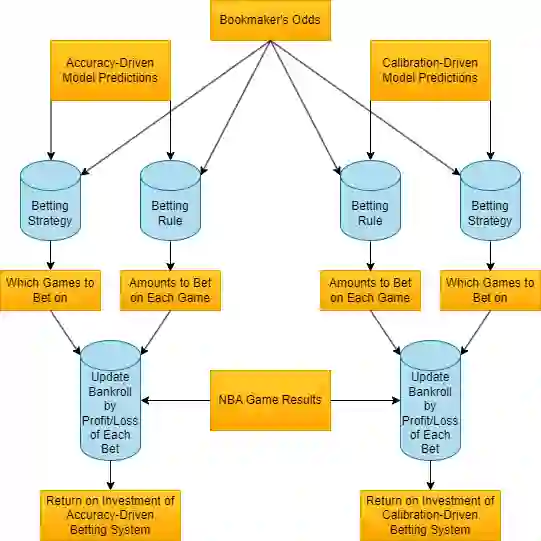
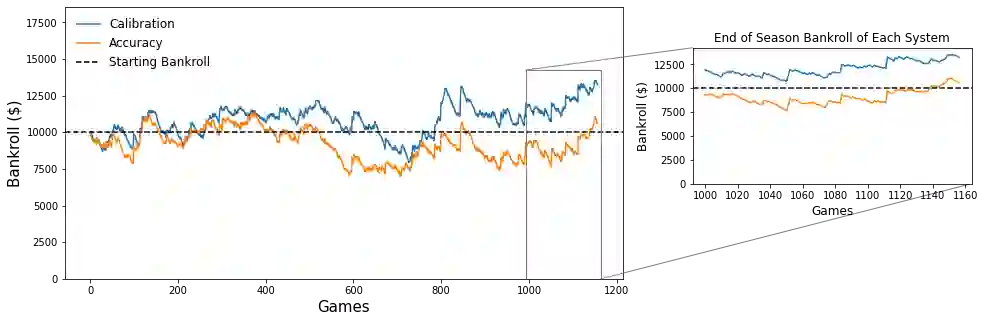
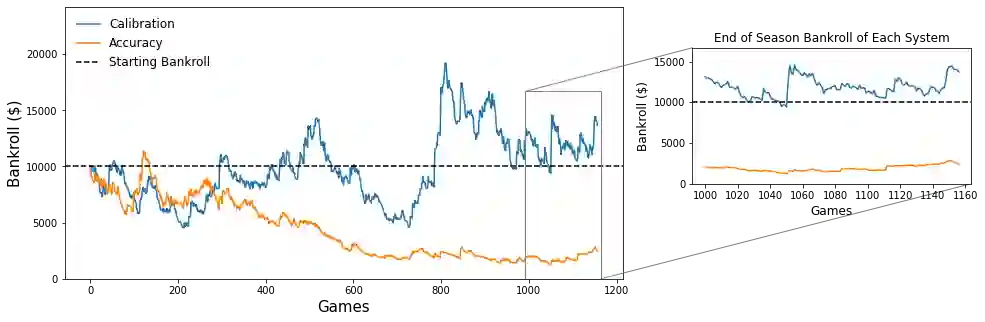
Sports betting's recent federal legalisation in the USA coincides with the golden age of machine learning. If bettors can leverage data to reliably predict the probability of an outcome, they can recognise when the bookmaker's odds are in their favour. As sports betting is a multi-billion dollar industry in the USA alone, identifying such opportunities could be extremely lucrative. Many researchers have applied machine learning to the sports outcome prediction problem, generally using accuracy to evaluate the performance of predictive models. We hypothesise that for the sports betting problem, model calibration is more important than accuracy. To test this hypothesis, we train models on NBA data over several seasons and run betting experiments on a single season, using published odds. We show that using calibration, rather than accuracy, as the basis for model selection leads to greater returns, on average (return on investment of $+34.69\%$ versus $-35.17\%$) and in the best case ($+36.93\%$ versus $+5.56\%$). These findings suggest that for sports betting (or any probabilistic decision-making problem), calibration is a more important metric than accuracy. Sports bettors who wish to increase profits should therefore select their predictive model based on calibration, rather than accuracy.
翻译:美国近期在联邦层面上将体育博彩合法化,恰逢机器学习的黄金时代。若博彩者能利用数据可靠预测结果概率,便能识别博彩公司赔率何时对其有利。鉴于仅在美国体育博彩就已是数十亿美元的产业,识别此类机会可能带来极高收益。众多研究者已将机器学习应用于体育结果预测问题,通常采用精度评估预测模型性能。我们假设在体育博彩问题中,模型校准比精度更为重要。为验证这一假设,我们在多个赛季的NBA数据上训练模型,并利用公开赔率在单个赛季进行博彩实验。结果表明,将校准而非精度作为模型选择依据,平均而言能带来更高回报(投资回报率分别为+34.69%和-35.17%),最优情况下亦是如此(+36.93%对比+5.56%)。这些发现表明,对于体育博彩(或任何概率决策问题),校准是比精度更重要的指标。因此,希望提高盈利的体育博彩者应基于校准而非精度选择预测模型。




相关内容





 微信扫码咨询专知VIP会员