

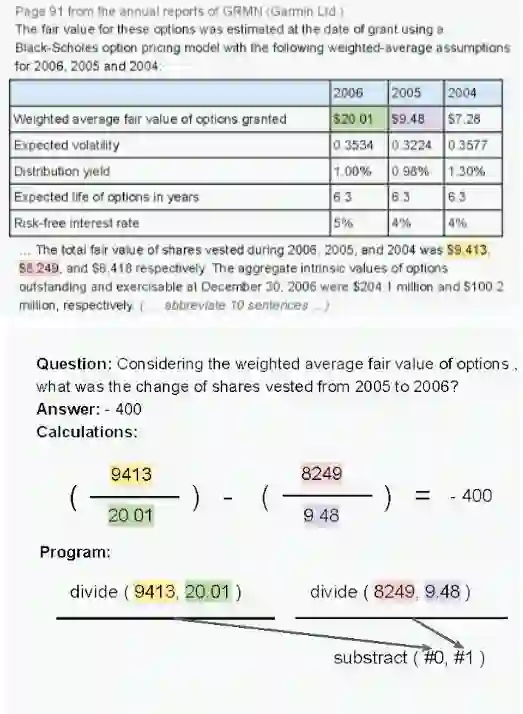
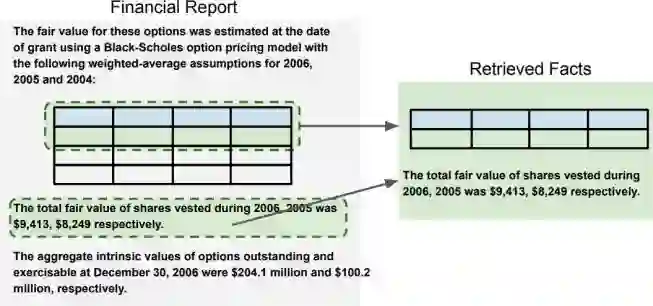
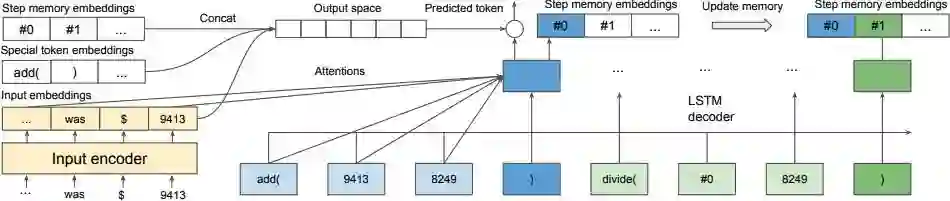
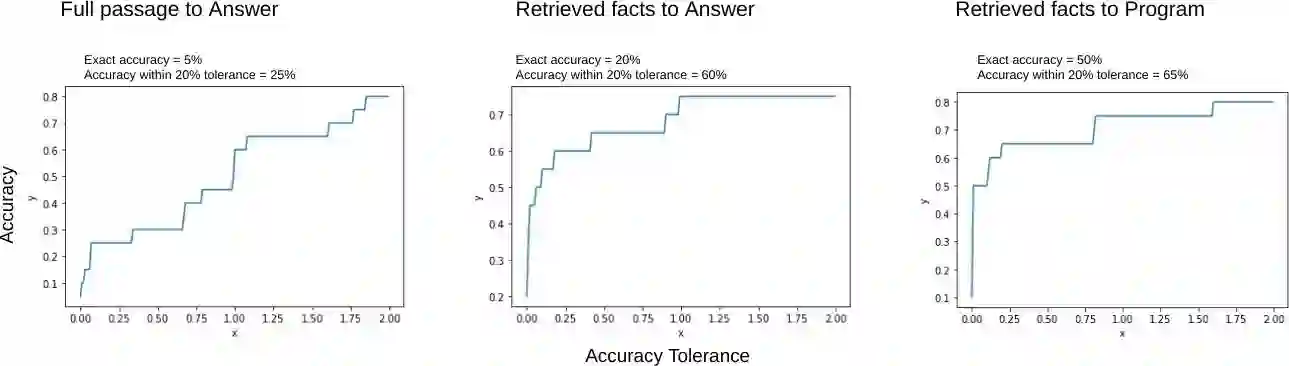
Financial analysis is an important tool for evaluating company performance. Practitioners work to answer financial questions to make profitable investment decisions, and use advanced quantitative analyses to do so. As a result, Financial Question Answering (QA) is a question answering task that requires deep reasoning about numbers. Furthermore, it is unknown how well pre-trained language models can reason in the financial domain. The current state-of-the-art requires a retriever to collect relevant facts about the financial question from the text and a generator to produce a valid financial program and a final answer. However, recently large language models like GPT-3 have achieved state-of-the-art performance on wide variety of tasks with just a few shot examples. We run several experiments with GPT-3 and find that a separate retrieval model and logic engine continue to be essential components to achieving SOTA performance in this task, particularly due to the precise nature of financial questions and the complex information stored in financial documents. With this understanding, our refined prompt-engineering approach on GPT-3 achieves near SOTA accuracy without any fine-tuning.
翻译:金融分析是评估公司绩效的重要工具。从业者致力于回答金融问题以做出盈利的投资决策,并采用高级定量分析来实现这一目标。因此,金融问题回答(QA)是一项需要对数字进行深度推理的问答任务。此外,预训练语言模型在金融领域中的推理能力尚未明确。当前最先进的方法需要一个检索器从文本中收集与金融问题相关的事实,以及一个生成器来生成有效的金融程序和最终答案。然而,近期像GPT-3这样的大型语言模型在仅需少量示例的情况下,已在多种任务上取得了最先进的性能。我们通过多项实验发现,由于金融问题的精确性以及金融文档中存储的复杂信息,独立的检索模型和逻辑引擎仍然是实现该任务SOTA性能的关键组成部分。基于这一认识,我们通过精炼提示工程方法,在GPT-3上实现了无需微调的接近SOTA的准确率。





相关内容



 微信扫码咨询专知VIP会员