

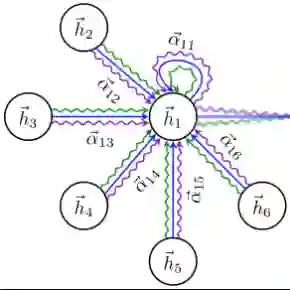
While recommender systems have significantly benefited from implicit feedback, they have often missed the nuances of multi-behavior interactions between users and items. Historically, these systems either amalgamated all behaviors, such as \textit{impression} (formerly \textit{view}), \textit{add-to-cart}, and \textit{buy}, under a singular 'interaction' label, or prioritized only the target behavior, often the \textit{buy} action, discarding valuable auxiliary signals. Although recent advancements tried addressing this simplification, they primarily gravitated towards optimizing the target behavior alone, battling with data scarcity. Additionally, they tended to bypass the nuanced hierarchy intrinsic to behaviors. To bridge these gaps, we introduce the \textbf{H}ierarchical \textbf{M}ulti-behavior \textbf{G}raph Attention \textbf{N}etwork (HMGN). This pioneering framework leverages attention mechanisms to discern information from both inter and intra-behaviors while employing a multi-task Hierarchical Bayesian Personalized Ranking (HBPR) for optimization. Recognizing the need for scalability, our approach integrates a specialized multi-behavior sub-graph sampling technique. Moreover, the adaptability of HMGN allows for the seamless inclusion of knowledge metadata and time-series data. Empirical results attest to our model's prowess, registering a notable performance boost of up to 64\% in NDCG@100 metrics over conventional graph neural network methods.
翻译:尽管推荐系统已从隐式反馈中显著受益,但它们往往忽略了用户与项目间多行为交互的细微差别。历史上,这些系统要么将所有行为(例如《印象》(原《查看》)、《加入购物车》和《购买》)合并为单一的“交互”标签,要么仅优先考虑目标行为(通常是《购买》动作),丢弃了有价值的辅助信号。尽管近期进展试图解决这种简化问题,但它们主要倾向于仅优化目标行为,与数据稀疏性作斗争。此外,它们往往绕过了行为固有的细微层次结构。为弥合这些差距,我们引入了**层次多行为图注意力网络**(HMGN)。这一开创性框架利用注意力机制从行为间和行为内辨别信息,同时采用多任务层次贝叶斯个性化排序(HBPR)进行优化。认识到可扩展性的需求,我们的方法集成了专门的多行为子图采样技术。此外,HMGN的适应性允许无缝整合知识元数据和时间序列数据。实证结果证明了我们模型的卓越性能,在NDCG@100指标上相较于传统图神经网络方法实现了高达64%的性能提升。




相关内容




 微信扫码咨询专知VIP会员