

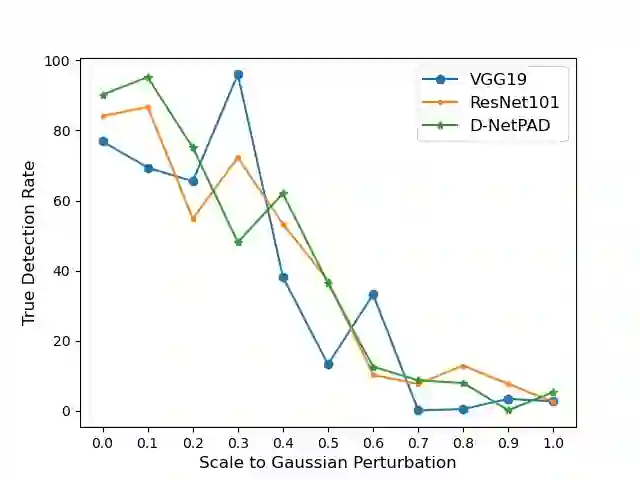
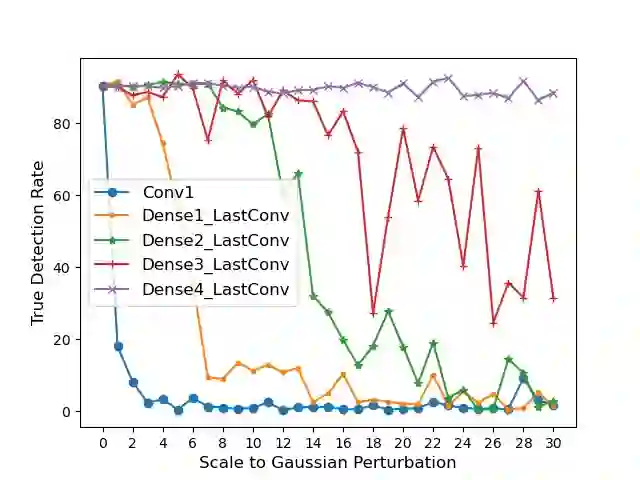
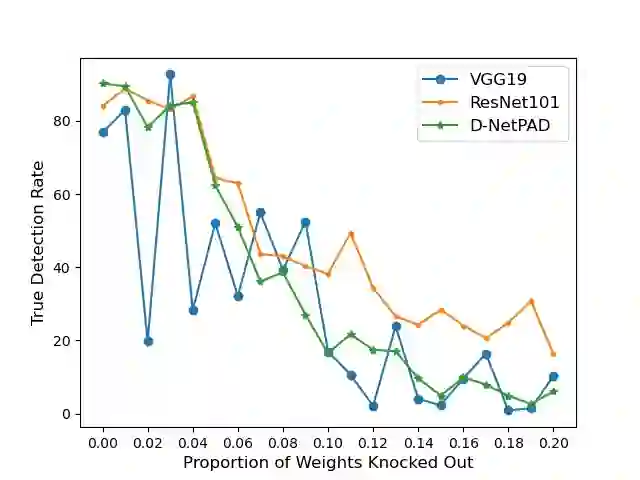
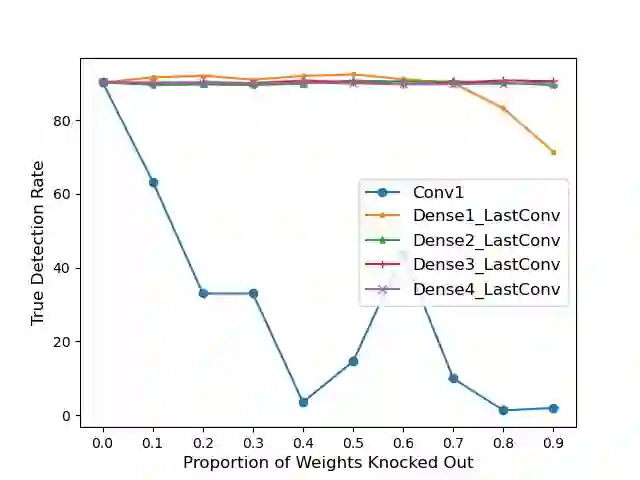
Deep neural networks (DNNs) exhibit superior performance in various machine learning tasks, e.g., image classification, speech recognition, biometric recognition, object detection, etc. However, it is essential to analyze their sensitivity to parameter perturbations before deploying them in real-world applications. In this work, we assess the sensitivity of DNNs against perturbations to their weight and bias parameters. The sensitivity analysis involves three DNN architectures (VGG, ResNet, and DenseNet), three types of parameter perturbations (Gaussian noise, weight zeroing, and weight scaling), and two settings (entire network and layer-wise). We perform experiments in the context of iris presentation attack detection and evaluate on two publicly available datasets: LivDet-Iris-2017 and LivDet-Iris-2020. Based on the sensitivity analysis, we propose improved models simply by perturbing parameters of the network without undergoing training. We further combine these perturbed models at the score-level and at the parameter-level to improve the performance over the original model. The ensemble at the parameter-level shows an average improvement of 43.58% on the LivDet-Iris-2017 dataset and 9.25% on the LivDet-Iris-2020 dataset. The source code is available at https://github.com/redwankarimsony/WeightPerturbation-MSU.
翻译:深度神经网络(DNN)在多种机器学习任务中展现出卓越性能,例如图像分类、语音识别、生物特征识别、目标检测等。然而,在实际部署前,分析其对参数扰动的敏感性至关重要。本研究评估了DNN在权重和偏置参数扰动下的敏感性。敏感性分析涉及三种DNN架构(VGG、ResNet和DenseNet)、三种参数扰动类型(高斯噪声、权重归零和权重缩放)以及两种设置(全网络和逐层)。我们在虹膜呈现攻击检测场景下开展实验,并基于两个公开数据集LivDet-Iris-2017和LivDet-Iris-2020进行评估。基于敏感性分析,我们通过直接扰动网络参数(无需训练)来提出改进模型。进一步地,我们在分数级和参数级对这些扰动模型进行集成,以提升原始模型的性能。参数级集成在LivDet-Iris-2017数据集上平均提升43.58%,在LivDet-Iris-2020数据集上平均提升9.25%。源代码已开源在https://github.com/redwankarimsony/WeightPerturbation-MSU。




相关内容



 微信扫码咨询专知VIP会员