

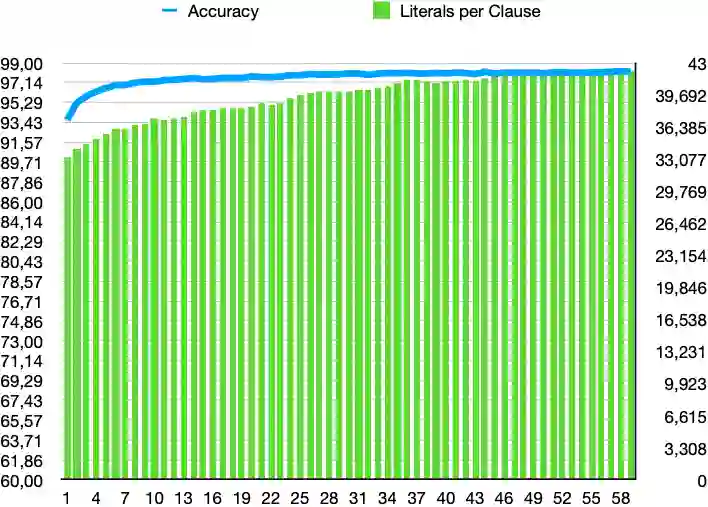
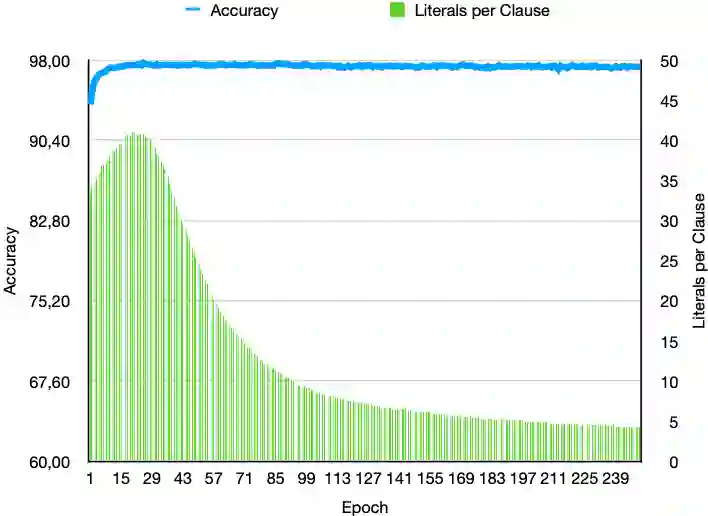
A set of variables is the Markov blanket of a random variable if it contains all the information needed for predicting the variable. If the blanket cannot be reduced without losing useful information, it is called a Markov boundary. Identifying the Markov boundary of a random variable is advantageous because all variables outside the boundary are superfluous. Hence, the Markov boundary provides an optimal feature set. However, learning the Markov boundary from data is challenging for two reasons. If one or more variables are removed from the Markov boundary, variables outside the boundary may start providing information. Conversely, variables within the boundary may stop providing information. The true role of each candidate variable is only manifesting when the Markov boundary has been identified. In this paper, we propose a new Tsetlin Machine (TM) feedback scheme that supplements Type I and Type II feedback. The scheme introduces a novel Finite State Automaton - a Context-Specific Independence Automaton. The automaton learns which features are outside the Markov boundary of the target, allowing them to be pruned from the TM during learning. We investigate the new scheme empirically, showing how it is capable of exploiting context-specific independence to find Markov boundaries. Further, we provide a theoretical analysis of convergence. Our approach thus connects the field of Bayesian networks (BN) with TMs, potentially opening up for synergies when it comes to inference and learning, including TM-produced Bayesian knowledge bases and TM-based Bayesian inference.
翻译:一组变量若包含预测某随机变量所需的全部信息,则构成该变量的马尔可夫毯。若该毯在保留有用信息的前提下无法缩减,则称为马尔可夫边界。识别随机变量的马尔可夫边界具有显著优势,因为边界外的所有变量均为冗余变量。因此,马尔可夫边界提供了最优特征集。然而,从数据中学习马尔可夫边界面临两大挑战:若从马尔可夫边界中移除一个或多个变量,边界外的变量可能开始提供信息;反之,边界内的变量可能停止提供信息。每个候选变量的真实作用仅在马尔可夫边界被识别后才能显现。本文提出一种新型Tsetlin机器(TM)反馈机制,该机制补充了I型和II型反馈,引入了一种新型有限状态自动机——上下文特异性独立性自动机。该自动机可学习哪些特征位于目标变量的马尔可夫边界外,从而在学习过程中从TM中剪除这些特征。我们通过实验验证了新机制的效能,证明其能利用上下文特异性独立性发现马尔可夫边界。此外,我们提供了收敛性的理论分析。本研究将贝叶斯网络(BN)领域与TM联系起来,为推理与学习中的协同效应开辟了潜在可能,包括TM生成的贝叶斯知识库及基于TM的贝叶斯推理。




相关内容



 微信扫码咨询专知VIP会员