

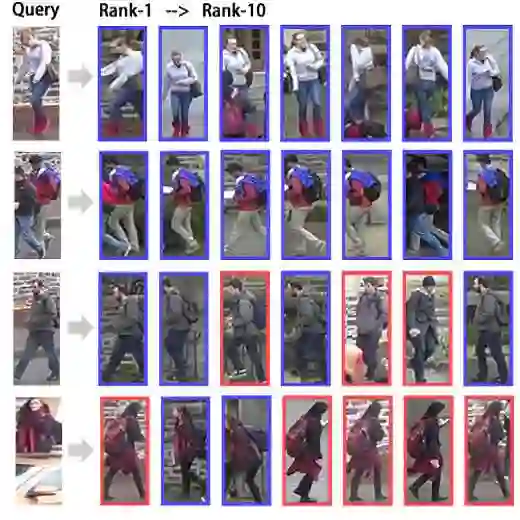
This work addresses the task of long-term person re-identification. Typically, person re-identification assumes that people do not change their clothes, which limits its applications to short-term scenarios. To overcome this limitation, we investigate long-term person re-identification, which considers both clothes-changing and clothes-consistent scenarios. In this paper, we propose a novel framework that effectively learns and utilizes both global and local information. The proposed framework consists of three streams: global, local body part, and head streams. The global and head streams encode identity-relevant information from an entire image and a cropped image of the head region, respectively. Both streams encode the most distinct, less distinct, and average features using the combinations of adversarial erasing, max pooling, and average pooling. The local body part stream extracts identity-related information for each body part, allowing it to be compared with the same body part from another image. Since body part annotations are not available in re-identification datasets, pseudo-labels are generated using clustering. These labels are then utilized to train a body part segmentation head in the local body part stream. The proposed framework is trained by backpropagating the weighted summation of the identity classification loss, the pair-based loss, and the pseudo body part segmentation loss. To demonstrate the effectiveness of the proposed method, we conducted experiments on three publicly available datasets (Celeb-reID, PRCC, and VC-Clothes). The experimental results demonstrate that the proposed method outperforms the previous state-of-the-art method.
翻译:本文针对长期行人重识别任务展开研究。传统行人重识别假定行人不会更换衣物,这限制了其在短期场景中的应用。为突破这一局限,我们探究了兼顾换衣与不变衣场景的长期行人重识别。本文提出一种新颖框架,能有效学习并利用全局与局部信息。该框架包含三个流:全局流、局部身体部位流和头部流。全局流与头部流分别从完整图像和头部裁剪区域中编码身份相关特征,两者均通过对抗擦除、最大池化与平均池化的组合提取最显著、较不显著及平均特征。局部身体部位流为每个身体部位提取身份相关信息,使其可与另一图像的相同部位进行比对。由于行人重识别数据集缺乏身体部位标注,我们采用聚类生成伪标签,并利用这些标签训练局部身体部位流中的身体部位分割头。所提框架通过反向传播身份分类损失、基于对的损失与伪身体部位分割损失的加权和进行训练。为验证方法有效性,我们在三个公开数据集(Celeb-reID、PRCC和VC-Clothes)上进行实验,结果表明所提方法优于现有最优方法。




相关内容


 微信扫码咨询专知VIP会员