

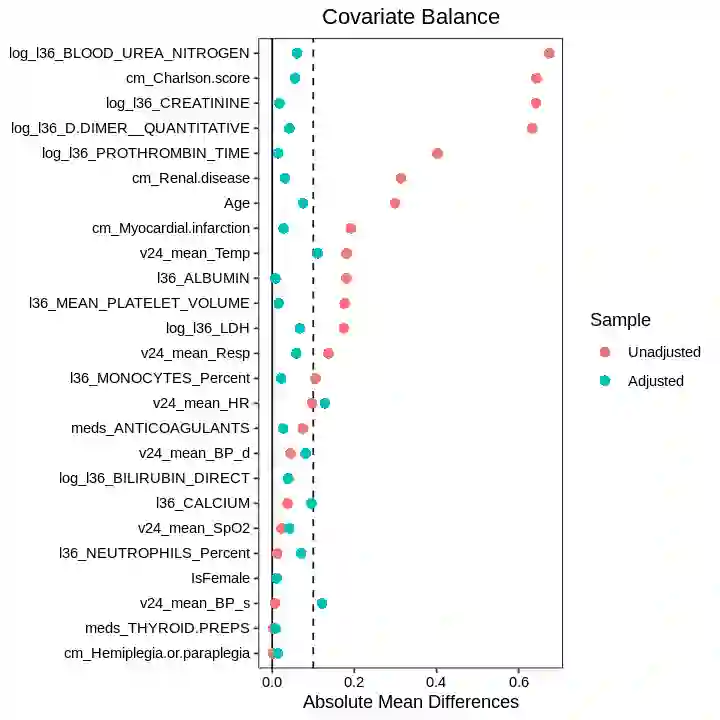
A key issue for all observational causal inference is that it relies on an unverifiable assumption - that observed characteristics are sufficient to proxy for treatment confounding. In this paper we argue that in medical cases these conditions are more likely to be met in cases where standardized treatment guidelines do not yet exist. One example of such a situation is the emergence of a novel disease. We study the case of early COVID-19 in New York City hospitals and show that observational analysis of two important thereapeutics, anti-coagulation and steroid therapy, gives results that agree with later guidelines issued via combinations of randomized trials and other evidence. We also argue that observational causal inference cannot be applied mechanically and requires domain expertise by the analyst by showing a cautionary tale of a treatment that appears extremely promising in the data, but the result is due to a quirk of hospital policy.
翻译:所有观测性因果推断面临的核心问题在于其依赖一个不可验证的假设——即观测到的特征足以代理治疗混杂因素。本文论证,在尚未建立标准化治疗指南的医学情境下,该假设更可能成立。新型疾病的出现便是此类情境的典型案例。我们以纽约市医院早期COVID-19病例为研究对象,通过对抗凝治疗与类固醇治疗这两类重要疗法的观测性分析,其结论与后来通过随机试验及其他证据联合发布的最新指南高度吻合。同时,我们通过一则警示案例指出:观测性因果推断不能机械套用,分析者须具备领域专业知识——该案例中的治疗手段虽在数据中呈现极佳效果,实则源于医院政策的特殊安排。




相关内容



 微信扫码咨询专知VIP会员