

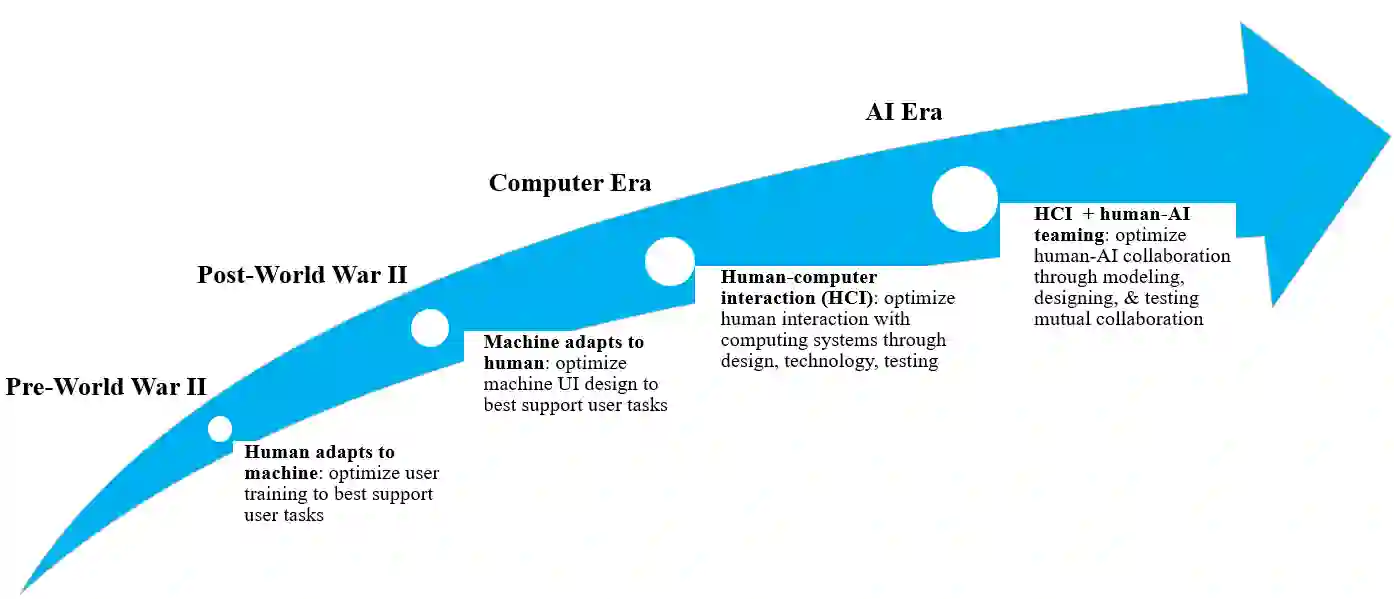
Research and application have used human-AI teaming (HAT) as a new paradigm to develop AI systems. HAT recognizes that AI will function as a teammate instead of simply a tool in collaboration with humans. Effective human-AI teams need to be capable of taking advantage of the unique abilities of both humans and AI while overcoming the known challenges and limitations of each member, augmenting human capabilities, and raising joint performance beyond that of either entity. The National AI Research and Strategic Plan 2023 update has recognized that research programs focusing primarily on the independent performance of AI systems generally fail to consider the functionality that AI must provide within the context of dynamic, adaptive, and collaborative teams and calls for further research on human-AI teaming and collaboration. However, there has been debate about whether AI can work as a teammate with humans. The primary concern is that adopting the "teaming" paradigm contradicts the human-centered AI (HCAI) approach, resulting in humans losing control of AI systems. This article further analyzes the HAT paradigm and the debates. Specifically, we elaborate on our proposed conceptual framework of human-AI joint cognitive systems (HAIJCS) and apply it to represent HAT under the HCAI umbrella. We believe that HAIJCS may help adopt HAI while enabling HCAI. The implications and future work for HAIJCS are also discussed. Insights: AI has led to the emergence of a new form of human-machine relationship: human-AI teaming (HAT), a paradigmatic shift in human-AI systems; We must follow a human-centered AI (HCAI) approach when applying HAT as a new design paradigm; We propose a conceptual framework of human-AI joint cognitive systems (HAIJCS) to represent and implement HAT for developing effective human-AI teaming
翻译:研究与应用已将人机协作(HAT)作为一种新范式来开发人工智能系统。HAT认识到人工智能将作为团队伙伴而非单纯工具与人类协作。高效的人机团队需能充分利用人类与人工智能的独特能力,同时克服各自已知的挑战与局限,增强人类能力,并提升联合绩效超越任一单独实体。2023年《国家人工智能研究与战略规划》更新版指出,主要关注人工智能系统独立性能的研究项目通常未考虑其在动态、自适应与协作团队中必须提供的功能,并呼吁进一步研究人机协作。然而,关于人工智能能否成为人类团队伙伴的讨论一直存在。主要担忧在于采用“协作”范式违背了以人为本的人工智能(HCAI)原则,导致人类失去对人工智能系统的控制。本文进一步分析了HAT范式及相关争议。具体而言,我们阐述了所提出的人机联合认知系统(HAIJCS)概念框架,并将其用于在HCAI框架下表征HAT。我们认为HAIJCS有助于在实现以人为本的人工智能的同时采纳人机协作。本文还探讨了HAIJCS的意义与未来工作。洞见:人工智能催生了新型人机关系——人机协作(HAT),这是人机系统的范式转变;在应用HAT作为新设计范式时,必须遵循以人为本的人工智能(HCAI)原则;我们提出人机联合认知系统(HAIJCS)概念框架来表征与实现HAT,以开发高效人机协作。






相关内容



 微信扫码咨询专知VIP会员