

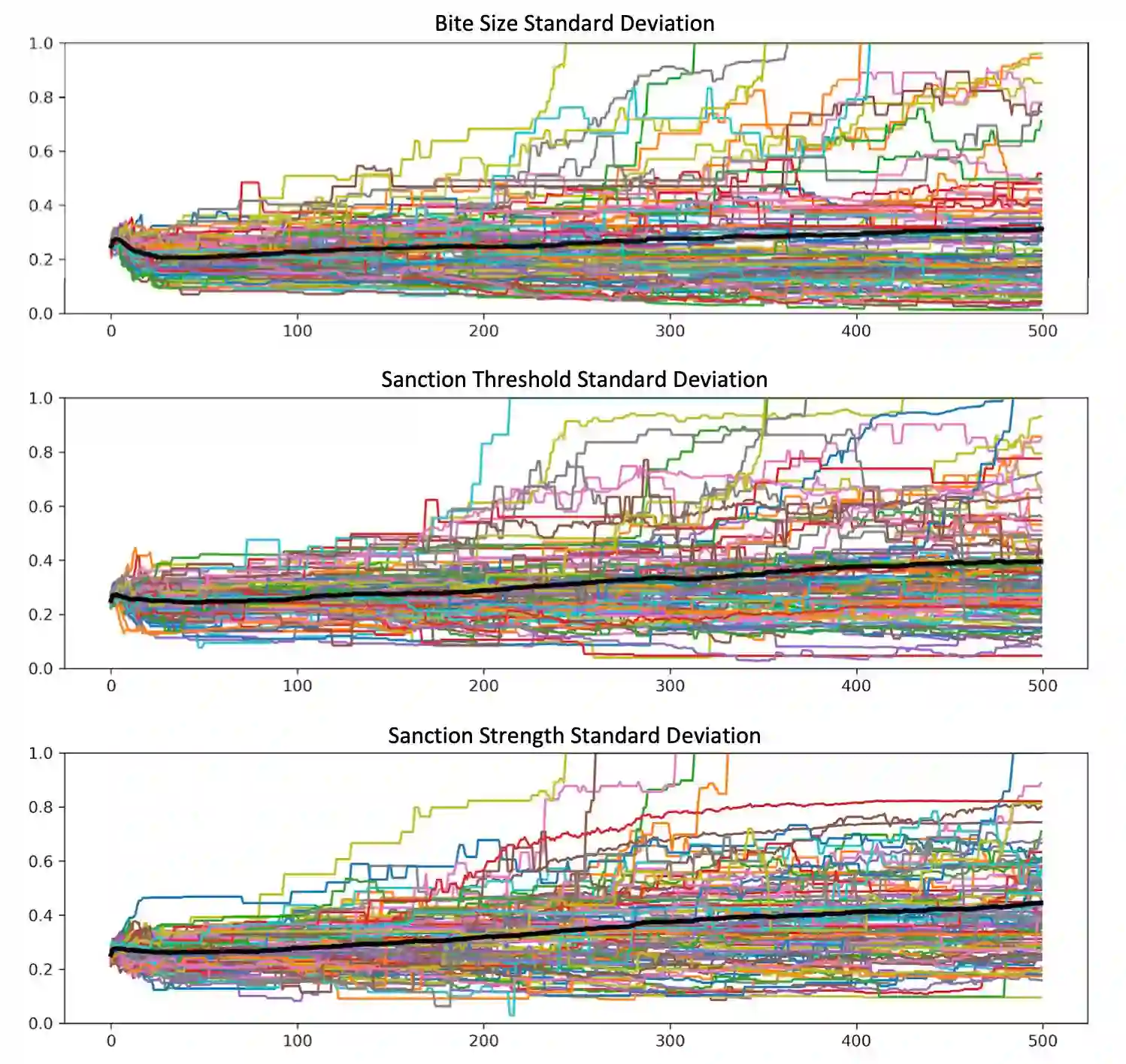
We examine the effect of noise on societies of agents using an agent-based model of evolutionary norm emergence. Generally, we see that noisy societies are more selfish, smaller and discontent, and are caught in rounds of perpetual punishment preventing them from flourishing. Surprisingly, despite the effect of noise on the population, it does not seem to evolve away. In fact, in some cases it seems that the level of noise increases. We carry out further analysis and provide reasons for why this may be the case. Furthermore, we claim that our framework that evolves the noise/ambiguity of norms may be a new way to model the tight/loose framework of norms, suggesting that despite ambiguous norms detrimental effect on society, evolution does not favour clarity.
翻译:我们采用基于智能体的演化规范涌现模型,研究了噪声对智能体社会的影响。总体而言,我们发现受噪声影响的社会更倾向于自私、规模较小且不满,并陷入无休止的惩罚循环,从而阻碍其繁荣发展。令人惊讶的是,尽管噪声对种群产生了显著影响,但噪声水平似乎并未在演化过程中降低。实际上,在某些情况下,噪声水平反而有所上升。我们进行了进一步分析,并阐释了这种现象可能的原因。此外,我们提出,这种用于演化规范噪声/模糊性的框架,可能为规范松紧程度的建模提供新思路。这表明,尽管模糊规范对社会存在不利影响,演化过程却并未偏好清晰性。




相关内容





 微信扫码咨询专知VIP会员