

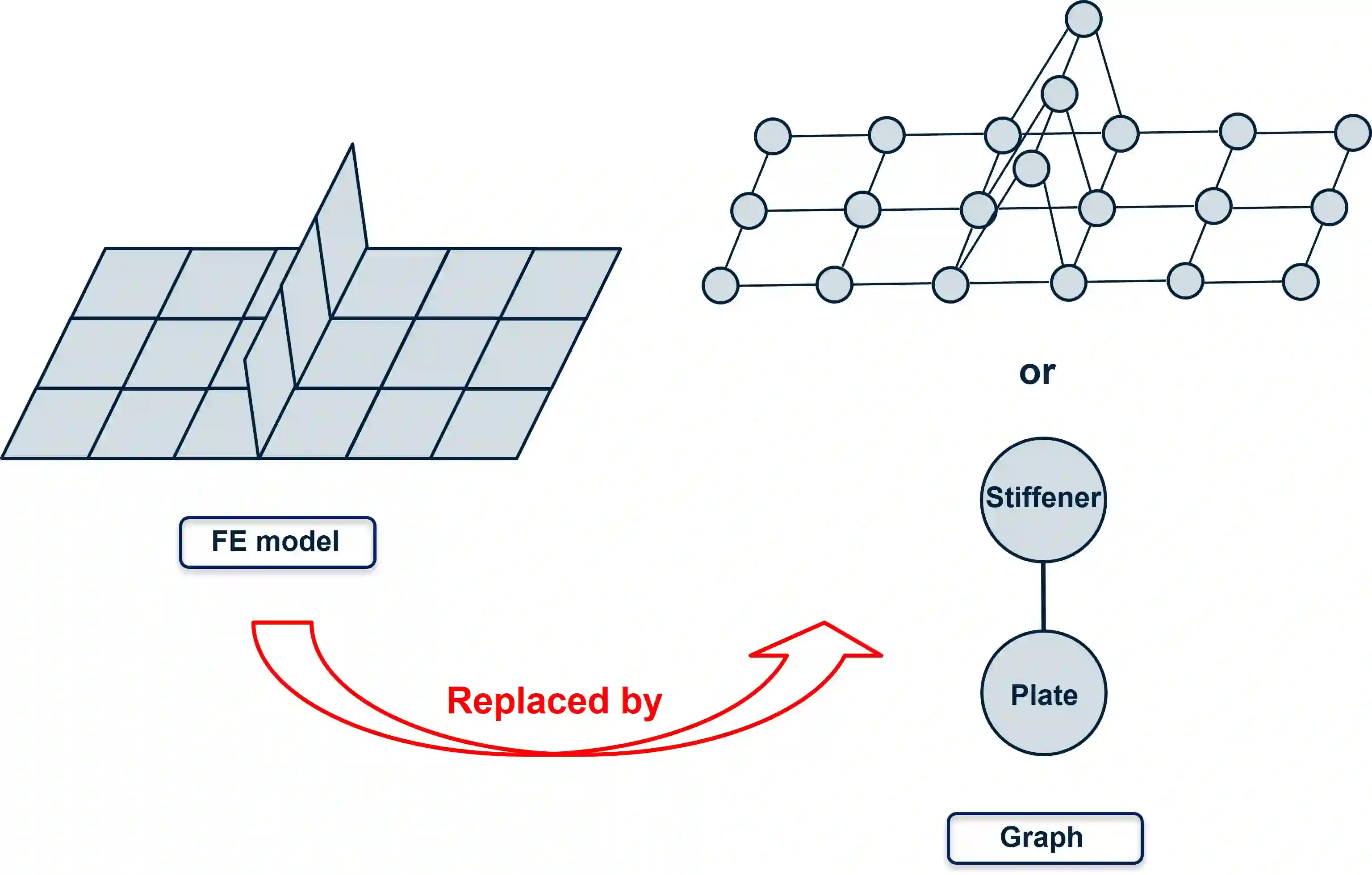
Machine learning (ML) and deep learning (DL) techniques have gained significant attention as reduced order models (ROMs) to computationally expensive structural analysis methods, such as finite element analysis (FEA). Graph neural network (GNN) is a particular type of neural network which processes data that can be represented as graphs. This allows for efficient representation of complex geometries that can change during conceptual design of a structure or a product. In this study, we propose a novel graph embedding technique for efficient representation of 3D stiffened panels by considering separate plate domains as vertices. This approach is considered using Graph Sampling and Aggregation (GraphSAGE) to predict stress distributions in stiffened panels with varying geometries. A comparison between a finite-element-vertex graph representation is conducted to demonstrate the effectiveness of the proposed approach. A comprehensive parametric study is performed to examine the effect of structural geometry on the prediction performance. Our results demonstrate the immense potential of graph neural networks with the proposed graph embedding method as robust reduced-order models for 3D structures.
翻译:机器学习(ML)与深度学习(DL)技术作为计算成本高昂的结构分析方法(如有限元分析(FEA))的降阶模型(ROMs)已受到广泛关注。图神经网络(GNN)是一种专用于处理可表征为图结构数据的神经网络,能够有效表示在结构或产品概念设计阶段可能发生变化的复杂几何构型。本研究提出一种新颖的图嵌入技术,通过将独立板域视为顶点来实现三维加筋板的高效表征,并采用图采样与聚合(GraphSAGE)方法预测不同几何构型加筋板的应力分布。通过与有限元-顶点图表征方法的对比验证了所提方法的有效性,同时开展了系统的参数化研究以探究结构几何参数对预测性能的影响。结果表明,采用所提图嵌入方法的图神经网络作为三维结构的鲁棒降阶模型具有巨大潜力。





相关内容




 微信扫码咨询专知VIP会员