

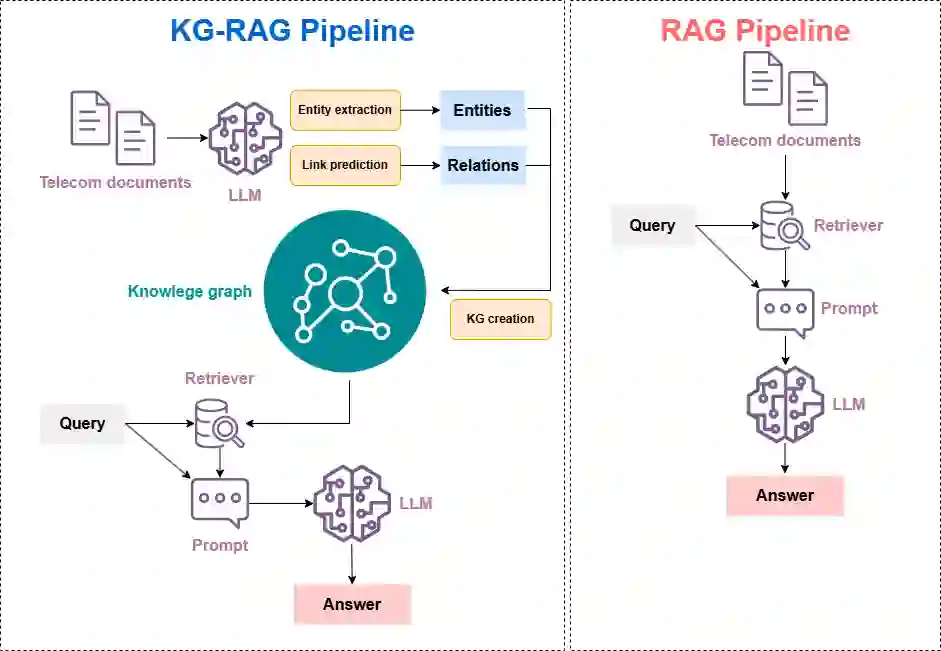
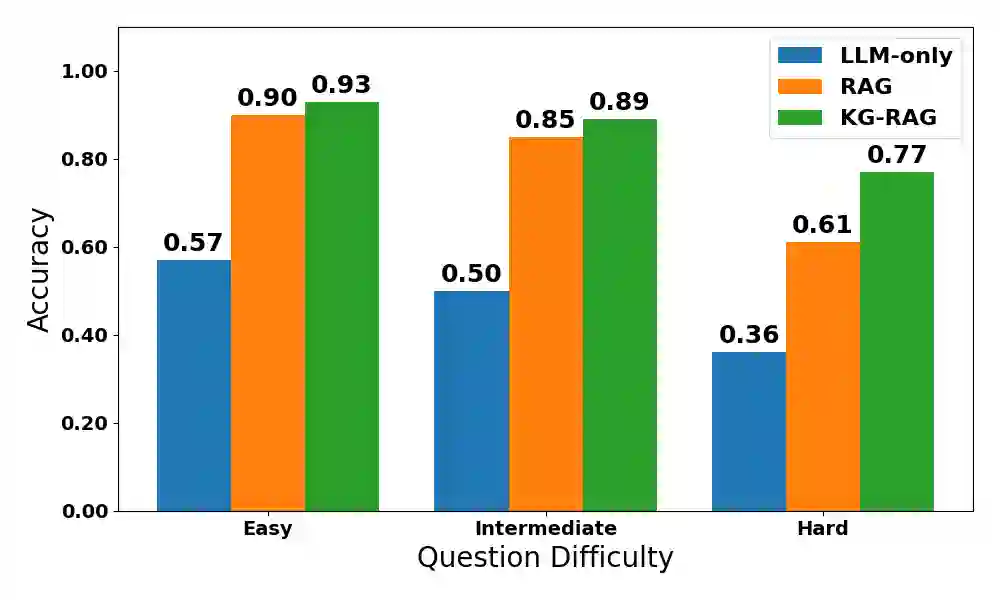
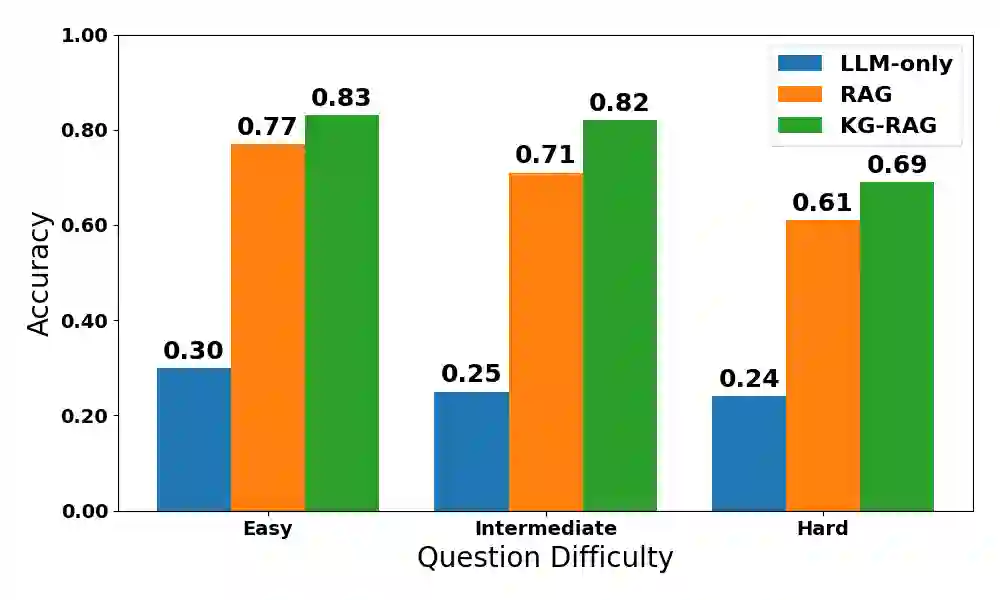
Large language models (LLMs) have made significant progress in general-purpose natural language processing tasks. However, LLMs are still facing challenges when applied to domain-specific areas like telecommunications, which demands specialized expertise and adaptability to evolving standards. This paper presents a novel framework that combines knowledge graph (KG) and retrieval-augmented generation (RAG) techniques to enhance LLM performance in the telecom domain. The framework leverages a KG to capture structured, domain-specific information about network protocols, standards, and other telecom-related entities, comprehensively representing their relationships. By integrating KG with RAG, LLMs can dynamically access and utilize the most relevant and up-to-date knowledge during response generation. This hybrid approach bridges the gap between structured knowledge representation and the generative capabilities of LLMs, significantly enhancing accuracy, adaptability, and domain-specific comprehension. Our results demonstrate the effectiveness of the KG-RAG framework in addressing complex technical queries with precision. The proposed KG-RAG model attained an accuracy of 88% for question answering tasks on a frequently used telecom-specific dataset, compared to 82% for the RAG-only and 48% for the LLM-only approaches.
翻译:大语言模型(LLMs)在通用自然语言处理任务中取得了显著进展。然而,当应用于电信等专业领域时,LLMs仍面临挑战,这些领域需要专业的知识体系以及对不断演进标准的适应能力。本文提出了一种新颖的框架,该框架结合了知识图谱(KG)与检索增强生成(RAG)技术,以提升LLMs在电信领域的性能。该框架利用知识图谱来捕获关于网络协议、标准及其他电信相关实体的结构化、领域特定信息,全面表征其相互关系。通过将知识图谱与RAG集成,LLMs能够在生成响应时动态访问并利用最相关且最新的知识。这种混合方法弥合了结构化知识表示与LLMs生成能力之间的差距,显著提升了准确性、适应性和领域特定理解能力。我们的实验结果表明,KG-RAG框架在处理复杂技术查询方面具有精确高效的优势。在常用的电信领域特定数据集上,所提出的KG-RAG模型在问答任务中达到了88%的准确率,而纯RAG方法和纯LLM方法的准确率分别为82%和48%。




相关内容




 微信扫码咨询专知VIP会员