

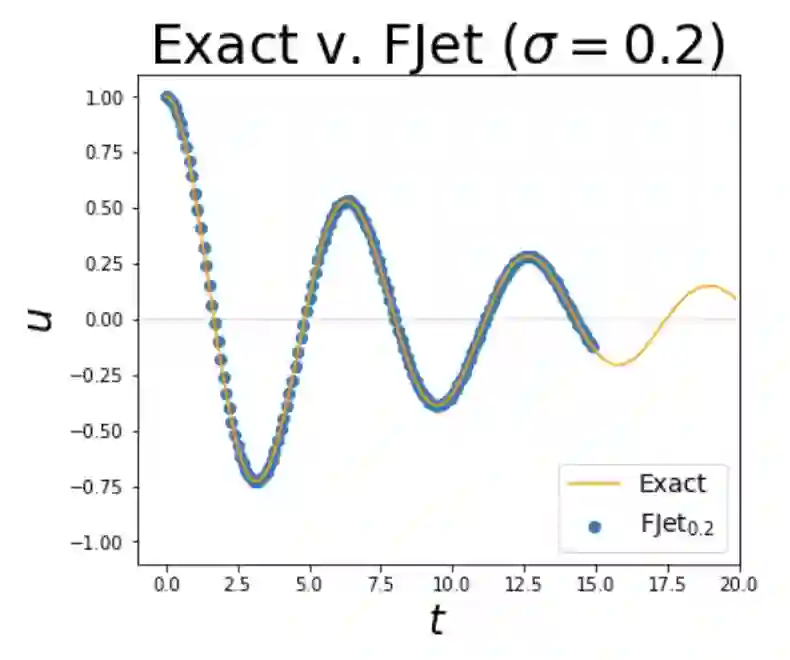
The problem of determining the underlying dynamics of a system when only given data of its state over time has challenged scientists for decades. In this paper, the approach of using machine learning to model the updates of the phase space variables is introduced; this is done as a function of the phase space variables. (More generally, the modeling is done over functions of the jet space.) This approach (named FJet) allows one to accurately replicate the dynamics, and is demonstrated on the examples of the damped harmonic oscillator, the damped pendulum, and the Duffing oscillator; the underlying differential equation is also accurately recovered for each example. In addition, the results in no way depend on how the data is sampled over time (i.e., regularly or irregularly). It is demonstrated that a regression implementation of FJet is similar to the model resulting from a Taylor series expansion of the Runge-Kutta (RK) numerical integration scheme. This identification confers the advantage of explicitly revealing the function space to use in the modeling, as well as the associated uncertainty quantification for the updates. Finally, it is shown in the undamped harmonic oscillator example that the stability of the updates is stable $10^9$ times longer than with $4$th-order RK (with time step $0.1$).
翻译:几十年来,仅凭系统状态随时间变化的数据来确定其潜在动力学的问题一直困扰着科学家。本文介绍了一种利用机器学习对相空间变量更新进行建模的方法;这是作为相空间变量的函数来实现的。(更一般地,建模是在射流空间的函数上进行的。)这种方法(命名为FJet)能够精确复现动力学过程,并以阻尼谐振子、阻尼摆和达芬振荡器为例进行了演示;每个例子的潜在微分方程也被准确恢复。此外,结果完全不受数据在时间上采样方式的影响(即,无论采样是规则还是不规则)。研究表明,FJet的回归实现与龙格-库塔(RK)数值积分方案的泰勒级数展开得到的模型类似。这一识别带来了明显优势:明确揭示了建模中应使用的函数空间,以及更新相关的量化不确定性。最后,在无阻尼谐振子示例中证明,更新的稳定性比四阶RK(时间步长0.1)长10^9倍。




相关内容



 微信扫码咨询专知VIP会员