

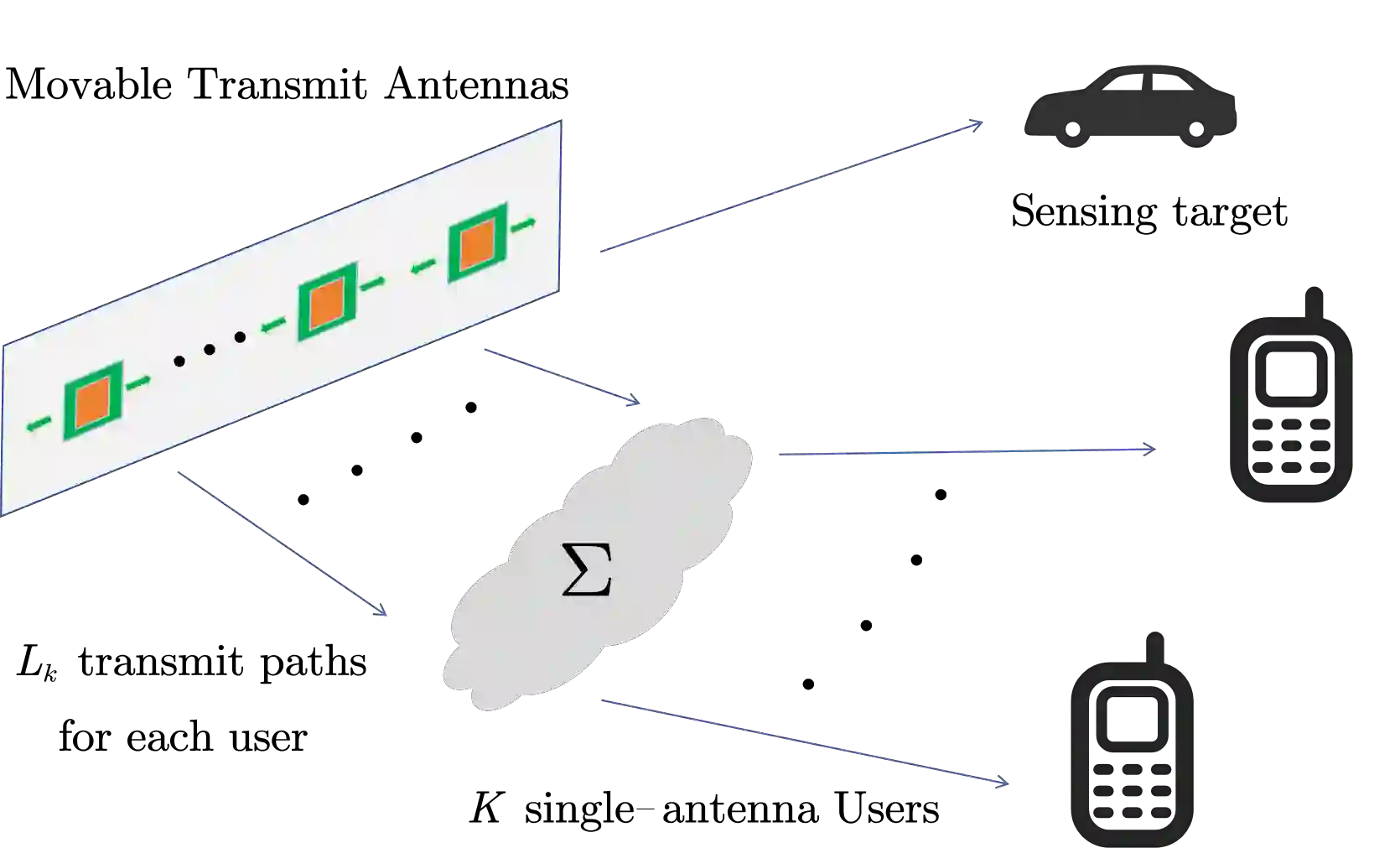
This work investigates the potential of exploiting movable antennas (MAs) to enhance the performance of a multi-user downlink integrated sensing and communication (ISAC) system. Specifically, we formulate an optimization problem to maximize the transmit beampattern gain for sensing while simultaneously meeting each user's communication requirement by jointly optimizing antenna positions and beamforming design. The problem formulated is highly non-convex and involves multivariate-coupled constraints. To address these challenges, we introduce a series of auxiliary random variables and transform the original problem into an augmented Lagrangian problem. A double-loop algorithm based on a penalty dual decomposition framework is then developed to solve the problem. Numerical results validate the effectiveness of the proposed design, demonstrating its superiority over MA designs based on successive convex approximation optimization and other baseline approaches in ISAC systems. The results also highlight the advantages of MAs in achieving better sensing performance and improved beam control, especially for sparse arrays with large apertures.
翻译:本文研究了利用可移动天线(MAs)提升下行多用户集成感知与通信(ISAC)系统性能的潜力。具体而言,我们构建了一个优化问题,旨在通过联合优化天线位置与波束成形设计,在满足各用户通信需求的同时,最大化用于感知的发射波束方向图增益。该问题具有高度非凸性,且涉及多元耦合约束。为应对这些挑战,我们引入一系列辅助随机变量,将原问题转化为增广拉格朗日问题。随后,提出了一种基于惩罚对偶分解框架的双层循环算法来求解该问题。数值结果验证了所提设计的有效性,表明其在ISAC系统中优于基于逐次凸逼近优化的MA设计及其他基线方法。结果还凸显了可移动天线在实现更优感知性能与改进波束控制方面的优势,尤其对于具有大孔径的稀疏阵列。




相关内容




 微信扫码咨询专知VIP会员