

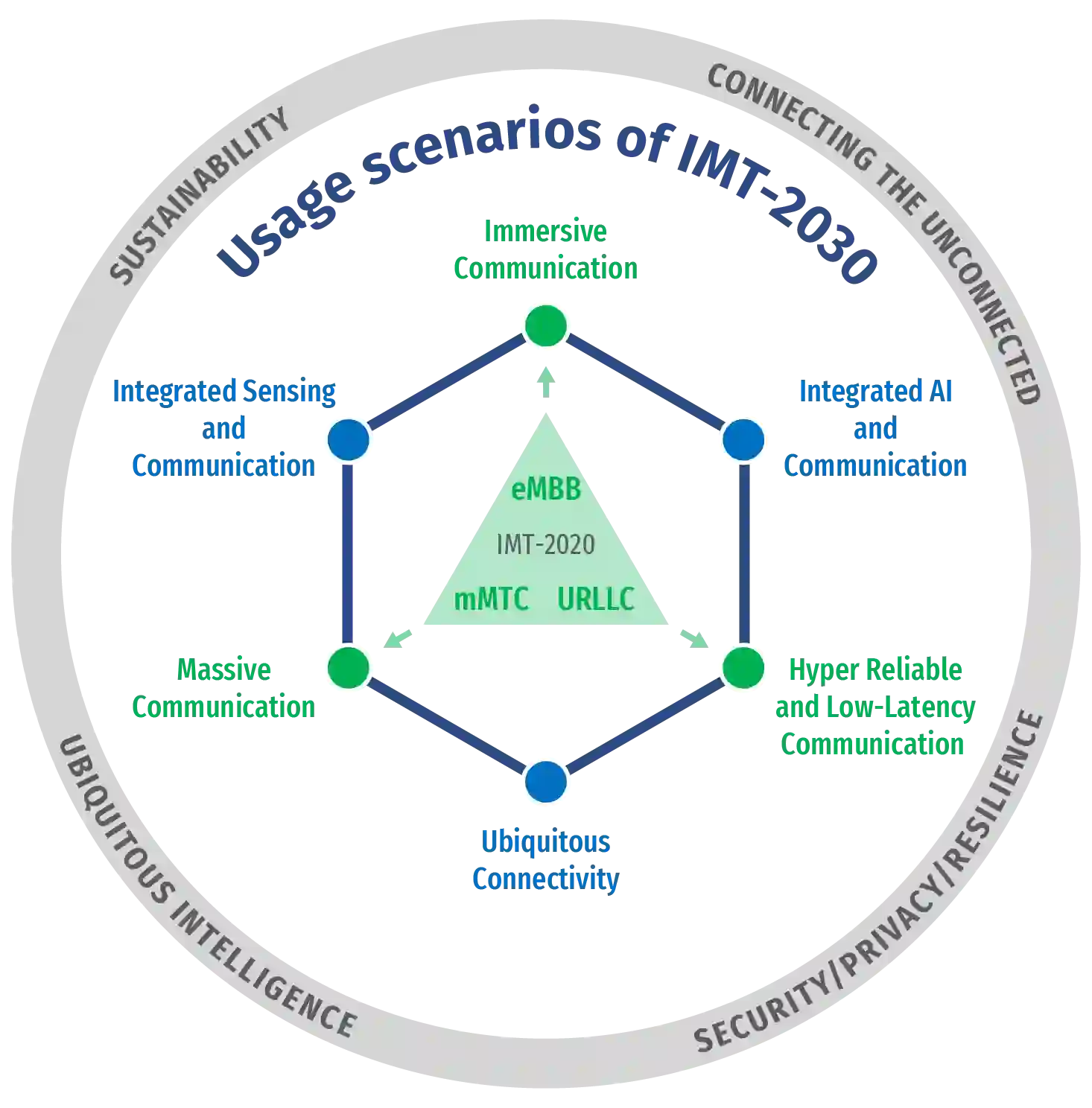
With the standardization and commercialization completed at an unforeseen pace for the 5th generation (5G) wireless networks, researchers, engineers and executives from the academia and industry have turned their attention to new candidate technologies that can support the next generation wireless networks enabling more advanced capabilities in sophisticated scenarios. Explicitly, the 6th generation (6G) terrestrial wireless network aims to providing seamless connectivity not only to users but also to machine type devices for the next decade and beyond. This paper describes the progresses moving towards 6G, which is officially termed as ``international mobile telecommunications (IMT) for 2030 and beyond'' in the International Telecommunication Union Radiocommunication Sector (ITU-R). Specifically, the usage scenarios, their representative capabilities and the supporting technologies are discussed, and the future opportunities and challenges are highlighted.
翻译:随着第五代(5G)无线网络以史无前例的速度完成标准化和商用化,学术界与产业界的科研人员、工程师及管理者已将目光转向能够支持下一代无线网络、在复杂场景中实现更先进能力的新型候选技术。具体而言,第六代(6G)地面无线网络旨在为未来十年及更长时间内,不仅为用户设备,同时也为机器类型设备提供无缝连接。本文阐述了向6G演进的最新进展——这一技术在国际电信联盟无线电通信部门(ITU-R)中被正式命名为"面向2030年及未来的国际移动通信系统(IMT)"。特别地,本文详细讨论了6G的使用场景、代表性能力及支撑技术,并展望了未来的机遇与挑战。






相关内容



 微信扫码咨询专知VIP会员