

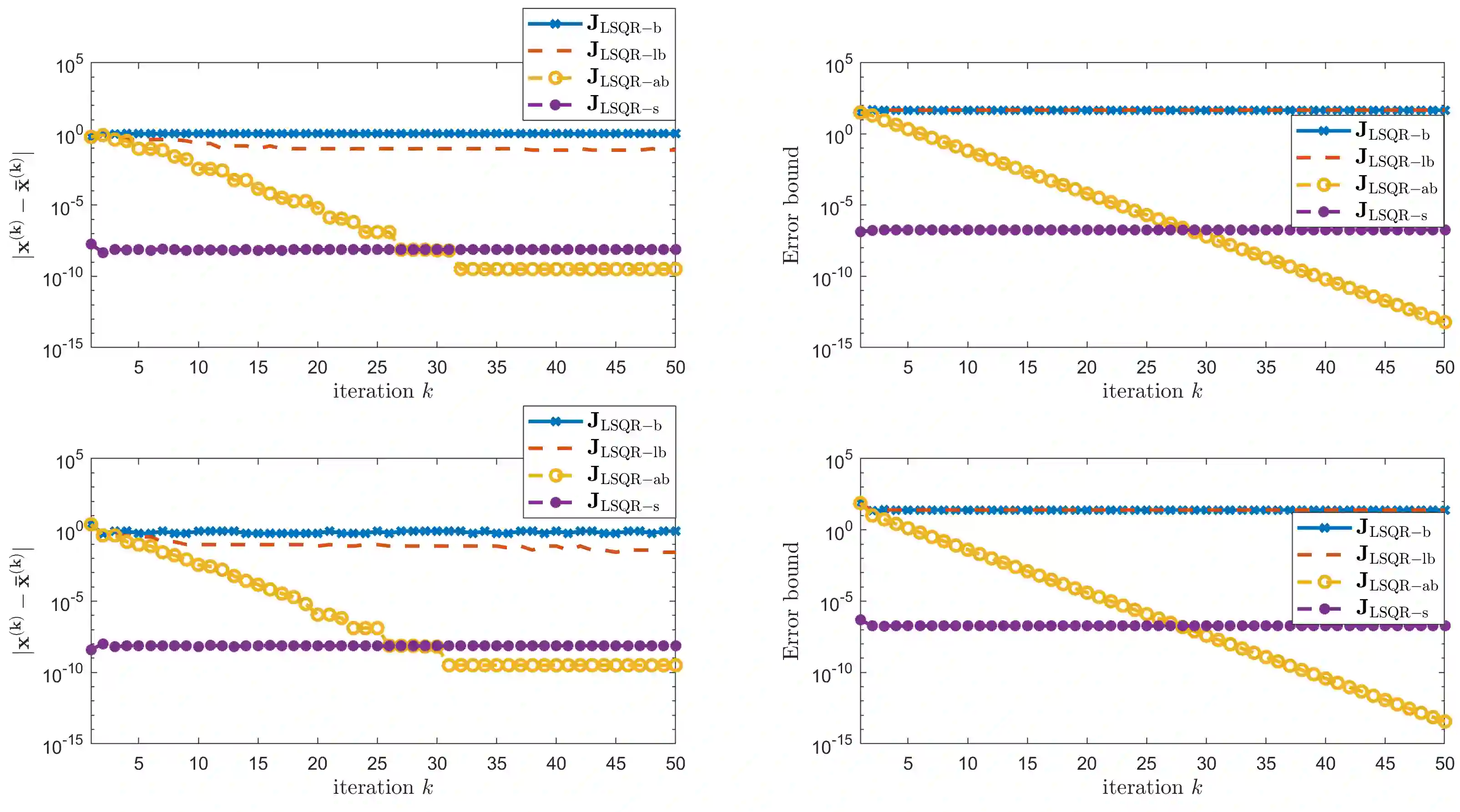
Variable projection methods prove highly efficient in solving separable nonlinear least squares problems by transforming them into a reduced nonlinear least squares problem, typically solvable via the Gauss-Newton method. When solving large-scale separable nonlinear inverse problems with general-form Tikhonov regularization, the computational demand for computing Jacobians in the Gauss-Newton method becomes very challenging. To mitigate this, iterative methods, specifically LSQR, can be used as inner solvers to compute approximate Jacobians. This article analyzes the impact of these approximate Jacobians within the variable projection method and introduces stopping criteria to ensure convergence. We also present numerical experiments where we apply the proposed method to solve a blind deconvolution problem to illustrate and confirm our theoretical results.
翻译:变量投影方法通过将可分离非线性最小二乘问题转化为简化的非线性最小二乘问题(通常可用高斯-牛顿法求解),在求解此类问题时展现出高效性。当采用一般形式吉洪诺夫正则化求解大规模可分离非线性反问题时,高斯-牛顿法中雅可比矩阵的计算需求变得极具挑战性。为缓解这一问题,可采用迭代方法(具体为LSQR)作为内层求解器来计算近似雅可比矩阵。本文分析了变量投影方法中这些近似雅可比矩阵的影响,并引入了确保收敛性的终止准则。我们通过数值实验将所提方法应用于求解盲反卷积问题,以说明并验证理论结果。




相关内容



 微信扫码咨询专知VIP会员