

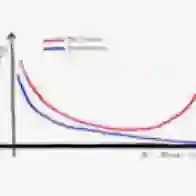
Embodied foundation models have recently been widely used to improve robot generalization and task success rates. Previous works apply lossy efficient-inference techniques such as quantization, pruning, and asynchronous inference, accepting small action quality degradation in exchange for lower per-inference computation cost and inter-action latency. However, unlike traditional static ML tasks, embodied tasks involve repeated interaction with the environment, and task-level performance is determined not only by inference cost, but also by closed-loop effects unique to embodied execution, which remain insufficiently characterized in current efficient-inference studies. In this work, we propose TISED (\underline{T}ask-level \underline{I}nference \underline{S}peedup \underline{E}ffect \underline{D}ecomposition), an analytical framework that unifies diverse lossy lightweighting inference optimization techniques and decomposes their effects on static and dynamic tasks; using it, we uncover several paradoxical effects: (1) on \textit{static tasks}, optimization can sometimes lengthen end-to-end per-task completion time even as per-chunk time drops; (2) on \textit{dynamic tasks}, moderate lossy lightweighting optimization can raise task success rate even above the baseline; and (3) the monotonicity and sweet-spot location of both effects can shift with hardware configuration. Together, our findings provide a new perspective on adapting inference optimization techniques to embodied tasks. Source code: https://github.com/thu-ee-acts-lab/robotics-the-speedup-paradox.
翻译:暂无翻译




相关内容



 微信扫码咨询专知VIP会员