

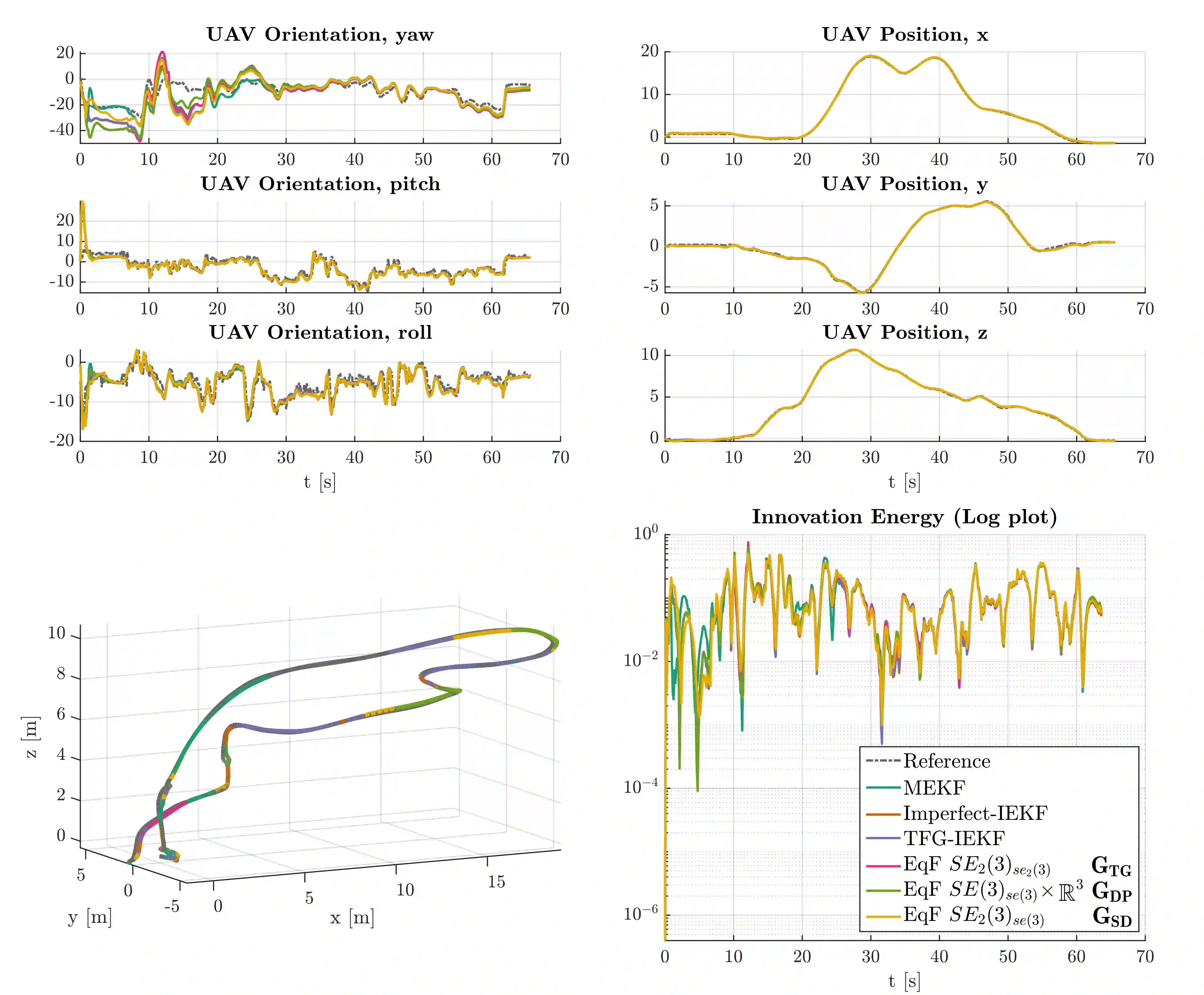
This paper investigates the problem of inertial navigation system (INS) filter design through the lens of symmetry. The extended Kalman filter (EKF) and its variants, have been the staple of INS filtering for 50 years; however, recent advances in inertial navigation systems have exploited matrix Lie group structure to design stochastic filters and state observers that have been shown to display superior performance compared to classical solutions. In this work we consider the case where a vehicle has an inertial measurement unit (IMU) and a global navigation satellite system (GNSS) receiver. We show that all the modern variants of the EKF for these sensors can be interpreted as the recently proposed Equivariant Filter (EqF) design methodology applied to different choices of symmetry group for the INS problem. This leads us to propose two new symmetries for the INS problem that have not been considered in the prior literature, and provide a discussion of the relative strengths and weaknesses of all the different algorithms. We believe the collection of symmetries that we present here capture all the sensible choices of symmetry for this problem and sensor suite, and that the analysis provided is indicative of the relative real-world performance potential of the different algorithms.
翻译:本文从对称性视角研究惯性导航系统(INS)滤波器设计问题。扩展卡尔曼滤波(EKF)及其变体在过去50年间一直是惯性导航滤波的主要方法;然而,惯性导航系统的最新进展已利用矩阵李群结构设计随机滤波器和状态观测器,这些方法相较于经典解表现出更优性能。本文考虑配备惯性测量单元(IMU)和全球导航卫星系统(GNSS)接收器的运载体情形。我们证明,针对这些传感器设计的现代EKF变体均可理解为将近期提出的等变滤波器(EqF)设计方法应用于惯性导航问题的不同对称群选择。基于此,我们提出两种文献中尚未探讨过的惯性导航系统新对称性,并讨论所有不同算法的相对优劣。我们相信,本文呈现的对称性集合囊括了该问题及传感器套件的所有合理对称选择,且所提供的分析能够反映不同算法在实际应用中的相对性能潜力。





相关内容





 微信扫码咨询专知VIP会员