

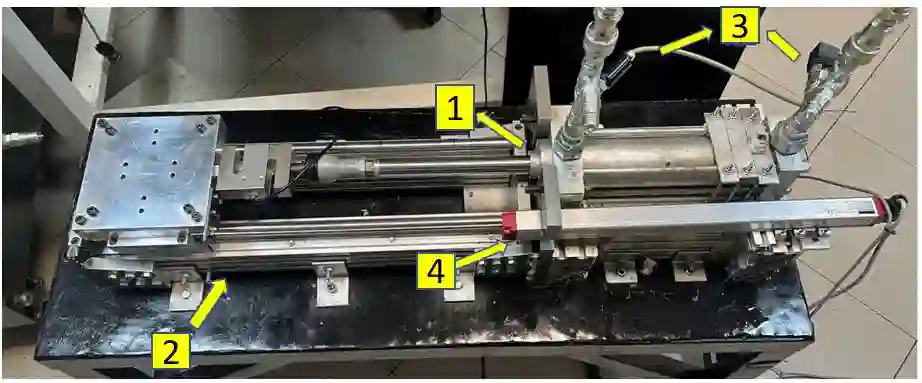
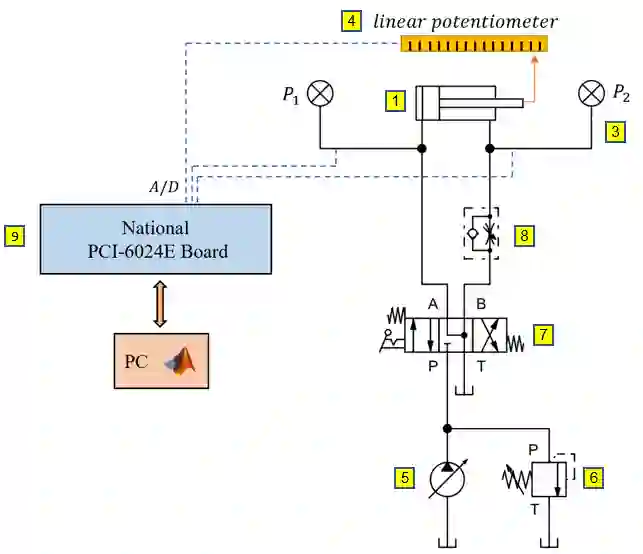
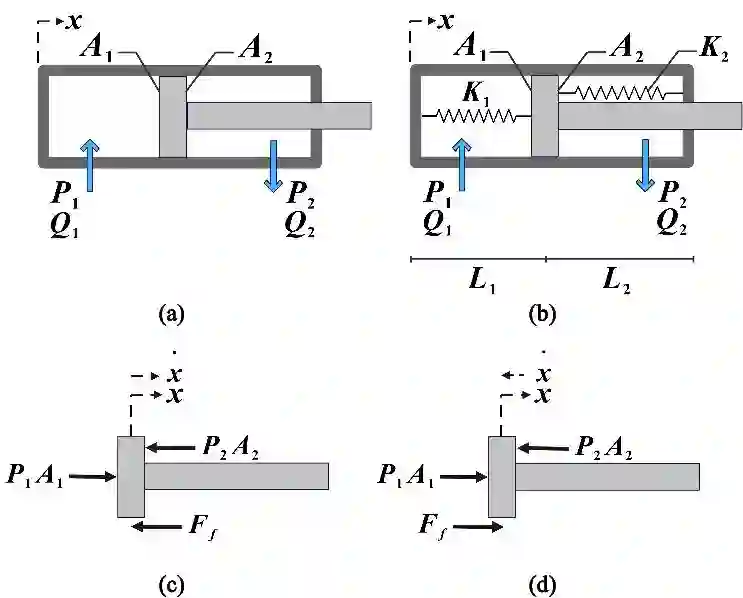
Hydraulic systems are widely utilized in industrial applications due to their high force generation, precise control, and ability to function in harsh environments. Hydraulic cylinders, as actuators in these systems, apply force and position through the displacement of hydraulic fluid, but their operation is significantly influenced by friction force. Achieving precision in hydraulic cylinders requires an accurate friction model under various operating conditions. Existing analytical models, often derived from experimental tests, necessitate the identification or estimation of influencing factors but are limited in adaptability and computational efficiency. This research introduces a data-driven, hybrid algorithm based on Long Short-Term Memory (LSTM) networks and Random Forests for nonlinear friction force estimation. The algorithm effectively combines feature detection and estimation processes using training data acquired from an experimental hydraulic test setup. It achieves a consistent and stable model error of less than 10% across diverse operating conditions and external load variations, ensuring robust performance in complex situations. The computational cost of the algorithm is 1.51 milliseconds per estimation, making it suitable for real-time applications. The proposed method addresses the limitations of analytical models by delivering high precision and computational efficiency. The algorithm's performance is validated through detailed analysis and experimental results, including direct comparisons with the LuGre model. The comparison highlights that while the LuGre model offers a theoretical foundation for friction modeling, its performance is limited by its inability to dynamically adjust to varying operational conditions of the hydraulic cylinder, further emphasizing the advantages of the proposed hybrid approach in real-time applications.
翻译:液压系统因其高功率输出、精确控制能力及恶劣环境适应性而广泛应用于工业领域。液压缸作为该类系统的执行机构,通过液压油位移实现力与位置控制,但其运行状态显著受摩擦力影响。要实现液压缸的精确控制,需建立不同工况下的准确摩擦力模型。现有解析模型多基于实验测试推导,虽能识别或估计影响因素,但在适应性与计算效率方面存在局限。本研究提出一种基于长短期记忆网络与随机森林的数据驱动混合算法,用于非线性摩擦力估计。该算法利用从实验液压测试平台获取的训练数据,有效融合特征检测与估计过程,在多样化工况及外部负载变化下实现稳定且一致的模型误差(低于10%),确保复杂场景下的鲁棒性能。算法单次估计计算成本为1.51毫秒,适用于实时应用场景。所提方法通过提供高精度与计算效率,解决了解析模型的局限性。通过详细分析与实验结果(包括与LuGre模型的直接对比)验证了算法性能。对比结果表明:LuGre模型虽为摩擦建模提供理论基础,但其性能受限于无法动态适应液压缸变化工况,进一步凸显了本混合方法在实时应用中的优势。






相关内容




 微信扫码咨询专知VIP会员